

Patients rarely choose a doctor based on a single search result. They may begin by researching a symptom, continue by comparing possible conditions or treatments, and eventually evaluate individual doctors, clinics, reviews, credentials, insurance options, and appointment availability. Each of these interactions can influence whether a patient trusts a medical practice enough to make contact. SEO for doctors is the process of making a medical practice more visible throughout this search journey. It includes far more than adding keywords to service pages or publishing occasional blog posts.
Medical SEO requires a combination of clinical credibility, clear website architecture, local visibility, useful patient education, technical performance, and conversion-focused design. This guide explains how doctors and medical practices can use these elements to attract qualified patients and convert organic searches into appointment requests.
Key Takeaway:
SEO for doctors is not simply about increasing website traffic. An effective medical SEO strategy helps a practice appear when potential patients search for symptoms, treatments, specialists, or nearby healthcare providers. By combining trustworthy medical content, strong doctor profiles, local SEO, technical optimization, patient reviews, and a clear appointment journey, practices can turn organic visibility into a sustainable source of new patients.
Why SEO Matters More Than Ever for Doctors
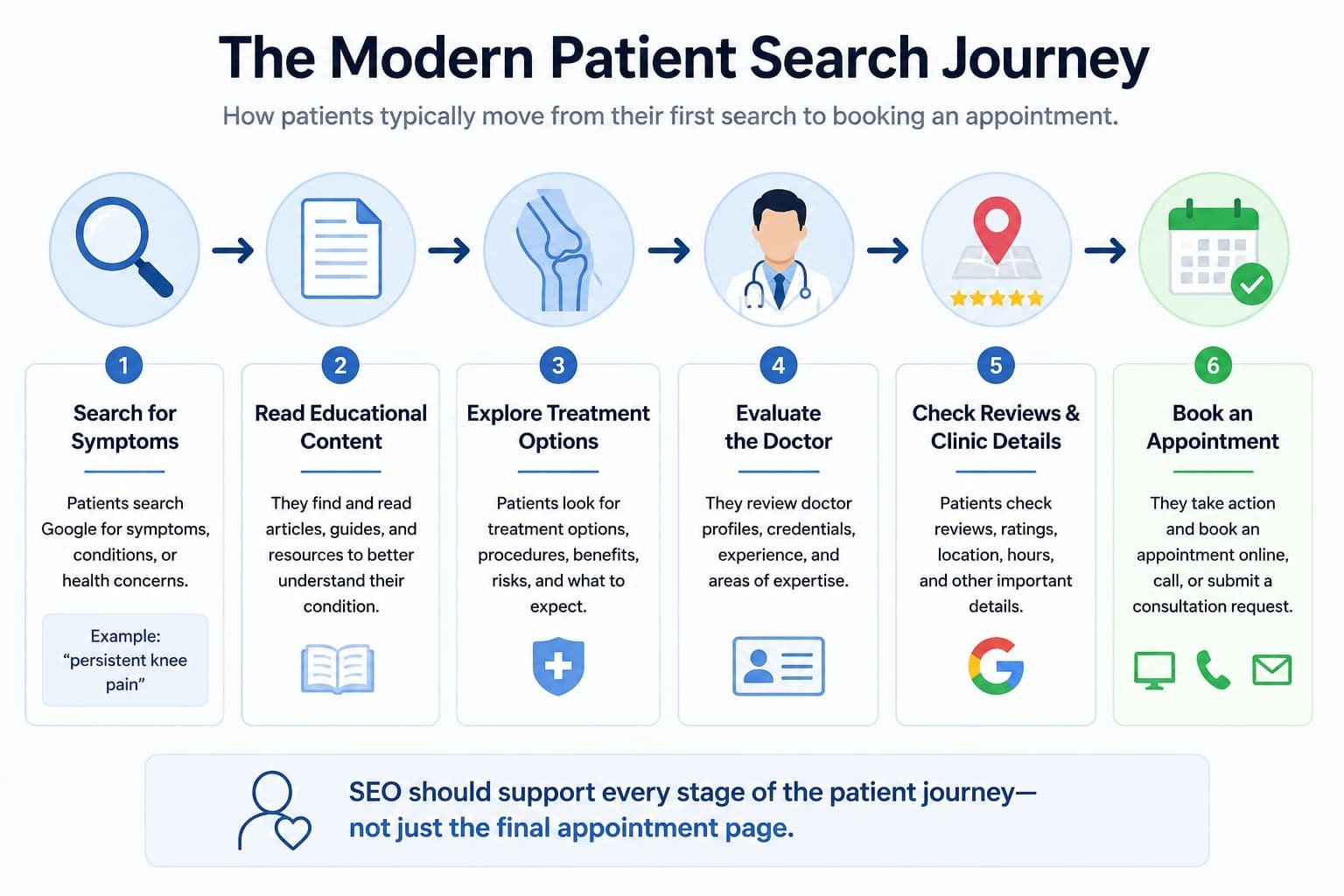
Patients use search engines to find specialists, research conditions, compare treatments, check insurance coverage, and evaluate doctors before booking an appointment. This gives medical practices opportunities to reach them at different stages of the decision-making process through educational content, treatment pages, doctor profiles, local listings, and reviews. Visibility alone, however, is not enough. Patients also need clear evidence of expertise and credibility, including physician qualifications, hospital affiliations, accurate treatment information, accepted insurance plans, clinic details, reviews, and straightforward appointment options. Effective medical SEO supports both discovery and trust, helping practices turn relevant searches into patient inquiries.
SEO Supports Sustainable Patient Acquisition
Paid advertising can deliver immediate visibility, but traffic usually declines when spending stops. SEO takes longer, yet strong service pages, doctor profiles, location pages, and educational content can continue attracting relevant patients over time. It still requires ongoing investment in content, technical improvements, expert review, local optimization, and performance tracking. The difference is that these efforts build a long-term digital asset that can rank across searches for doctors, specialties, treatments, conditions, and locations, reducing reliance on a small number of highly competitive keywords.
Local Visibility Can Influence Which Practice Patients Contact
Many searches for doctors have local intent. Patients often search by city, neighborhood, or phrases such as “near me,” while search engines also use location signals to display nearby practices. Strong local visibility depends on more than a website. A practice’s Google Business Profile, directory listings, patient reviews, location pages, and consistent contact information all influence how it appears in local search results. Accurate local SEO can increase calls, appointment requests, website visits, and direction requests from patients actively looking for care nearby.
Search Visibility Builds Familiarity Before the First Appointment
Patients often visit multiple pages before booking an appointment. They may start with an educational article, continue to a treatment page, and then review a doctor’s profile, location page, or Google Business Profile before making contact. For this reason, medical SEO should optimize the entire patient journey rather than just the homepage. Educational content answers early questions, treatment pages explain available care, doctor profiles build credibility, and location pages provide practical information. Connected through clear navigation and internal links, these pages help guide patients from research to appointment.
How Patients Search for Doctors Today
Patients rarely begin their search by looking for a specific doctor or specialty. They usually start with a symptom, condition, or treatment question before searching for the right specialist. Understanding this journey helps practices build a website that supports patients at every stage, from their first search to booking an appointment. A typical patient journey may look like this: Symptom → Possible condition → Treatment options → Specialist → Doctor or clinic → Reviews and credentials → Appointment Not every patient follows the same path. Some begin with a diagnosis or specialist referral, while others compare several providers before deciding where to book an appointment.
Symptom-Based Searches
Many patients begin by searching for symptoms rather than a specific doctor. Educational content should explain possible causes, when medical evaluation may be appropriate, and which specialist typically treats the condition, without attempting to diagnose the reader. These pages also provide a natural entry point to related condition and treatment content.
Condition and Diagnosis Searches
After receiving a diagnosis or suspecting a condition, patients usually look for information about causes, diagnosis, treatment options, and recovery. Well-structured condition pages should answer these questions while linking to related treatments, specialists, and supporting resources to strengthen topical authority.
Treatment and Procedure Searches
Patients researching treatments are often closer to booking an appointment. Treatment pages should explain who the procedure is for, how it works, potential risks, recovery expectations, and available alternatives, while providing a clear path to request a consultation.
Specialist and Local Provider Searches
Searches for specialists often include a treatment, condition, or location, signalling strong intent to find a provider. To compete for these queries, practices need dedicated service pages, detailed doctor profiles, accurate location information, and straightforward appointment options.
Reputation and Validation Searches
Before booking, many patients research a doctor’s qualifications, reviews, experience, and professional affiliations. Complete doctor profiles, trustworthy patient reviews, and consistent practice information help reinforce credibility and turn search visibility into appointment requests.
What Makes Medical SEO Different?
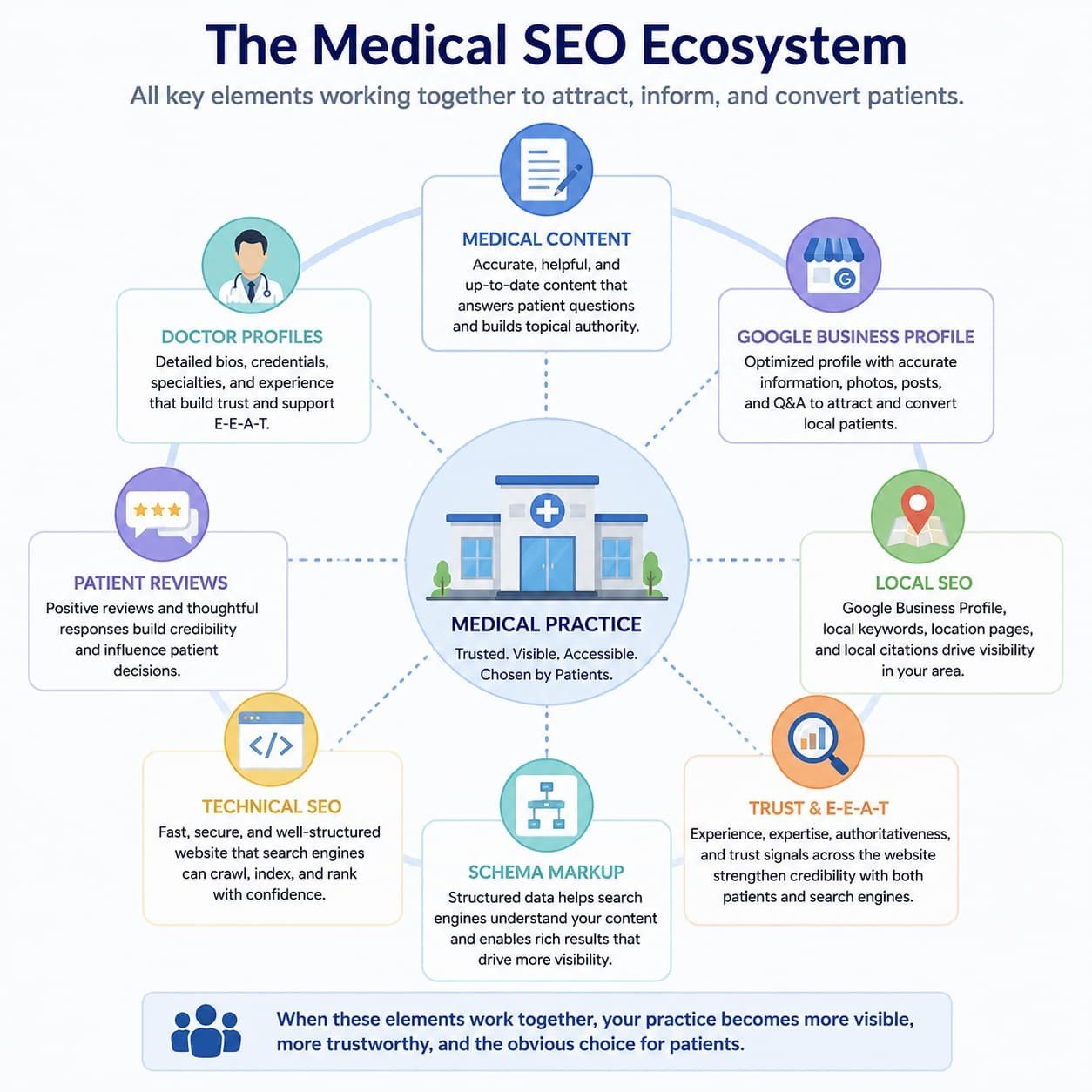
Medical SEO follows the same core principles as any other industry, including strong site architecture, high-quality content, technical performance, keyword targeting, and internal linking. The difference is that medical information can influence healthcare decisions, making accuracy, credibility, and trust far more important. For this reason, search engines place greater emphasis on signals of expertise and reliability. Clear authorship, qualified medical review, evidence-based content, reputable sources, and transparent information about the doctor or practice all help demonstrate that patients can trust the information they find.
Medical Content Falls Under YMYL
Medical content falls under Google’s Your Money or Your Life (YMYL) category because it can influence healthcare decisions. For this reason, articles should be accurate, evidence-based, and avoid exaggerated claims, guaranteed outcomes, or language that could be interpreted as medical advice or a diagnosis.
Demonstrate Expertise and Trust
Patients and search engines both want to know who stands behind the information. Strong medical content should clearly identify its author or medical reviewer and provide signals of credibility, such as:
- Named medical author or reviewer
- Relevant qualifications and credentials
- Doctor profile and clinic information
- References to reputable medical or government sources
- Publication or review date
- Clear contact information and practice locations
Prioritize Accuracy Over Keywords
Keyword research helps identify the language patients use, but medical accuracy should always come first. Pages can acknowledge common search terms while explaining the correct clinical terminology and avoiding unsupported or misleading claims.
Keep Content Up to Date
Medical guidance evolves over time, so important pages should be reviewed regularly by qualified professionals. Reviews should verify that medical information, references, links, and details about the practice remain accurate and current.
Build a Website That Patients and Search Engines Trust
A medical website should make it easy for patients to understand who you are, what you treat, where you practice, and how to book an appointment. The following elements help improve both patient trust and search visibility.
Create Detailed Doctor Profiles
Doctor profiles are often among the most visited pages before a patient books an appointment. They should highlight the doctor’s qualifications, areas of expertise, conditions treated, procedures performed, professional affiliations, consultation locations, accepted insurance, and clear appointment options.
- Full name and professional title
- Medical qualifications and certifications
- Areas of expertise
- Conditions treated and procedures performed
- Hospital or clinic affiliations
- Professional memberships
- Languages spoken
- Consultation locations
- Accepted insurance providers
- Appointment or contact options
Make Contact Information Easy to Find
Contact details should be visible, accurate, and consistent across your website, Google Business Profile, and healthcare directories. Practices with multiple locations should create a dedicated page for each clinic with its address, opening hours, map, and appointment information.
Explain Insurance and Pricing Clearly
Clearly explain accepted insurance providers, self-pay options, and how patients can request pricing. If treatment costs vary, describe the factors that influence pricing and how patients can obtain a personalized estimate.
Provide a Clear Appointment Journey
Once patients decide to contact the practice, the next step should be obvious. Include clear calls to action, keep booking forms short, and explain what happens after an appointment request is submitted.
Design for Mobile Users
Most patients search for healthcare providers on mobile devices. Ensure pages load quickly, navigation is simple, phone numbers are clickable, and booking forms are easy to complete on smaller screens.
Improve Speed and Technical Performance
Fast-loading pages improve both search visibility and patient experience. Optimize images, reduce unnecessary scripts, improve server response times, and regularly test high-value pages such as doctor profiles, treatment pages, and appointment forms.
Protect Patient Information
Use HTTPS across the entire website, collect only the information needed through forms, and provide a clear privacy policy explaining how patient data is handled.
Make the Practice Easy to Understand
Patients should quickly understand which services you provide, which doctors deliver them, where consultations take place, and how to book an appointment. Clear navigation and straightforward language improve both usability and search engine understanding.
Keyword Research for Medical Practices
Effective keyword research reflects how patients search at different stages of their healthcare journey. Instead of targeting broad terms like “doctor” or “medical clinic,” organize keywords by search intent, speciality, condition, treatment, location, and physician. This helps each page serve a clear purpose while reducing keyword overlap.
Informational Keywords
Informational searches focus on symptoms, conditions, treatments, recovery, and prevention. These pages help attract patients early in their journey while linking naturally to relevant services and doctor profiles.
- What causes persistent shoulder pain?
- Symptoms of atrial fibrillation
- How is a hernia diagnosed?
- Recovery after knee replacement
- When should you see a dermatologist?
Commercial and Treatment Keywords
These searches come from patients actively comparing providers or treatments. Service pages should explain the treatment, highlight the doctor’s expertise, answer common questions, and provide a clear path to book a consultation.
- Private cardiology consultation
- ACL surgery specialist
- Cost of cataract surgery
- Dermatologist accepting insurance
- Second opinion for cancer treatment
Local Keywords
Local searches combine a specialty or treatment with a location. Target these queries with dedicated location or service pages that contain genuinely useful local information rather than creating thin, near-duplicate pages.
- Orthopedic surgeon in Manchester
- Cardiologist near me
- Private clinic in central London
- Dermatologist in Brooklyn
- Physiotherapy clinic near Cambridge
Symptom and Condition Keywords
Focus on symptoms and conditions that match the practice’s expertise. Publishing content outside your specialties simply because a topic has high search volume rarely benefits patients or supports long-term SEO.
Doctor and Brand Keywords
Patients often search for a doctor’s or clinic’s name before booking. Ensure branded searches lead to complete doctor profiles, clinic pages, reviews, and other information that reinforces trust.
- Doctor’s name
- Practice name
- Doctor’s name + reviews
- Doctor’s name + specialty
- Doctor’s name + hospital
- Doctor’s name + location
Map Keywords to the Right Pages
Assign each keyword group to the page that best matches the user’s intent. This creates a clearer site structure, avoids keyword cannibalization, and makes it easier for both patients and search engines to find the right information.
- Specialty keywords → Service pages
- Treatment keywords → Treatment pages
- Condition keywords → Condition guides
- Doctor names → Doctor profiles
- Location keywords → Location pages
- Symptom keywords → Educational articles
Create Topical Authority Around Your Specialty
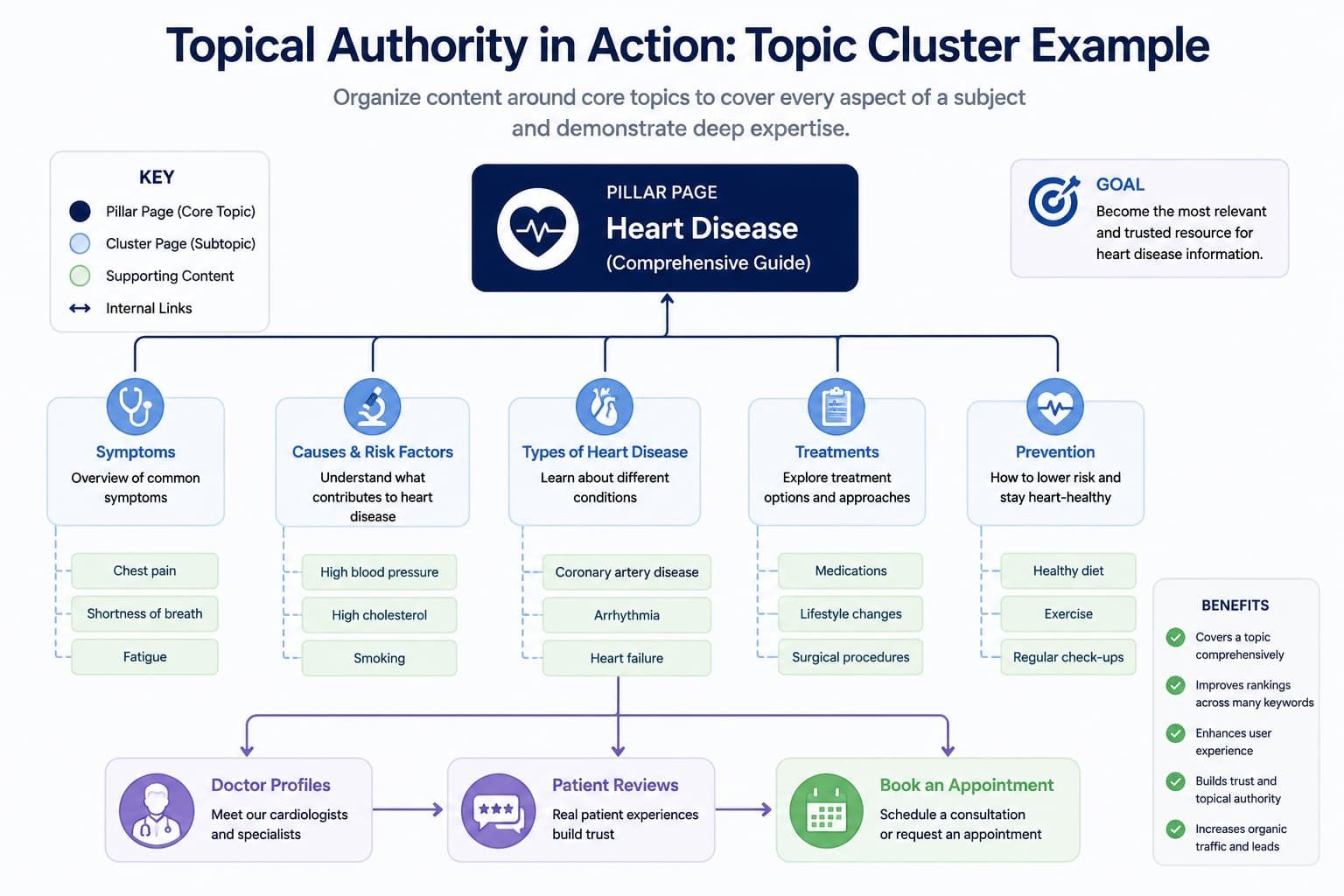
Topical authority is built by publishing comprehensive, interconnected content around your medical specialty rather than isolated blog posts. Covering related conditions, treatments, procedures, and patient questions helps both patients and search engines better understand your expertise.
Think in Topics, Not Keywords
Instead of creating unrelated articles for individual keywords, organize content into topic clusters that cover a specialty from multiple angles. An orthopedic content cluster might include:
- Main Orthopedic Services page
- Knee Pain
- Hip Pain
- Sports Injuries
- ACL Injuries
- Meniscus Tears
- Rotator Cuff Injuries
- Knee Replacement Surgery
- Hip Replacement Surgery
- Physical Rehabilitation
- Recovery Timelines
- Frequently Asked Questions
Internal links between these pages help users navigate the topic while reinforcing the practice’s expertise.
Build Pillar Pages for Core Services
Create pillar pages for your main specialties and use them as hubs linking to related conditions, treatments, doctor profiles, and patient resources. A cardiology pillar page, for example, could link to:
- Heart rhythm disorders
- Coronary artery disease
- Heart failure
- Diagnostic testing
- Stress testing
- Echocardiography
- Preventive cardiology
- Interventional procedures
Connect Related Topics Naturally
Use internal links to connect symptoms, conditions, treatments, diagnostic procedures, doctor profiles, and appointment pages. This creates a logical site structure while helping patients continue their journey.
- Relevant symptoms
- Associated conditions
- Diagnostic procedures
- Treatment options
- Recovery guidance
- Doctor profiles
- Appointment pages
Answer Real Patient Questions
Patients often search using practical questions rather than medical terminology. Address these questions throughout your content to improve both patient education and topical coverage.
- When should I see an orthopedic surgeon?
- How long does knee replacement recovery take?
- Can back pain be treated without surgery?
- What should I expect during my first cardiology appointment?
- Does this procedure require general anesthesia?
Guide Patients to the Next Step
Educational content should naturally direct readers to the next relevant page, whether that’s a condition guide, treatment page, doctor profile, or appointment booking page. Every article should support the patient’s journey, not exist as a standalone piece of content.
Local SEO for Doctors
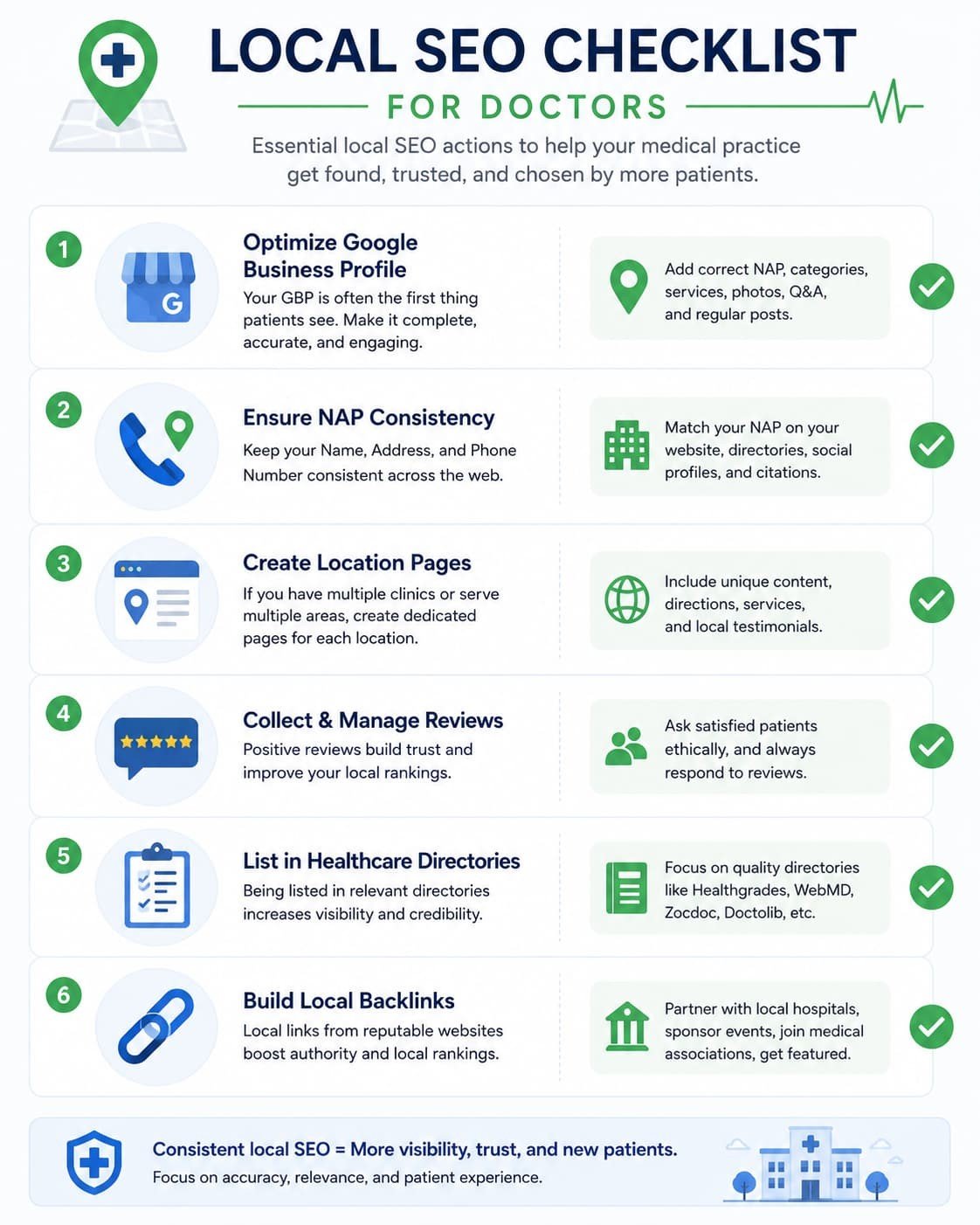
Local SEO is essential for most medical practices because patients typically search for care within a specific geographic area. Strong local visibility depends on more than your website. Search engines also evaluate your Google Business Profile, patient reviews, local citations, and the consistency of your business information.
Optimize Your Google Business Profile
Your Google Business Profile is often a patient’s first impression of your practice. Keep it complete and up to date with accurate contact details, business categories, opening hours, services, appointment links, and professional photos.
- Practice name
- Business categories
- Address and phone number
- Website URL
- Opening hours
- Professional photographs
- Services offered
- Appointment links
- Practice description
Keep NAP Information Consistent
Your practice’s name, address, and phone number (NAP) should be consistent across your website, Google Business Profile, healthcare directories, insurance listings, and social media. Multi-location practices should maintain separate, accurate details for each clinic.
Create Dedicated Location Pages
Each clinic should have its own location page with contact details, opening hours, directions, doctors, services, and other practical information relevant to that office.
- Address
- Phone number
- Opening hours
- Map and directions
- Parking or public transport information
- Doctors at that location
- Available services
Encourage Genuine Patient Reviews
Patient reviews strengthen both local visibility and trust. Encourage feedback through ethical follow-up processes and respond professionally while protecting patient privacy.
- After treatment completion
- Following follow-up appointments
- Post-visit email reminders
- Patient portals
- Reception review cards
Build Local Authority
Maintain accurate listings across trusted healthcare directories, medical associations, hospital websites, insurance networks, and other reputable local sources. Prioritize quality over quantity.
Be Active in Your Community
Community involvement can strengthen your local reputation and generate valuable mentions, backlinks, and brand awareness. Examples include health campaigns, educational events, hospital partnerships, charity initiatives, and local media appearances.
Optimize Every Doctor Profile
Doctor profile pages often play a key role in a patient’s decision to book an appointment. They should clearly demonstrate the physician’s qualifications, experience, areas of expertise, and role within the practice.
Include Relevant Professional Information
Keep profiles informative and easy to scan. Include details such as:
- Medical education
- Board certifications
- Clinical specialties
- Conditions treated
- Procedures performed
- Years of experience
- Hospital affiliations
- Professional memberships
- Research publications (where relevant)
- Languages spoken
Where appropriate, link to related treatments, educational resources, and appointment booking pages.
Make Profiles Personal and Professional
Patients choose doctors, not just clinics. A concise introduction describing the physician’s approach to patient care or area of special interest can help build trust, supported by a professional photograph and a clear summary of their expertise.
Connect Profiles to Related Content
Link doctor profiles to the treatments, conditions, and procedures they specialize in, and link those pages back to the relevant physician. This improves navigation, strengthens topical relevance, and helps patients find the right doctor more easily.
Create Medical Content That Builds Trust
Medical content should educate patients, answer common questions, and help them make informed decisions. Focus on creating accurate, medically reviewed resources that support your specialties rather than publishing large volumes of generic articles.
Develop Detailed Condition Pages
Condition pages should explain the diagnosis, common symptoms, causes, treatment options, and when patients should seek medical advice. Link them to relevant treatments, specialists, and related resources.
- Condition overview
- Symptoms
- Causes and risk factors
- Diagnosis
- Treatment options
- Possible complications
- Related specialists
Create Comprehensive Treatment Pages
Treatment pages should explain how a procedure works, who it is suitable for, expected recovery, potential risks, and how patients can request a consultation. Avoid guarantees or personalized medical advice.
- Procedure overview
- Who may benefit
- Preparation
- Recovery
- Risks and alternatives
- Consultation options
Answer Common Patient Questions
Include FAQs where they genuinely help patients understand your services, consultations, insurance, or treatment process. Complex topics are often better covered in dedicated sections or standalone articles.
- Do I need a referral?
- Which insurance plans are accepted?
- How should I prepare for my appointment?
- Can I request a second opinion?
- What should I bring?
Add Original Clinical Insight
Differentiate your content by sharing practical insights from clinical experience, such as common misconceptions, treatment considerations, preparation tips, and recovery guidance, while protecting patient confidentiality.
Use Visual Content to Improve Understanding
Diagrams, illustrations, photographs, and videos can help explain medical conditions and procedures more clearly. Whenever possible, use original visuals and educational videos featuring your doctors instead of generic stock images.
Review Content Regularly
Medical content should be reviewed and updated regularly by qualified professionals to ensure it remains accurate, reflects current clinical practice, and continues to meet patient needs.
Technical SEO Essentials for Medical Websites
Strong technical SEO helps search engines crawl, index, and understand your website while providing a better experience for patients. Prioritize the pages that drive appointments, including services, treatments, doctor profiles, and location pages.
Make Important Pages Crawlable and Indexable
Ensure your key pages are accessible to search engines and free from technical issues such as incorrect noindex tags, broken internal links, invalid canonicals, duplicate URLs, and unnecessary redirect chains.
- Correct status codes
- Crawlable pages
- Proper use of noindex tags
- Correct canonical tags
- Working internal links
- Minimal redirect chains
- Consistent URL structure
Create a Logical Site Structure
Organize your website so patients can quickly find specialties, treatments, doctors, locations, and appointment information through clear navigation and internal linking.
- Specialties
- Conditions
- Treatments and procedures
- Doctors
- Locations
- Patient resources
- Appointments and contact
Maintain an XML Sitemap
Keep your XML sitemap up to date and include only important canonical pages. Large practices may benefit from separate sitemaps for doctors, locations, services, and articles.
Fix Broken Links and Redirects
Regularly identify broken links and outdated redirects. Redirect removed pages to the most relevant alternative where appropriate instead of sending everything to the homepage.
Optimize Titles and Meta Descriptions
Write unique page titles and meta descriptions that accurately describe the content and encourage users to click. Include relevant specialties, treatments, doctors, or locations where appropriate.
Improve Accessibility
Accessible websites provide a better experience for all patients and support SEO. Focus on readable typography, sufficient contrast, descriptive image alt text, keyboard navigation, clear form labels, captions for videos, and a logical heading structure.
Use Medical Schema Markup Carefully
Structured data helps search engines better understand your doctors, clinics, services, articles, and locations. While it does not directly improve rankings, it can strengthen how your website is interpreted and displayed in search results. Common schema types for medical websites include:
- Physician
- MedicalClinic
- MedicalOrganization
- LocalBusiness
- Article
- BreadcrumbList
- FAQPage (where appropriate)
Ensure structured data accurately reflects the visible content on each page and validate it regularly after website updates or redesigns.
The Role of Reviews in Medical SEO
Patient reviews help build trust and strengthen local visibility. Focus on generating a consistent flow of genuine feedback rather than pursuing perfect ratings.
Request Reviews Ethically
Ask patients for feedback through appropriate follow-up communications while respecting platform policies and professional guidelines.
- Post-appointment emails
- Follow-up messages
- Patient portals
- Printed review cards
- Reception workflows
Respond Professionally
Thank patients for their feedback, protect their privacy, and avoid discussing personal medical information publicly. Constructive responses demonstrate professionalism and encourage trust.
Learn from Negative Reviews
Recurring complaints can highlight opportunities to improve scheduling, communication, waiting times, or other aspects of the patient experience. Strong SEO can attract patients, but long-term success depends on delivering high-quality care.
How AI Search Is Changing Medical SEO
Patients increasingly discover healthcare information through AI-powered search experiences. While the way people search is evolving, the fundamentals remain the same: accurate, trustworthy, and well-structured medical content is more likely to be cited and referenced.
Create Content AI Can Understand
Use descriptive headings, clear explanations, concise answers, and logical page structure. Lists, tables, and summaries can improve readability for both patients and AI systems without oversimplifying medical topics.
Strengthen Your Professional Identity
Maintain consistent information about your doctors, clinics, specialties, and professional credentials across your website, Google Business Profile, trusted directories, hospital affiliations, and structured data. Clear entity signals make it easier for search engines and AI systems to understand your expertise.
- Doctor profiles
- Clinic pages
- Professional registrations
- Hospital affiliations
- Published research
- Trusted directories
- Structured data
Highlight Original Expertise
Differentiate your content with insights that reflect real clinical experience, such as practical patient guidance, physician commentary, treatment comparisons, original visuals, and educational videos.
Build for Patients First
AI visibility is a by-product of strong SEO, not a separate strategy. Continue investing in high-quality content, technical SEO, local visibility, and a trustworthy website that helps patients make informed decisions and book appointments.
Common Medical SEO Mistakes to Avoid
Many medical SEO campaigns underperform because they rely on generic content, weak trust signals, or poor website structure. Avoid these common mistakes to improve both search visibility and patient confidence.
- Publishing Generic AI Content
- Using Thin Doctor Profiles
- Creating Duplicate Location Pages
- Targeting Irrelevant Keywords
- Ignoring Branded Search Results
- Avoiding Unsupported Marketing Claims
- Publishing Outdated Content
- Neglecting Internal Links
- Prioritizing Traffic Over Patients
How to Measure Medical SEO Success
SEO success is measured by patient inquiries and appointments, not rankings or traffic alone. Track the metrics that show whether your website is attracting the right patients and generating meaningful business outcomes.
Track Appointment Requests
Measure appointment and consultation form submissions while separating genuine patient inquiries from spam, job applications, and other non-patient requests.
Measure Phone Calls and Bookings
Track calls and completed online bookings to understand how organic search contributes to new patient acquisition. Completed appointments provide a more meaningful metric than button clicks alone.
Monitor Local Search Performance
Review key local SEO metrics, including:
- Google Business Profile calls
- Website visits
- Direction requests
- Appointment clicks
- Local keyword rankings
- Review volume and ratings
Track Branded and Non-Branded Visibility
Monitor both branded and non-branded searches. Non-branded visibility helps attract new patients, while branded searches often reflect growing awareness and referrals.
Evaluate Performance by Page Type
Compare how different page types contribute to patient acquisition, including:
- Doctor profiles
- Service pages
- Treatment pages
- Condition pages
- Location pages
- Educational articles
Measure Lead Quality
Focus on qualified inquiries rather than lead volume alone. Track whether inquiries match your services, location, and patient criteria, and whether they result in confirmed appointments.
SEO Checklist for Doctors and Medical Practices
Use this checklist to review your website, local presence, and overall SEO performance.
Website and Trust
- Clearly explain your specialties and services
- Publish detailed doctor profiles
- Display accurate contact and location information
- Explain insurance and payment options
- Provide a clear appointment process
- Use HTTPS and protect patient privacy
- Ensure the website is mobile-friendly and accessible
Medical Content
- Create dedicated condition and treatment pages
- Organize content into topical clusters
- Identify content authors and medical reviewers
- Reference reliable sources where appropriate
- Review important content regularly
- Avoid unsupported claims and guarantees
- Include original clinical insights
Local SEO
- Complete and verify your Google Business Profile
- Keep name, address, and phone details consistent
- Create unique pages for each clinic location
- Encourage authentic patient reviews
- Respond professionally while protecting patient privacy
- Maintain accurate healthcare directory listings
Technical SEO
- Ensure important pages are indexable
- Use a clear site architecture
- Maintain an accurate XML sitemap
- Fix broken links and redirect issues
- Write unique page titles and meta descriptions
- Improve page speed and Core Web Vitals
- Validate structured data
Measurement
- Track appointment requests
- Measure phone calls and completed bookings
- Monitor Google Business Profile performance
- Track branded and non-branded visibility
- Compare performance by page type
- Measure lead quality
Conclusion
Successful medical SEO is built on trust, not shortcuts. Practices that publish accurate content, demonstrate genuine expertise, maintain a strong local presence, and provide an excellent patient experience are more likely to earn lasting visibility in both traditional and AI-powered search. Over time, these efforts can translate into more qualified patient inquiries, a stronger reputation, and sustainable practice growth.
Article Sources
- https://www.seobility.net/en/blog/seo-for-doctors/
- https://www.practicebeat.com/blog/seo-for-doctors-2025-guide
- https://www.remedo.io/blog/a-comprehensive-guide-to-seo-for-doctors
- https://www.sermo.com/resources/seo-for-healthcare/
- https://www.zocdoc.com/resources/blog/article/introduction-to-seo-for-doctors-and-medical-practices/
- https://www.medwriter.ai/blog/boost-your-medical-practices-online-visibility-seo-strategies-for-doctors