
When people search for a product or service nearby, Google uses their location and information about local businesses to decide which results to show. For a small business, appearing prominently in these results can mean more website visits, phone calls, direction requests, and customers.
Local SEO helps improve that visibility by strengthening the information and signals Google uses to understand your business and its relevance to local searches. In this guide, we will look at how local rankings work, which areas deserve your attention first, and how to improve your Google Business Profile, reviews, website, citations, and local authority.
What Is Local SEO?
Local SEO is the process of improving a business’s visibility when people search for products or services in a specific area. It focuses primarily on Google Search and Maps, where potential customers may find your business through your Google Business Profile, local results, or website.
Google builds its understanding of a local business from multiple sources. According to Google’s documentation, these include Business Profiles, publicly available web content, licensed third-party data, and user contributions. This is why local SEO extends beyond your profile to your website, reviews, and business listings across the web.
Although local and general SEO overlap, they place different emphasis on the signals and search results that matter most:
| Area | Local SEO | General SEO |
| Typical audience | People searching in a specific area | Anyone searching, regardless of location |
| Search results | Local pack, Google Maps, localized organic results | Standard organic results |
| Key areas | Business Profile, reviews, location, website, business listings | Website content, links, technical SEO |
| Main assets | Google Business Profile and website | Website |
Where Local Search Results Appear
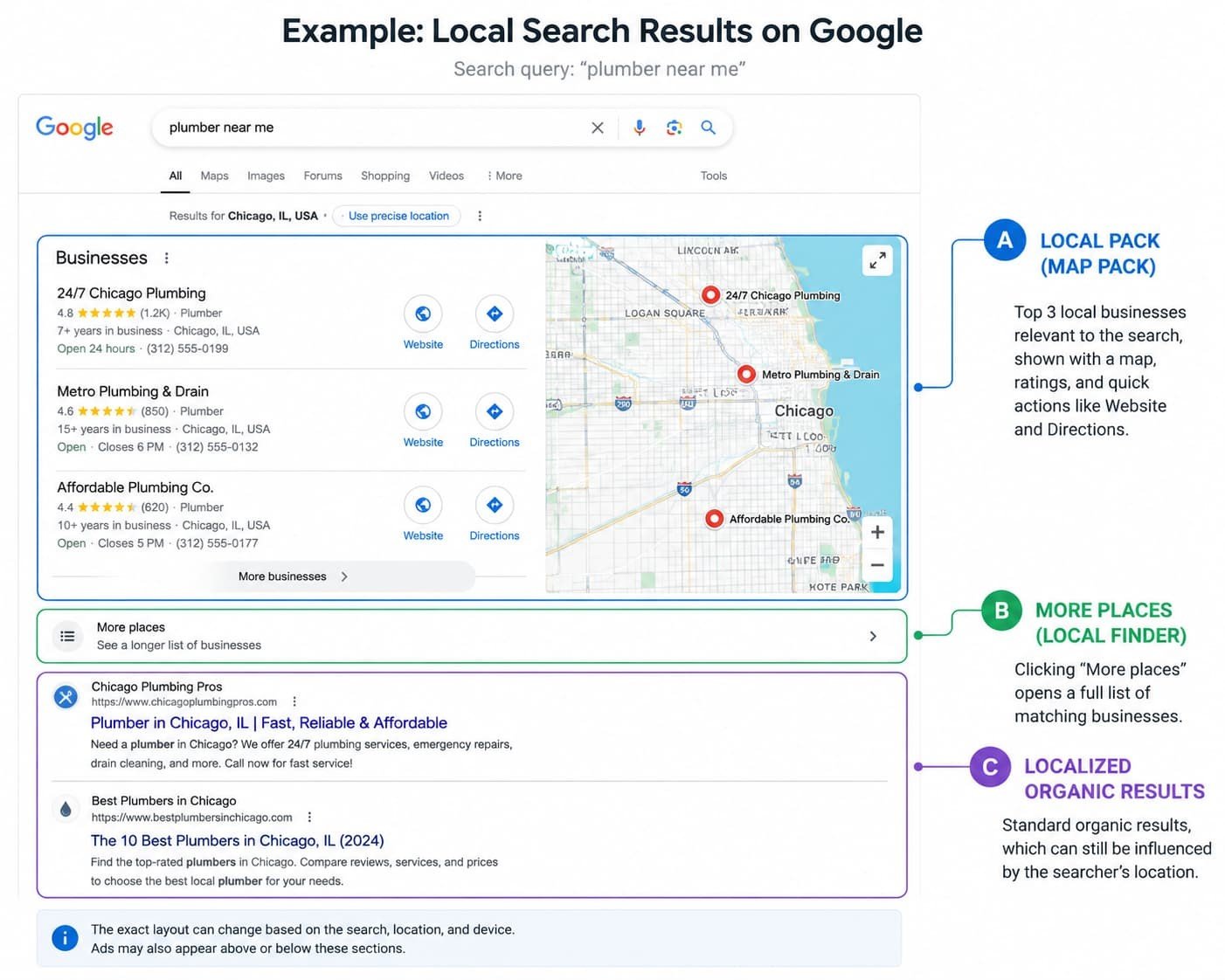
For searches with local intent, Google may display a group of nearby businesses alongside a map, commonly known as the local pack or map pack. Selecting “More places” opens a larger set of local results, often referred to as the Local Finder.
Google may also show localized organic results below these listings. These look like standard search results, but the searcher’s location can influence which pages appear. This distinction is important because visibility in the local pack and visibility in organic search depend on a different mix of factors, which we will look at next.
How Google Ranks Local Businesses
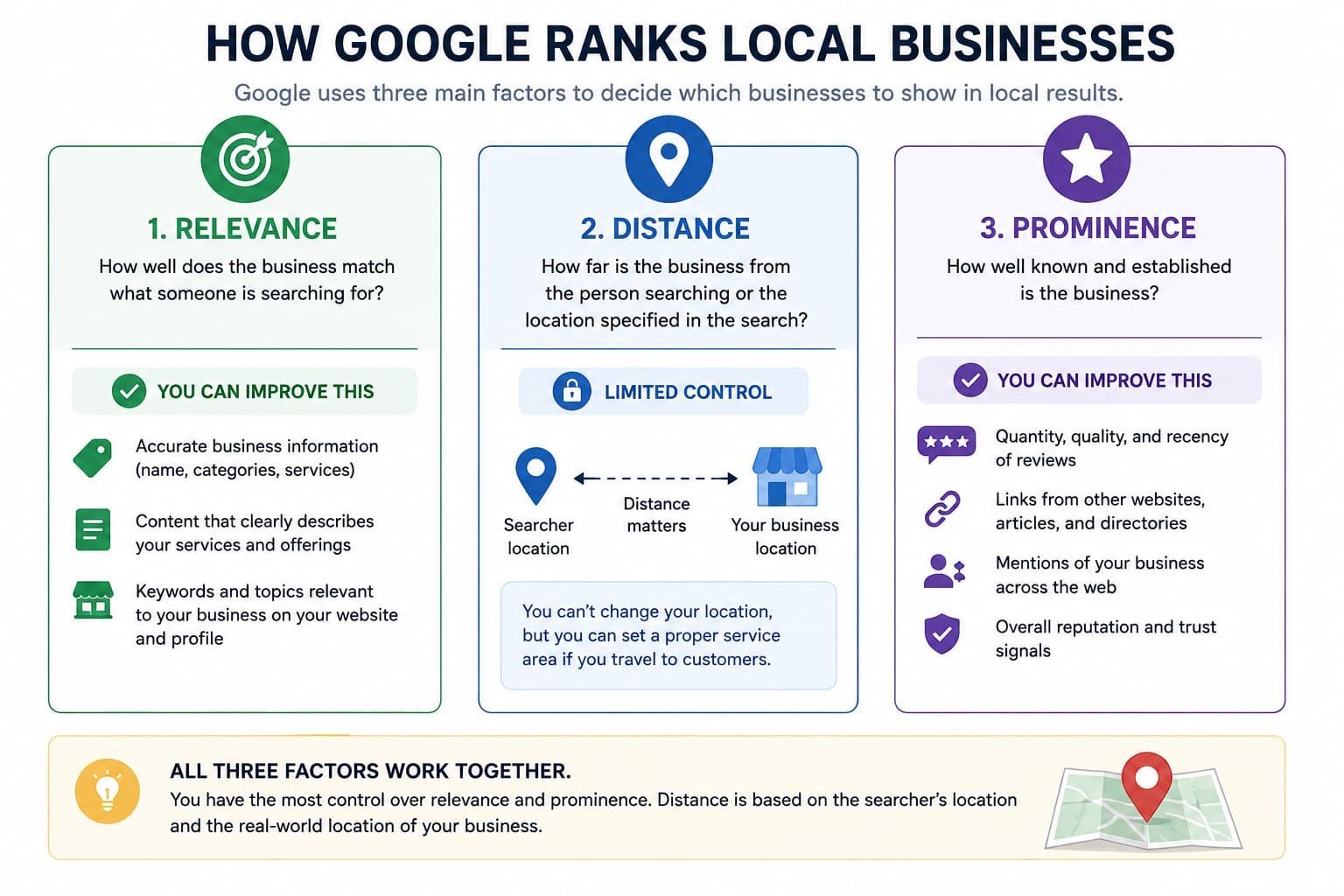
According to Google’s local ranking documentation, local results are based mainly on three factors: relevance, distance, and prominence. Understanding these factors makes it easier to see which parts of local SEO you can improve and which are largely outside your control.
Relevance describes how well a business matches what someone is searching for. Accurate business information, appropriate categories, and content that clearly describes your services help Google understand when your business is a relevant result.
Distance considers how far a business is from the person searching, or from the location used in their search. Unlike other areas of local SEO, you have little control over this factor because it depends primarily on the physical location of your business and the searcher.
Prominence reflects how well known and established a business is. Google considers information from across the web, including links and reviews, and states that more reviews and positive ratings can help local rankings.
In practical terms, most local SEO work focuses on improving relevance and prominence. Distance explains why even a well-optimized business will not rank equally well for every search across a city or service area.
Which Local SEO Signals Matter Most?
Google does not publish the individual factors or weights behind its local ranking systems. The percentages below therefore come from Whitespark’s 2026 Local Search Ranking Factors survey, in which 47 local SEO experts evaluated 187 potential factors. They should be treated as industry estimates rather than Google’s official ranking weights.
| Signal group | Local pack / Maps | Local organic |
| Google Business Profile signals | 32% | 7% |
| Review signals | 20% | 6% |
| On-page signals | 15% | 33% |
| Link signals | 8% | 24% |
| Behavioral signals | 9% | 10% |
| Citation signals | 6% | 7% |
| Personalization | 6% | 8% |
| Social signals | 4% | 5% |
The comparison highlights an important difference. Google Business Profile and review signals carry the greatest estimated influence in the local pack, while website content and links play a much larger role in localized organic results. A complete local SEO strategy therefore needs to work on both your Business Profile and your website rather than treating either one as sufficient on its own.
Where to Start With Local SEO
You do not need to tackle every part of local SEO at once. Start with the areas that can have the greatest impact on local visibility, then build the remaining work into your regular marketing routine.
| Priority | What to do | Effort | Frequency |
| 1 | Claim and complete your Google Business Profile | Medium | One-time setup with ongoing updates |
| 2 | Build a steady review process | Low | Ongoing |
| 3 | Check and correct your business information on major platforms | Low to medium | Initial cleanup with periodic checks |
| 4 | Improve your service and location pages | Medium to high | Initial project with ongoing improvements |
| 5 | Earn relevant local links and mentions | Medium | Ongoing |
| 6 | Track leads and visibility | Low | Monthly |
If your time is limited, focus first on your Business Profile, reviews, and accurate business information. Once those foundations are in place, your website and local link building become the next areas to develop.
Optimize Your Google Business Profile
Your Google Business Profile (GBP) is one of the most important assets for appearing in Google Search and Maps. Creating and managing a profile is free, but your business must be eligible. According to Google’s guidelines, it must either have a physical location customers can visit or provide services to customers in person.
Start by verifying your profile and completing the essential information, including your business name, category, address or service area, phone number, website, and opening hours. Keep these details accurate as your business changes. Google states that complete and accurate information makes businesses more likely to appear for relevant local searches.
Choose the Right Business Categories
Your primary category should describe the main type of business you operate as specifically as possible. For example, Google recommends choosing “Nail salon” rather than the broader “Salon” when that more accurately describes the business. You can add a few relevant secondary categories for other parts of the business, but avoid adding categories simply because you want to rank for related keywords.
A useful test from Google’s guidance is to think of categories as completing the sentence “This business IS a…” rather than “This business HAS a…” A hotel with a swimming pool, for example, should not add “Swimming pool” as a business category.
Use Your Real Business Name and Address
Your profile should use the same business name that customers see in the real world. Adding services, locations, marketing phrases, or other keywords to the name simply to improve rankings violates Google’s guidelines and can put the profile at risk of suspension.
This can be tempting when competitors appear to benefit from keyword-rich business names, but copying the tactic is not worth risking one of your most important local search assets.
Your address must also represent a genuine business location. P.O. boxes and remote mailboxes are not eligible, while virtual offices and co-working locations must meet Google’s specific requirements before they can be used as a Business Profile address.
Set Up Service Areas Correctly
If you travel to customers rather than serving them at your location, set up the profile as a service-area business and hide the address from customers. Your service area should reflect where you actually operate rather than every location where you would like to attract customers.
A wider service area does not give your business a wider ranking radius. Distance still depends largely on where the business and the person searching are located, so adding more cities to your service area will not make you rank equally across them.
Hybrid businesses that both receive customers at their location and travel to customers can show their address and specify a service area.
Build a Consistent Review Strategy
Reviews matter for both visibility and trust. Google states that more reviews and positive ratings can help your local ranking, while potential customers use them to decide whether your business is worth contacting. According to the BrightLocal Local Consumer Review Survey 2026, 97% of US consumers read reviews for local businesses and 41% say they always read them.
For most small businesses, the goal should not be to collect as many reviews as possible in a short period. A steady flow of genuine reviews from real customers is more sustainable and gives potential customers a more current picture of the business.
Follow the Rules When Asking for Reviews
You can ask customers to leave reviews, but the process should be neutral and based on genuine experiences. Avoid offering discounts, payments, free products, or other incentives in exchange for reviews. You should also avoid review gating, where only customers expected to leave positive feedback are encouraged to post publicly.
Fake reviews create an additional risk. The FTC’s Rule on Consumer Reviews and Testimonials prohibits practices such as buying or selling fake reviews and testimonials, including AI-generated reviews that misrepresent a real person’s experience. In other words, outsourcing fake reviews does not remove the responsibility from the business using them.
Make Review Requests Part of Your Routine
The easiest review strategy is usually the one your team can repeat consistently. Ask customers after a genuine interaction, make the process simple by sharing a direct review link, and use the same approach regardless of whether you expect the customer to leave positive or negative feedback.
The right moment depends on the business. A plumber might send the link after completing a job, while a restaurant may include it in a follow-up message or receipt. The important part is to make the request a normal part of the customer process rather than something you remember only when reviews slow down.
Respond to Your Reviews
Review responses are an opportunity to show future customers how you communicate. Keep replies brief, professional, and specific enough that they do not feel automated. Thank customers for positive feedback and address criticism calmly without sharing private information or turning the response into an argument.
Google encourages businesses to respond to reviews, but there is no need to treat every reply as a ranking tactic. The more immediate benefit is that anyone comparing your business with a competitor can see how you handle both satisfied and dissatisfied customers.
Keep Your Business Information Consistent
Local citations are online mentions of your business’s name, address, and phone number, often shortened to NAP. They appear on platforms such as business directories, maps, social networks, and industry-specific websites.
Google uses information from across the web to understand local businesses, so inaccurate or outdated listings can create conflicting information about your business. The practical goal is not to appear in as many directories as possible, but to keep your core details accurate on the platforms that customers and search engines are most likely to use.
Focus on the Platforms That Matter
For a US business, start with major platforms such as Google Business Profile, Apple Business Connect, Bing Places, Yelp, Facebook, and relevant industry directories. Depending on your business, a strong listing on a respected local or industry-specific website may be more useful than dozens of listings on generic directories that few customers visit.
Fix Existing Listings Before Building New Ones
Before creating more citations, check your existing listings for outdated addresses, old phone numbers, duplicate profiles, and incorrect business details. Use one consistent version of your core information and update important platforms whenever something changes.
If you use call tracking, keep your regular business number consistent across third-party listings rather than replacing it with different tracking numbers. We will cover the appropriate use of call tracking later in the measurement section.
Improve Your Website for Local Search
Your Google Business Profile may be central to local visibility, but your website gives you much more space to explain what you offer, where you operate, and why customers should choose your business. It is also particularly important for localized organic results, where website content and links carry much greater estimated weight.
Start with clear pages for your main services and make it easy for both visitors and search engines to understand the areas you serve. Use descriptive page titles, explain each service in useful detail, and include location information naturally where it helps the reader. A page should answer the questions a potential customer in that area would actually have, rather than simply repeat a city and service name.
Create Useful Location Pages
If your business has multiple locations or serves several distinct areas, dedicated location pages can help customers find information relevant to them. Each page should have a genuine purpose and provide useful details about that specific location or service area.
A useful location page might include the services available there, opening hours, contact details, directions, nearby landmarks, photos, customer reviews, or examples of work completed in the area. The exact content will depend on the business, but it should give someone a reason to visit that page instead of a generic service page.
Avoid creating dozens of near-identical pages where only the city name changes. Google’s spam policies specifically address doorway abuse, including pages created for similar location-based searches that ultimately funnel visitors to the same destination. If you cannot add meaningful local value to a page, it probably does not need to exist.
Add LocalBusiness Structured Data
LocalBusiness structured data gives search engines machine-readable information about your business, such as its name, address, opening hours, phone number, and business type. Keep this information consistent with your website and Google Business Profile.
Structured data can help Google understand your business and may make pages eligible for certain search features, but it is not a shortcut to higher local rankings. Think of it as a way to describe your business more clearly to search engines rather than as a ranking tactic.
Make the Mobile Experience Easy
Many potential customers will visit your site from a phone, often because they want to call, get directions, check opening hours, or compare a service quickly. Make those actions easy: use readable text, simple navigation, prominent contact options, and pages that load without unnecessary delays.
Page speed matters when poor performance gets in the customer’s way, but chasing perfect performance scores should not come before useful content and a functional website. Fix slow pages and obvious mobile usability problems, then focus your effort on the parts of the site that help visitors become customers.
Earn Relevant Local Links
Links from other websites can strengthen your local search visibility and help Google understand how your business fits into its local market. For a small business, the most valuable opportunities often come from organizations, publications, and businesses that already have a genuine connection to your community or industry.
Look for opportunities that make sense outside SEO. These might include coverage in local news, membership in a chamber of commerce or trade association, partnerships with nearby businesses, community involvement, or sponsorship of a local event or organization. Industry-specific directories and professional organizations can also be valuable when they are relevant to your business.
For example, a local contractor might earn a mention from a supplier or trade association, while a restaurant could be featured by a local publication covering new places to eat. These links are difficult to reproduce with generic link-building campaigns because they come from real relationships and local relevance.
Avoid judging opportunities simply by how many links you can acquire or by third-party SEO metrics alone. Buying links or participating in schemes designed primarily to manipulate rankings can violate Google’s link spam policies. A smaller number of relevant links from legitimate local and industry sources is a better goal than a large volume of unrelated placements.
Track Your Local SEO Results
Local SEO should ultimately generate more opportunities for customers to find and contact your business. Instead of focusing only on rankings, track a small set of metrics that show whether your visibility is turning into website visits, calls, direction requests, and leads.
Google Business Profile Performance
Google Business Profile Performance shows how people interact with your profile in Search and Maps. Useful metrics include the search terms people use to find your business, profile views, website clicks, calls, and direction requests.
Review these numbers monthly rather than reacting to short-term fluctuations. Keep in mind that a recorded call represents a click on the call button, not necessarily a completed phone conversation, so profile metrics are best used alongside your actual lead and sales data.
Search Console and GA4
Google Search Console helps you understand how your website performs in search by showing metrics such as clicks, impressions, search queries, and average positions. GA4 shows what visitors do after reaching your website, including the actions and conversions you choose to track.
Adding UTM parameters to the website link in your Google Business Profile can also help you distinguish visits coming from the profile from other website traffic. This makes it easier to see whether people who discover you through local results go on to contact or convert through your website.
Track Phone Leads When They Matter
If phone calls are an important source of leads, call tracking can help connect marketing activity with real inquiries. A common approach is to use Dynamic Number Insertion on your website while keeping your regular business number consistent in your underlying business information and third-party listings.
The most useful measurement combines visibility with outcomes. Over time, look for growth in relevant search visibility, website visits, calls, direction requests, inquiries, and ultimately customers. Local rankings can vary significantly depending on where a search is made, so a single ranking checked from one location rarely tells the whole story.
How AI Search Affects Local SEO
AI tools are becoming another way for consumers to discover local businesses. According to the BrightLocal Local Consumer Review Survey 2026, 45% of US consumers said they had used tools such as ChatGPT for local recommendations. This makes it worth paying attention to AI search, but it does not replace the local search fundamentals covered in this guide.
Google’s guidance for AI features in Search states that existing SEO best practices remain relevant for features such as AI Overviews and AI Mode, with no additional technical requirements or special optimization needed. For local businesses, that means the same fundamentals still matter: accurate business information, a complete Google Business Profile, genuine reviews, useful website content, and a strong presence across relevant sources on the web.
Rather than treating GEO or AEO as a separate marketing program, focus first on making your business easy to understand, verify, and recommend across the web. As AI-driven discovery evolves, these fundamentals give search engines and AI systems stronger information to work with.
Understand the Limits of Local SEO
Local SEO can improve how often potential customers find your business, but it cannot overcome every competitive or business limitation. Setting realistic expectations helps you focus on improvements you can actually influence.
- You cannot optimize away distance. A strong local presence can improve visibility, but it cannot change where your business is physically located. If a searcher is far from your location, closer relevant competitors may have an advantage.
- You cannot pay for better organic local rankings. Google Ads can place your business in paid results, but advertising does not buy a higher position in Google’s unpaid local rankings.
- You cannot guarantee a ranking or timeline. Local SEO improvements may take weeks or months to show meaningful results, and the impact varies by market, competition, and the work being done. Be skeptical of anyone promising a specific position or guaranteed results within a fixed number of days.
- SEO cannot compensate for a poor customer experience. Better visibility can bring more people to your business, but it cannot fix weak service, an uncompetitive offer, or consistently dissatisfied customers. In local search, reviews often make those problems more visible rather than hiding them.
Watch for Local SEO Scams and Red Flags
Local businesses are frequent targets for sales pitches that use Google’s name, guaranteed rankings, or artificial urgency to sell unnecessary services. Knowing a few common warning signs can help you separate legitimate SEO help from risky tactics and outright scams.
- Guaranteed rankings. No SEO provider can guarantee a specific position in Google’s local or organic results. Be especially cautious of anyone claiming a special relationship with Google or access to a faster way of getting your business ranked.
- Claims that you need to pay to keep your Google Business Profile. Creating and managing a Business Profile is free. Paid advertising and third-party SEO services are separate from maintaining your basic listing.
- Unsolicited calls creating artificial urgency. Treat calls claiming that your Google listing is about to expire, disappear, or requires immediate payment with suspicion. Never provide payment or sensitive account information simply because a caller claims to represent Google.
- Shortcuts that put your profile at risk. A provider recommending fake reviews, keyword stuffing in your business name, or other tactics that violate Google’s guidelines may create a temporary advantage at the cost of suspension or other problems later.
- Fake review extortion. Some businesses have been targeted with waves of fraudulent negative reviews followed by demands for payment to remove them. Do not pay the person making the demand. Document what happened and report the reviews and extortion through Google’s available reporting channels.
A useful rule when evaluating local SEO advice is to ask what will actually be changed, why it should help, and whether the tactic complies with Google’s guidelines. A legitimate provider should be able to explain the work without relying on guarantees, secrecy, or pressure.
When to Manage Local SEO Yourself and When to Get Help
Many local SEO tasks are manageable without an agency or specialist. A small business owner or team can maintain a Google Business Profile, ask for and respond to reviews, keep business information accurate, and monitor basic performance with free tools. If your market is not highly competitive and you can dedicate a few hours each month, these activities are a reasonable place to start.
Professional help becomes more useful when the work grows beyond routine maintenance. This may be the case if you operate multiple locations, compete in a crowded market, need significant website or technical SEO improvements, have unresolved Business Profile issues, or simply do not have enough time to manage local search consistently.
If you hire an SEO provider, ask what they plan to change, how they will measure progress, and what access they need to your website and Business Profile. Look for clear explanations and realistic expectations rather than promises about specific rankings or timelines. The goal is not to find someone with a secret way to influence Google, but someone who can execute the fundamentals consistently and identify opportunities you may not have the time or expertise to handle yourself.
Make Local SEO Part of Your Routine
Once the main setup work is complete, local SEO becomes much easier to manage as a routine. A few scheduled checks can help you keep business information accurate, respond to customers, spot problems early, and continue building visibility over time.
| Frequency | Tasks |
| Weekly | Read and respond to new reviews; check your Business Profile for unexpected changes or suggested edits. |
| Monthly | Review Business Profile performance, website traffic, calls and leads; check that your review process is working; verify opening hours and important business information. |
| Quarterly | Check major business listings for outdated information; review important service and location pages; look for relevant local link opportunities; revisit your Business Profile categories if your services have changed. |
You do not need to make changes simply because another week or month has passed. The purpose of the routine is to catch outdated information, identify new opportunities, and see whether your local visibility is translating into more inquiries and customers over time.
Conclusion: Build Local Visibility Around the Customer
The strongest local search presence is usually built from the same things that make a business easier for customers to trust and choose: accurate information, clear services, genuine feedback, a useful website, and a visible connection to the area it serves. Local SEO brings those pieces together and makes them easier for search engines to understand.
That also makes local SEO easier to prioritize. Start with anything that prevents customers from finding, understanding, or contacting your business, then improve the areas that can expand your visibility over time. The goal is not simply to appear higher on a map, but to turn local searches into real opportunities for the business.