
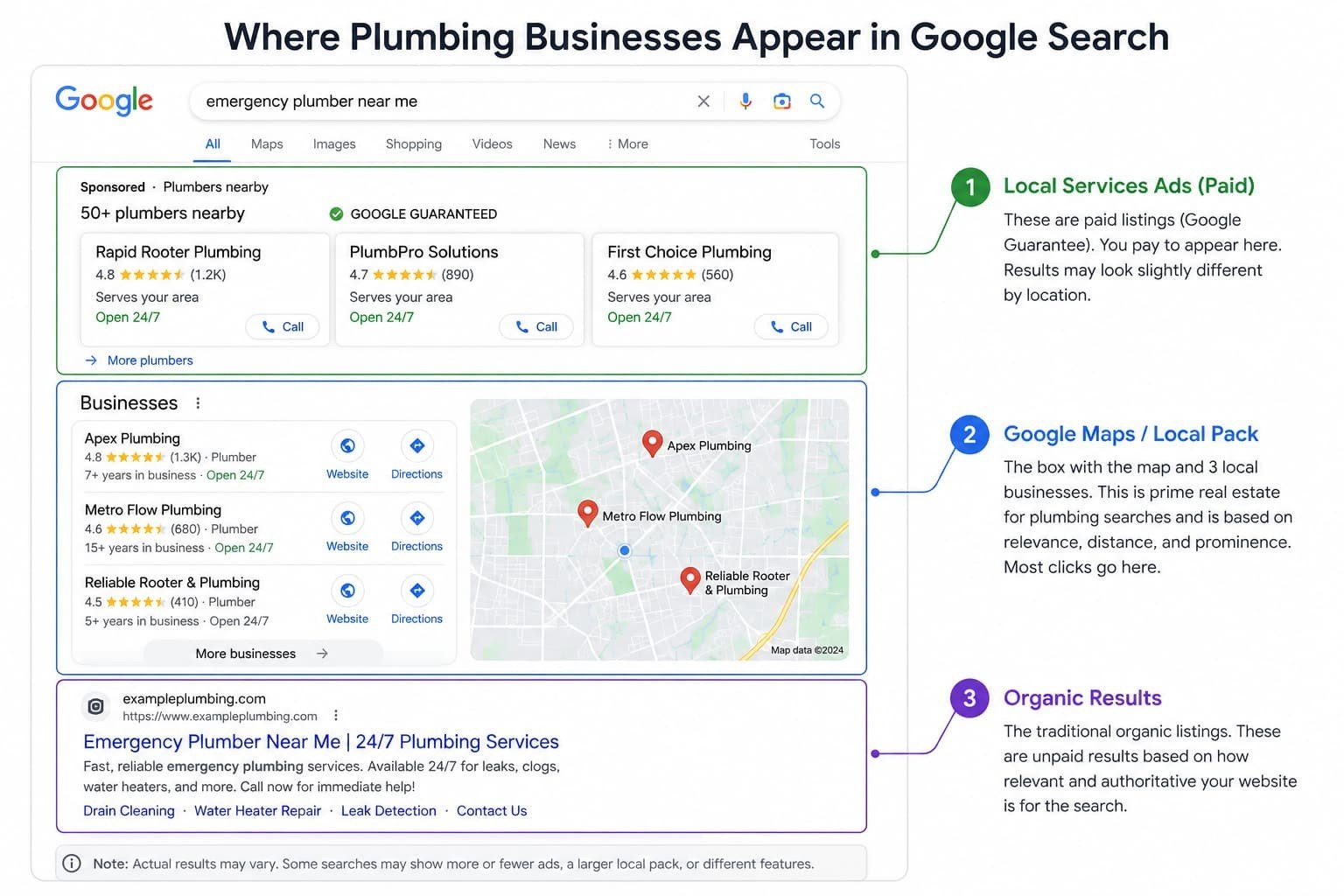
SEO for plumbers helps your business show up when people search Google for plumbing services. Visibility comes from two main areas: the local Google Maps package and the organic search results below it.
In this article, we’ll explain how to improve your visibility in both areas. We’ll start with the things that can have the biggest impact first. You’ll learn how to optimize your Google Business Profile. Why you should build service and location pages. How to earn reviews. How to position yourself as a local authority. How to measure results and learn how much SEO for plumbers costs and how long it takes.
What is SEO for Plumbers?
This term is a combination of local and website optimization. It helps plumbing businesses become more visible in relevant Google searches. This type of optimization involves properly setting up your Google Business Profile. Next comes better service and location pages. Getting customer reviews for a job well done. Mentions from local authority sources. Also ensuring that search engines can easily understand and crawl your website.
For most plumbing companies, search engine visibility comes from two main types of results:
- Local Pack: Map-based search results. Most often, a few nearby businesses are shown, based on information from their Google Business Profiles. This is a primary focus of local SEO.
- Organic results: Web pages on sites that appear in search results. Their ranking is influenced by factors such as a web page’s relevance and quality, the website’s structure, and links from other websites to it.
SEO is different from the two paid services, Google Ads and Local Services Ads (LSA). With SEO, businesses cannot pay Google directly to rank higher in local organic results. This is clearly explained in Google’s local ranking documentation.
How does Google choose which plumbers to show up first?
According to Google’s local ranking documentation, its results are primarily influenced by three important factors:
- Relevance: Does your business profile match what a user is searching for?
- Distance: How far you are from the location used in the search.
- Visibility: Does your business appear to be a well-known and established business? This is based on signals such as links, reviews, and other information available on the web.
Distance is out of your control, especially if you’re trying to reach searchers in a larger service area. Relevance and visibility can be improved, however. This is done by optimizing your Google Business Profile.
There’s a Whitespark study on local search ranking factors, based on the opinions of local SEO experts. It provides additional insight into the factors that can affect local visibility. The study highlights factors such as the correct primary category in the Google Business Profile, proximity to the searcher, and the business name. However, business names should not contain keywords unless they are part of the actual company name.
Navigation for SEO optimization of plumbing services: What to do first, second, and third
SEO for plumbing services covers several areas. Trying to improve everything at once is not the most effective approach. It’s better to start with your local presence first. Then build pages around the services and areas you want to target. Only then can you strengthen the website’s authority and technical foundation over time.
| Phase | Suggested timeframe | Main focus |
| 1: Local foundations | Month 1 | Google Business Profile, review process, and key business listings |
| 2: Service and location pages | Months 2 to 4 | Dedicated service pages and useful service-area content |
| 3: Authority and ongoing improvement | Month 4 onward | Technical improvements, supporting content, local authority, and links |
Phase One (Month 1): Lay the Foundations of Your Local SEO
Google Business Profile Settings and Optimization
Your Google Business Profile (GBP) plays a key role in how your plumbing business appears on Google Maps and other local search results. Start by claiming and verifying your profile there. Make sure your information is complete and accurate. According to Google Business Profile Help, businesses with complete and accurate information are more likely to appear in relevant local searches.
- Choose “Plumber” as your primary category if it best represents your business. You may use additional categories only when they accurately represent the services you provide (Google’s category guidelines).
- Make sure your business name, phone number, hours, and website are accurate and up to date.
- If you don’t serve customers from a staffed office, set up your profile as a service area business and hide your address where Google’s presentation guidelines require.
- Add original photos of you and your team, if you have them. Vehicles, tools, and equipment, and completed work for customers (Google’s photo guidelines).
- Add the plumbing services you provide and describe them clearly and accurately.
- Use the posts option when you have updates, offers, or information to share. Follow Google’s guidelines for posting on business profiles to stay out of trouble.
Important! Do not add keywords or a city/town name to your Google Business Profile name. Google requires businesses to use the name they consistently use and represent in the real world. Violating these guidelines may result in account restrictions or suspension.
Have a clear and consistent review process
Reviews affect not only how potential customers evaluate your business, but also how visible it is in local search. Google says that more genuine reviews and positive ratings help local rankings. A BrightLocal study of local user reviews shows that users pay attention not only to ratings, but also to how recent the reviews are. So make asking for feedback part of your normal process after work is done.
When asking for feedback from your customers, follow Google’s review policy and guidelines for receiving it:
| Do | Do not |
| Ask customers for feedback after completed jobs | Pay, discount, or offer gifts in exchange for reviews |
| Make the process easy with a direct review link | Ask only customers you expect to leave positive feedback |
| Respond professionally to both positive and negative reviews | Pressure customers to leave a review |
Fake, bought, and incentivized reviews can pose legal risks. The FTC’s Consumer Reviews and Testimonials Rule prohibits such practices. The safest approach is to ask real customers for honest feedback without offering them incentives or influencing what they say.
Here is a sample text for a request to leave a review, sent soon after a completed job:
“Thanks for choosing us today. If you have a moment, we’d appreciate your feedback on Google: [your GBP review link].”
When responding to negative feedback, maintain a professional, work-related tone:
“Thank you for the feedback. We’re sorry to hear about your experience and would like the opportunity to discuss it with you. Please contact our office so we can look into what happened.”
Keep your business information up to date in key listings
Local citations are online mentions or listings of information about your business. They typically include your name, address, and phone number (NAP). This information should be accurate across your website, Google Business Profile, and authoritative platforms such as Yelp, BBB, Apple Maps, Bing Places, Facebook, and specialized home services directories. BrightLocal’s NAP Guide and Whitespark’s U.S. citation list provide helpful starting points for identifying relevant listings.
Don’t just look at citations as numbers only. Focus on all the platforms that customers actually use. Correct outdated data and, if possible, remove or update duplicate listings.
Stage Two (Months 2 to 4): Creating Missing Service Pages and Service Areas
Create dedicated pages for your main services
It is not wise to try to rank one general plumbing service page for every service you offer. You should create dedicated pages for the services that customers are actively looking for. These can include services such as boiler repair and installation, drain cleaning, sewer pipe repair, leak detection, and emergency plumbing services.
Each page should explain the specific service and the problems it solves. What customers can expect and why they should choose you. Use a unique and readable page title that naturally reflects the topic and location.
For example: “Drain Cleaning in Plano, TX | CompanyName.”
This example follows Google’s guidelines for title links, which recommend descriptive, short titles rather than keyword stuffing.
The page you target should also match what the searcher is trying to accomplish:
| Search | Likely intent | Target page |
| water heater repair near me | Ready to hire | Water heater service page |
| drain cleaning cost | Comparing options and pricing | Drain cleaning page with pricing context |
| emergency plumber near me | Needs immediate help | Emergency plumbing page |
| sewer line repair | Looking for a specific service | Sewer line repair page |
For high-intent searches (e.g., emergency plumbing services), guide visitors to the next step. Include a visible click-to-call option, clear service availability, customer reviews, and licensing information. These are relevant trust signals and can help visitors quickly decide whether to contact you.
Create Useful Service-Area Pages
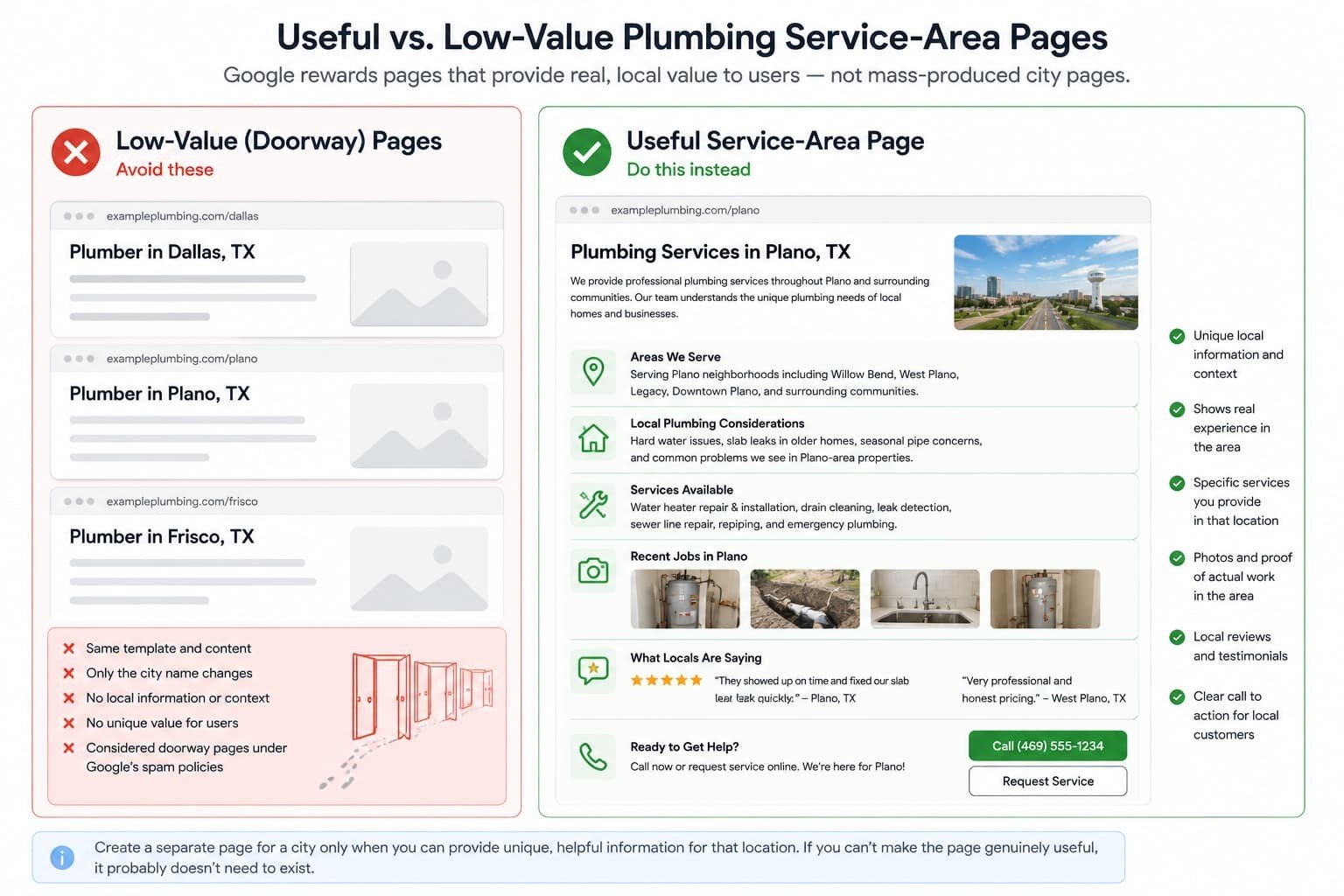
A useful page in the field of services includes:
- Information about the neighborhoods and communities you serve in the area
- Plumbing issues important to local homes or properties
- Examples of work services performed in the area
- Customer testimonials
- Clear information about the plumbing services you provide there
Don’t create dozens of pages that repeat the same content just by changing the locality name. Google’s spam rules identify pages created for specific regions or cities, primarily to direct visitors to another destination as a form of door abuse.
Phase Three (Month 4 and Beyond): Strengthen your website and build authority
Good mobile performance and technical SEO
Plumbing customers often seek help quickly, so your website should work well on mobile devices and make it easier to contact you. Google uses the mobile version of the site’s content for indexing and ranking, as explained in its mobile-first indexing documentation. Check that important pages load quickly, navigation works properly, and phone numbers are easy to dial.
Technical improvements should focus on issues such as crawling, indexing, usability, and performance. This includes fixing broken pages and links, avoiding intrusive pop-ups, and monitoring Core Web Vitals. The Google Page Experience Guide clearly shows that there is no single page experience signal that ensures higher rankings, so prioritize issues that have a meaningful impact on users and search engines.
Add LocalBusiness structured data so search engines can better understand your business. For a plumbing business, Plumber is a more specific Schema.org type within LocalBusiness. Include accurate information that matches the details shown elsewhere on the website. For example: the business name, address (where applicable), telephone number, opening hours, and service area. Google LocalBusiness Structured Data Documentation guides implementation and eligibility.
Create useful content that brings natural links to the site
Supporting content can expand the range of searches for which the website appears. It will also help potential customers make decisions before contacting you. Focus on topics related to real customer issues. These topics include plumbing repair costs, common causes of recurring sewer problems, and when the water heater needs repair rather than replacement.
Link these resources to the relevant service pages. In this way, visitors can move naturally from researching a problem to finding the service that solves it. Don’t publish articles just to increase the number of pages on the site. A smaller number of useful, well-connected resources is more valuable than a large archive of general content. Links and mentions from relevant websites also enhance your business’s online presence.
Opportunities can come from local organizations, chambers of commerce, suppliers and manufacturers, community sponsorships, local media coverage, and other businesses you work with. Avoid schemes designed to manipulate rankings, including buying large volumes of low-quality backlinks, which could violate Google’s spam policies.
Prepare your business for AI search
AI-generated responses and experiences with recommendations, such as reviews and Google AI tools such as ChatGPT and Perplexity, are increasingly influencing search. There is overlap between traditional SEO and visibility in these systems, but AI-driven search optimization is neither a shortcut nor a substitute for SEO.
- The same fundamentals that make the plumbing business easier to discover and understand on the web keep it visible in AI-driven search:
- Keep business information accurate and consistent across your website, Google Business Profile, and other relevant platforms.
- Build a strong base of true customer reviews.
- Structure important information clearly. Thus, visitors and search systems will be able to identify useful answers quickly. Add real mentions and references on relevant local, industry, and website.
How to read SEO results for a business?
Ranking can help you know if your search visibility is improving, but it’s not the main measure of SEO success. For the plumbing business, the more important question is whether organic demand generates qualified leads and reserved jobs.
Useful tracking metrics include:
- Calls and form submissions: How many leads connect to your business through organic search.
- Google Business Profile Interactions: Use the statistics to track metrics such as calls, website clicks, directions requests, and searches.
- Organic search performance: Google Search Console shows which queries and pages generate impressions and clicks. GA4 helps you understand what visitors do after they reach the website.
- Quality of leads and jobs booked: Track which inquiries become paying customers. Not every call or form submission is equally valuable.
- Price of a job booked: Compare your SEO investment with the number of customers it generates. This way you will know if the channel provides sustainable returns.
How long does SEO take for plumbers, and is it expensive?
The price of SEO varies depending on the market, the scope of work, the number of locations, the website’s condition, and the Google Business Profile. A survey of Ahrefs among SEO providers provides useful metrics for the industry. Yet, these figures should be treated as reference points rather than fixed prices.
| Engagement type | Typical price range |
| Monthly local SEO retainer | Approximately $500 to $3,000 per month |
| One-time SEO project | Approximately $1,000 to $5,000+ |
| Hourly SEO consulting | Approximately $75 to $150+ per hour |
A plumbing business in a small market with a good website requires less work than a business with multiple locations.
SEO deadlines vary for the same reasons. Google’s SEO Hiring Guide recommends that this process can take anywhere from 4 months to a year before you see the potential benefits of SEO work. Ahrefs’ research on how long page rankings take shows why expectations need to be realistic: new pages need months to establish organic visibility, especially for competitive searches.
SEO is a continuous process, not a fixed period or a one-time service.
Do you do SEO for your plumbing business yourself or hire someone?
Many of the basics in this guide are sufficient, especially for a small business in a small competitive market. Google notes that small local businesses can do much of the SEO work themselves. Maintaining your Google business profile, requesting feedback, and keeping service information up to date is enough to get you started.
Professional help makes sense when you’re working in a competitive market, serving multiple locations, and don’t have time to manage the SEO process on your own. An experienced SEO specialist or agency will help identify problems in previous work, prioritize opportunities, and develop a strategy focused on the services most important to your business.
What to pay attention to when hiring an SEO provider
Google’s SEO hiring guidelines and third-party guidelines are fused for some warning signs:
- Guaranteed #1 place in the ranking or guaranteed placement on Google
- Claims of a special connection to Google or access to their internal information
- Unclear explanations of what work will be done
- Pricing, contract terms, or reports that are difficult to understand
- Request for property or control over your accounts and finances
Conclusion: Build your SEO as a plumbing system
A strong plumbing SEO strategy works like the plumbing system itself. Before you can turn on the shower and expect water to flow, the pipes must be connected, the pressure must be correct, and every part of the system must do its job. SEO works the same way.
Before you expect a steady stream of leads from Google, you need the basics: accurate business information, a technically sound website, useful service and location pages, and strong local alerts. This is how they turn visitors into customers. Skipping these steps and focusing only on grading is like installing a shower before connecting the pipes.
Build the system correctly, improve each part over time, and ranking becomes a means to an end, not the end itself.