SEO for roofers is not just about getting your website to rank. It is about showing your roofing company when local homeowners and property managers search online. They are searching for services such as roof replacement, emergency roof repair, hail-damage roof repair, commercial roofing, and metal roofing.
The best roofing SEO strategy matches the right search to the right page. Strengthens your Google Business Profile. Builds trust with reviews. Measures success by calls, estimate requests, inspections, qualified leads, and closed jobs.
If you want SEO to help your roofing company win better jobs from Google, focus on this:
- Build separate pages for your highest-value roofing services
- Set up and actively improve your Google Business Profile
- Create useful location coverage without churning out duplicate city pages
- Earn more reviews that mention real roofing work and service areas
- Publish roofing content that supports sales, not just traffic
- Improve technical basics so your site loads fast and works well on mobile
- Track leads and revenue outcomes, not rankings alone
That includes visibility in:
- The regular organic search results
- The Local Pack and Google Maps through your Google Business Profile
- Service-related searches with local intent
- Problem-based searches from homeowners who may not know exactly what service they need yet
In practical terms, roofing SEO helps you show up for searches like:
- roof replacement Dallas
- emergency roof repair Tampa
- roofer near me
- commercial roofing Phoenix
- metal roofing contractor Nashville
- hail damage roof repair Omaha
- leaking roof what to do
A roofing company does not benefit from generic traffic that will never call. The goal is not “more visitors.” It is more of the right visitors: people who need roofing work in the areas you serve.
How roofing SEO is different from general SEO
Roofing SEO is more local, more urgent, and more trust-driven than many other industries.
A few examples:
1. Search behavior is highly local
Most roofing buyers want a contractor near them. Even when they do not type a city name, Google often treats the search as local.
That means your SEO strategy has to support both:
- location-based website pages
- strong map visibility through your Google Business Profile
2. Many searches are tied to expensive decisions
A homeowner searching for roof replacement cost is not browsing casually. A property manager searching commercial roofing company near me may be looking for a contractor for a high-value project. Roofing SEO needs to guide those users toward a quote, inspection, or consultation.
3. Emergency and storm-related searches move fast
Searches like emergency roof repair + city, roof leak after storm, or hail damage roof often happen when the homeowner wants immediate help. Those searches need pages built for fast action, clear phone CTAs, and confidence-building proof.
4. Trust matters as much as visibility
Roofing is a high-risk purchase. People want signs that your company is established, responsive, and credible. Reviews, photos, service area, licensing information, and detailed service pages all matter because they reduce hesitation.
5. Different roofing services need different pages
A general “roofing services” page is rarely enough if you want to attract high-value searches. A company that wants more replacement jobs, metal roofing jobs, storm damage work, and commercial leads should create dedicated pages for each.
How homeowners actually search for roofing services on Google
If you want SEO to produce booked roofing jobs, you need to understand how buyers search at different stages.
Bottom-of-funnel (BoFo): ready to hire now
These searches often lead directly to calls and estimate requests:
- roof replacement + city
- emergency roof repair + city
- commercial roofing + city
- metal roofing contractor + city
- roofer near me
- roofing company + city
These users need a service page, location page, or your Google Business Profile.
Middle-of-funnel (MoFo): comparing options
These searches show interest but often require more education:
- roof replacement cost
- metal roof vs shingles
- best roofing company in [city]
- flat roof repair contractor
- commercial roof coating company
These users may land on a service page, a pricing guide, a comparison page, or a trust-building page.
Top-of-funnel (ToFo): Problem-based or early-stage searches
These are often the first sign of future roofing work:
- leaking roof
- hail damage roof
- water stain on ceiling after rain
- missing shingles after storm
- how to tell if roof needs replacement
These users need an informational guide that also naturally leads to an inspection request or a repair estimate.
The mistake many roofing websites make is sending all of these search types to the same page. That lowers conversion rates because the page does not match the visitor’s intent.
Match the query to the page type
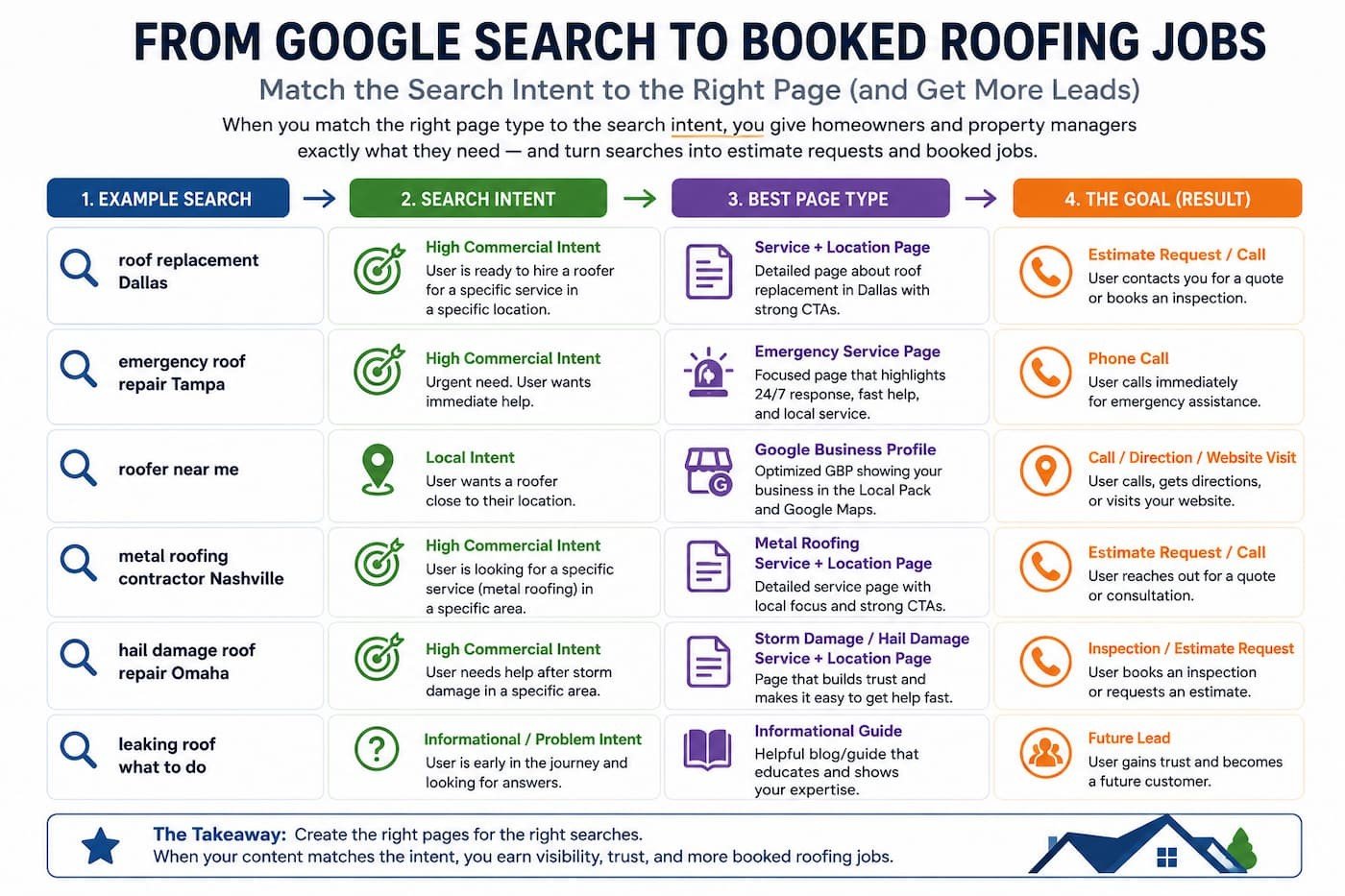
The fastest way to make roofing SEO more effective is to stop thinking in terms of keywords alone and start thinking in terms of keyword intent + page type.
| Search query example | Search intent | Best page type | Why it helps generate jobs |
| roof replacement + city | Hire a contractor | Service + location page | Captures local replacement demand |
| emergency roof repair + city | Urgent service | Emergency repair page | Encourages immediate calls from urgent leads |
| roofer near me | Local contractor search | Google Business Profile + homepage/service page | Strong fit for Local Pack and mobile leads |
| commercial roofing + city | B2B contractor search | Dedicated commercial roofing page | Filters for qualified commercial jobs |
| roof replacement cost | Research and comparison | Pricing guide or cost explainer | Educates while pushing estimate requests |
| hail damage roof | Problem-based, often storm-related | Storm damage or hail damage page | Turns insurance-related concern into inspection leads |
| leaking roof | Problem diagnosis | Informational guide + repair page | Captures urgency and channels it to repair requests |
This is the core of effective seo for roofers: each important search should have a logical destination.
Roofing keyword research: focus on service, location, and problem
Roofing keyword research should be built around the jobs you want more of, not around random phrases with search volume.
A useful way to structure roofing keywords is to sort them into three buckets.
1. Service keywords
These align directly with revenue-producing work.
Examples:
- roof replacement
- roof repair
- emergency roof repair
- storm damage roof repair
- hail damage roof repair
- commercial roofing
- metal roofing
- flat roof repair
- roof inspection
- roof maintenance
If roof replacement is one of your most profitable services, it deserves its own strong page. The same goes for commercial roofing and storm damage work.
2. Location keywords
These combine your services with the places you serve.
Examples:
- roof replacement Houston
- emergency roof repair Fort Worth
- commercial roofing Charlotte
- metal roofing contractor Knoxville
- roofer in Aurora CO
These searches should map to either:
- service-specific location pages
- location pages that clearly cover multiple services
- Google Business Profile visibility for nearby searches
3. Problem-based keywords
These capture people before they know what contractor to call.
Examples:
- leaking roof
- hail damage roof
- roof leak after storm
- shingles blown off roof
- sagging roof repair
- roof damage insurance claim
These are excellent content opportunities because they can attract homeowners considering repairs or replacements.
A practical keyword research process for a roofing company
Start with your highest-value services:
- roof replacement
- emergency roof repair
- storm damage repair
- commercial roofing
- metal roofing
Then expand each with:
- city names
- surrounding service areas
- urgency modifiers like “near me,” “same day,” or “after storm”
- problem modifiers like “leak,” “hail,” “insurance,” or “damage”
That gives you a usable content and page plan, such as:
- /roof-replacement/
- /roof-replacement/dallas/
- /emergency-roof-repair/
- /storm-damage-repair/
- /hail-damage-roof-repair/
- /commercial-roofing/
- /metal-roofing/
- /service-areas/fort-worth/
- /blog/roof-replacement-cost/
- /blog/leaking-roof-what-to-do/
The key is not to create hundreds of pages. It is to create the right pages for the services and areas most likely to produce profitable jobs.
Start with your highest-value roofing service pages
If your website has only a generic “Roofing Services” page, Google and your potential customers have to guess what you really specialize in.
Dedicated service pages make that easier.
Priority pages most roofing companies should consider
Roof replacement
This is often one of the most commercially valuable pages on a roofing site. It should explain:
- signs a roof may need replacement
- residential roof replacement process
- roofing materials you install
- financing, inspection, or estimate options if applicable
- the areas you serve
- clear calls to action
Emergency roof repair
This page should feel urgent and practical. It should cover:
- what qualifies as an emergency
- how quickly customers should call
- temporary protection steps
- common emergency scenarios like active leaks, storm damage, or missing sections
Storm damage repair
This page should speak directly to post-storm demand:
- wind damage
- hail damage
- fallen debris
- leak discovery after severe weather
- inspection and repair process
Commercial roofing
This page should not read like a residential page with “commercial” inserted. It should address:
- roof systems you work on
- maintenance and repairs
- coatings or replacement if relevant
- property managers, building owners, and facility decision-makers
- project communication and scheduling expectations
Metal roofing
Metal roofing buyers often compare options before they call. A strong page can cover:
- residential or commercial applications
- benefits and tradeoffs
- installation expertise
- replacement versus new installation
- style or material options if relevant
Each page should answer a simple business question:
Why should this person trust us with this specific type of roofing project?
Google Business Profile is one of the biggest lead drivers for roofers
For roofing companies, visibility in the Local Pack can be just as important as website rankings.
When someone searches for “roofer near me” or “roof repair [city]”, Google often shows a map with local business listings. That can produce calls directly from searchers who never even visit your website.
Google provides guidance for representing your business on Google through your Business Profile.
What matters most for roofing companies
Accurate business information
Your business name, phone number, website, hours, and service area should be consistent and up to date.
Strong categories
Choose the most relevant primary category and supporting categories based on your actual services.
Real photos
Roofing is visual. Photos of your team, trucks, completed roofing work, storm repairs, commercial projects, and jobsite activity make the listing more credible.
Reviews
Reviews can influence whether someone clicks, calls, or keeps comparing. More on that below.
Services and updates
Use the profile to reinforce what you actually do: roof replacement, repair, commercial roofing, storm damage, metal roofing, and so on.
Why this helps generate better jobs
A strong Google Business Profile helps capture high-intent local searches at the exact moment a customer wants a contractor. That is especially important for:
- emergency roof repair
- local replacement estimates
- storm-related inspections
- “near me” searches from mobile users
Reviews and local trust signals: where clicks become leads
Roofing SEO is not just visibility. It is trust at the moment of decision.
A homeowner comparing three roofers in Google may see similar service claims. Reviews often become the deciding factor.
What kinds of reviews help most
The strongest reviews are specific. For example, a review that mentions:
- the city or neighborhood
- the type of project
- whether it was replacement, repair, hail damage, or commercial work
- responsiveness or communication
- cleanup and professionalism
Specific reviews help future customers feel more confident. They also reinforce relevance around the services and service areas you want to be known for.
Other local trust signals that support SEO and conversions
- Before-and-after project photos
- Clear service area coverage
- Consistent business details across the web
- Testimonials tied to real project types
- Team, company, and contact information that shows you are established locally
A roofing site that looks vague or anonymous usually converts worse, even if it gets traffic.
Location pages and service-area pages: do them without creating thin content
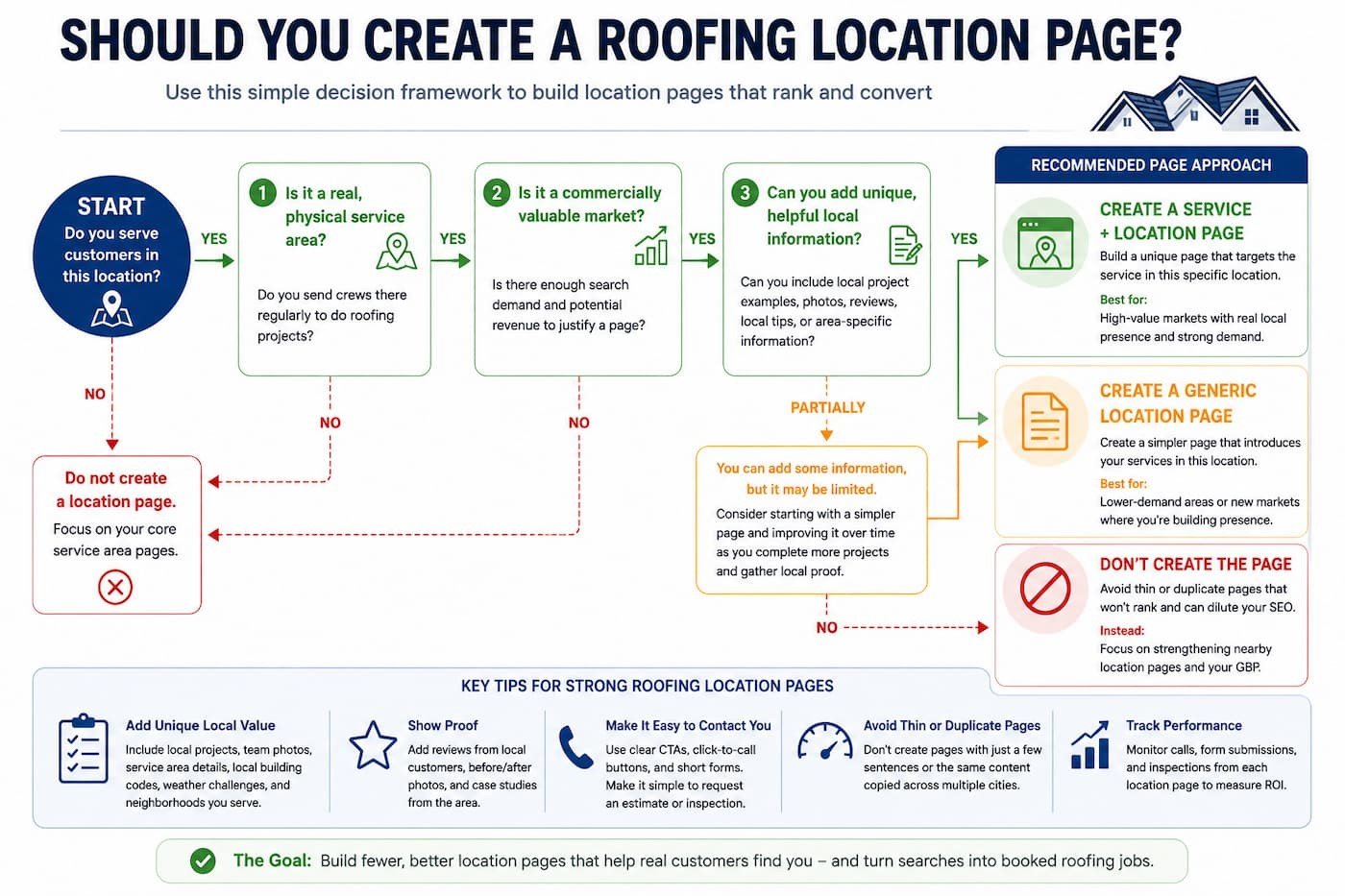
Many roofing companies know they need city pages, but many execute them poorly.
The common mistake is publishing dozens of nearly identical pages like:
- Roofer in City A
- Roofer in City B
- Roofer in City C
with only the city name changed. That kind of thin duplication is weak for both users and search engines.
A better approach
Create location pages only for real service areas you actually want to grow in. Then make those pages useful.
A solid roofing location page can include:
- services offered in that city or region
- common roofing issues in that market, such as hail, wind, aging shingles, or flat roof needs
- neighborhoods or nearby areas covered
- project types handled there
- how scheduling, inspections, or dispatch works for that area
- links to the most relevant service pages
Even better: combine service + location where commercial value is high
If a city is strategically important, consider pages like:
- Roof Replacement in Plano, TX
- Emergency Roof Repair in Tulsa, OK
- Commercial Roofing in Jacksonville, FL
This is often stronger than a generic city page because it matches what people actually search and what you actually want to sell.
How to avoid duplication
Do not mass-produce pages with the same paragraph structure and filler text. Instead:
- prioritize fewer, stronger pages
- write city-specific details that reflect real demand
- link to local reviews or project photos where appropriate
- connect each page to the relevant service pages
If you cannot make a page genuinely distinct, it probably should not exist.
Roofing-specific content strategy: publish content that supports sales
A lot of roofing companies hear “content marketing” and think blog traffic. That is too vague.
For roofers, content should support one of three outcomes:
- bring in early-stage searchers who may need roofing work soon
- help undecided prospects move toward an estimate
- support your service and location pages with topical relevance and internal links
Good content topics for roofing companies
Cost and budgeting content
Examples:
- Roof Replacement Cost: What Homeowners Should Expect
- Metal Roof Cost vs Asphalt Shingles
- What Affects Commercial Roof Replacement Pricing?
This helps convert research-stage buyers into estimate requests.
Problem diagnosis content
Examples:
- Leaking Roof: What to Do Before Water Damage Gets Worse
- Hail Damage Roof Signs After a Storm
- Missing Shingles After Wind: Repair or Replace?
This helps turn concern into inspections.
Service comparison content
Examples:
- Roof Repair vs Roof Replacement
- Metal Roof vs Shingle Roof
- TPO vs EPDM for Commercial Roofing
This helps buyers decide which service they need.
Process and expectation content
Examples:
- What Happens During a Roof Inspection?
- How Emergency Roof Repair Works
- What Homeowners Should Know About Storm Damage Roof Inspections
This reduces friction before the call.
The sales role of roofing content
A good roofing guide should not end with generic advice. It should naturally lead to a next step.
For example, a page about hail-damaged roofs should guide the visitor toward:
- a storm damage inspection
- a repair estimate
- a consultation about whether repair or replacement makes more sense
That is how content contributes to booked jobs, rather than just pageviews.
Internal linking: connect your money pages so Google and customers can navigate clearly
Internal linking is simple but important.
A roofing website should make it easy for both users and search engines to move between:
- core service pages
- city or service-area pages
- supporting informational content
A practical roofing example
Your Storm Damage Roof Repair page can link to:
- Emergency Roof Repair
- Hail Damage Roof guide
- Roof Replacement
- relevant location pages for storm-prone areas
Your Roof Replacement Cost article can link to:
- Roof Replacement
- Metal Roofing
- service-area pages in target markets
- inspection or estimate request pages
This helps in two ways:
- It gives Google a clearer picture of your site structure and topical coverage
- It gives potential customers a clear path from question to service inquiry
If important pages are isolated, they are harder to rank and harder to convert.
Citations, backlinks, and authority: what matters for roofing companies
You do not need a vague backlink campaign. You need authority signals that make sense for a local roofing business.
Citations
Citations are mentions of your business information on directories and local platforms. Consistency matters. If your name, address, or phone details vary widely, that can create confusion.
For roofers, citation work is most useful when it strengthens local trust and supports map visibility.
Backlinks
Backlinks matter most when they come from relevant, credible places.
For roofing companies, practical examples include:
- local chambers or business organizations
- community sponsorship pages
- local news coverage if your company is featured
- manufacturer or partner directories if available
- local associations or contractor directories
The right question is not “How do we get more backlinks?” It is:
What legitimate local or industry relationships can also earn us mentions and links?
What to avoid
Avoid low-quality directory spam, irrelevant guest posts, or bulk link schemes. Those usually create clutter rather than real business value.
Technical SEO fundamentals that help roofing leads, not just rankings
Technical SEO sounds intimidating, but most roofing companies only need to get the essentials right. Google explains key crawling and indexing concepts in its Search documentation.
Mobile usability
Many roofing searches happen on phones, especially urgent ones. If your site is hard to navigate on mobile, you will lose leads even if people find you.
Speed
A slow roofing website hurts both user experience and lead generation. People searching for emergency roof repair will not wait around.
Crawlability and indexing
Important pages should be easy for search engines to find and index. Your top service pages should not be buried or blocked.
Clear page structure
Use descriptive titles, headings, and page copy so that both users and search engines can quickly understand the page.
Basic schema and business details
Structured data can help reinforce core business information and page meaning, though it does not replace strong content and page targeting.
Secure site and reliable experience
A professional roofing company’s website should be secure, stable, and free of broken pages or obvious errors. These are trust issues as much as SEO issues.
How to measure roofing SEO by revenue opportunity, not vanity metrics
The biggest reporting mistake in roofing SEO is celebrating rankings while ignoring business outcomes.
A roofing owner should ask:
- How many calls came from organic search?
- How many estimate requests came from organic search?
- How many inspection bookings came from local search and Maps?
- How many of those leads were qualified?
- How many turned into actual roofing jobs?
- Which services produced the best leads?
- Which cities produced the best leads?
Metrics that matter most
- Calls – Especially for emergency repair, storm damage, and “near me” searches.
- Estimate requests – A core measure for replacement, metal roofing, and commercial jobs.
- Inspection requests – Often the best conversion point for storm and hail-related traffic.
- Qualified leads – Not every form fill matters. You want leads in your service area asking about work you actually want.
- Booked jobs – The final measure. SEO should support revenue, not just website sessions.
Common roofing SEO mistakes
These are the issues that most often prevent roofing SEO from producing real jobs.
One generic service page for everything
If roof replacement, emergency repair, commercial roofing, and metal roofing all live on one page, you miss clear intent matching.
Duplicate city pages
Changing only the city name creates weak location pages that are hard to trust and hard to sustain.
Ignoring Google Business Profile
Many roofing companies focus only on the website and overlook a major local lead source.
Publishing content with no conversion path
A page about a leaking roof should lead to repair help or inspection options, not end as a dead informational article.
Chasing traffic that does not turn into jobs
If a topic brings visitors from outside your service area or from people who will never hire a contractor, it may not help the business.
Weak trust presentation
Thin service descriptions, no project photos, few reviews, and vague location details reduce conversions.
No lead tracking
If you cannot tell whether SEO is producing estimate requests and booked work, you cannot improve it intelligently.
Treating commercial roofing like residential roofing
Commercial buyers have different concerns. They need dedicated messaging, not recycled homeowner copy.
A practical roofing SEO checklist
If you want a focused action plan, start here.
Foundation
- Claim and complete your Google Business Profile
- Check that your business name, phone, website, and hours are accurate
- Confirm your website works well on mobile
- Add clear phone and estimate CTAs on key pages
High-value service pages
- Create dedicated pages for:
- roof replacement
- emergency roof repair
- storm damage repair
- commercial roofing
- metal roofing
- Make each page specific to that service, not generic roofing copy
Local SEO
- Build strong pages for your main service areas
- Create service + location pages where commercial value is high
- Avoid publishing duplicate city pages with only name swaps
Reviews and trust
- Ask satisfied customers for reviews consistently
- Encourage reviews that mention the type of roofing work completed
- Add real jobsite and finished-project photos
Content
- Publish guides for:
- roof replacement cost
- leaking roof
- hail damage roof
- repair vs replacement questions
- End each guide with a clear next step such as an inspection or estimate request
Internal linking
- Link service pages to related location pages
- Link informational pages to the relevant money pages
- Make it easy for users to move from question to quote
Authority
- Clean up and standardize core citations
- Pursue relevant local and industry mentions
- Focus on legitimate reputation signals, not spammy link tactics
Measurement
- Track organic calls
- Track estimate form submissions
- Track inspection requests
- Track qualified lead volume by service and city
- Compare booked jobs back to SEO-generated lead sources
Final thought: roofing SEO works when it is built around jobs, not just keywords
The best SEO strategy for roofers is not the one that generates the most impressions. It is the one that puts your company in front of people searching for the roofing work you actually want more of.
That usually means:
- visibility for local, high-intent searches
- dedicated pages for your most profitable services
- a Google Business Profile that drives calls
- reviews that increase trust
- content that helps undecided buyers move forward
- tracking that shows which SEO efforts lead to real jobs
And that is what separates roofing SEO that looks busy from roofing SEO that actually helps fill the schedule.