

Architecture is sold through trust, relevance, and proof of past work. Before prospective clients contact a firm, they often want to know what it has designed, where it works, what kinds of projects it understands, and whether its experience matches their own.
Search is often part of that evaluation.
A homeowner planning a major renovation may search “residential architect in Austin”, compare portfolios, read about the design process, and look for evidence that a firm understands local permitting, neighborhood constraints, and the type of home they want to create.
A developer may search for a “mixed-use architecture firm Dallas”, review completed projects, check credentials, and look for experience with similar sites and building types.
A business owner may search “commercial architect for restaurant buildout” because they need a firm that understands code, accessibility, layout, permitting, and operational requirements.
SEO for architects is the process of ensuring the right pages from your website appear in those searches and give prospective clients enough evidence to decide whether your firm is relevant.
Done well, SEO connects five things:
- The services your firm wants to sell
- The project types and sectors you want more of
- The locations you realistically serve
- The completed work that proves your expertise
- The trust signals that help a prospective client take the next step
It should not turn an architecture website into a wall of keywords or compromise the visual experience. The goal is to make strong design work easier to discover, understand, and evaluate.
Why SEO matters for architecture firms
Architecture is a high-consideration professional service. Prospective clients rarely wake up and hire the first firm they see. They research. They compare. They look for evidence of fit.
SEO matters because it helps your firm participate in that research phase.
Done well, SEO can support business goals such as:
- Attracting inquiries for the types of projects you actually want
- Increasing visibility for high-value services
- Building awareness in target cities or regions
- Strengthening credibility through project proof and thought leadership
- Generating consultations, shortlist consideration, and RFP opportunities
For many firms, referrals remain important. SEO does not replace referrals. It complements them. A referred prospect often still searches your firm name, reviews your work, compares your site with competitors, and reads a few articles before reaching out. Organic search helps at that stage too.
How prospective clients search for architects
One of the biggest SEO mistakes for architects is assuming everyone searches the same way.
They do not.
A homeowner planning a major renovation, a developer evaluating multifamily firms, a school board researching public-sector experience, and a hospitality brand seeking a design partner will use different language and expect different information.
Here are the main search patterns to understand.
Broad category searches
These are high-level searches such as:
- architect
- architecture firm
- architects near me
- architecture services
These terms are broad and often competitive. They can matter, but they are usually not the best place to build your entire strategy. A firm is often better served by becoming highly visible for more specific searches with clearer intent.
Service-specific searches
These indicate someone is looking for a defined offering, such as:
- architectural design services
- interior architecture services
- master planning services
- feasibility study architect
- historic preservation architect
- architect for home renovation
These searches should usually lead to dedicated service pages, not just a general homepage.
Project-type searches
These are often some of the most commercially useful searches because they show what kind of work the prospect needs:
- residential architect
- commercial architect
- multifamily architect
- hospitality architect
- healthcare architect
- civic architecture firm
- luxury home architect
- sustainable architect
If your firm works across multiple sectors, each important sector may deserve its own page with examples, process, and proof.
Location-based searches
These include:
- architect near me
- architecture firm Dallas
- residential architect San Francisco
- commercial architect Atlanta
- luxury home architect Naples FL
These searches usually carry strong intent. The searcher often wants a firm that operates in a specific city, metro area, or region, even if the project is still months away.
Informational research searches
These happen earlier in the buyer journey, but they are still valuable:
- how much does an architect cost
- do I need an architect for a renovation
- architect vs design-build
- architect for custom home process
- how long does architectural design take
- sustainable design strategies for commercial buildings
These searches should lead to informational articles or guides, not a service page forced to do every job at once.
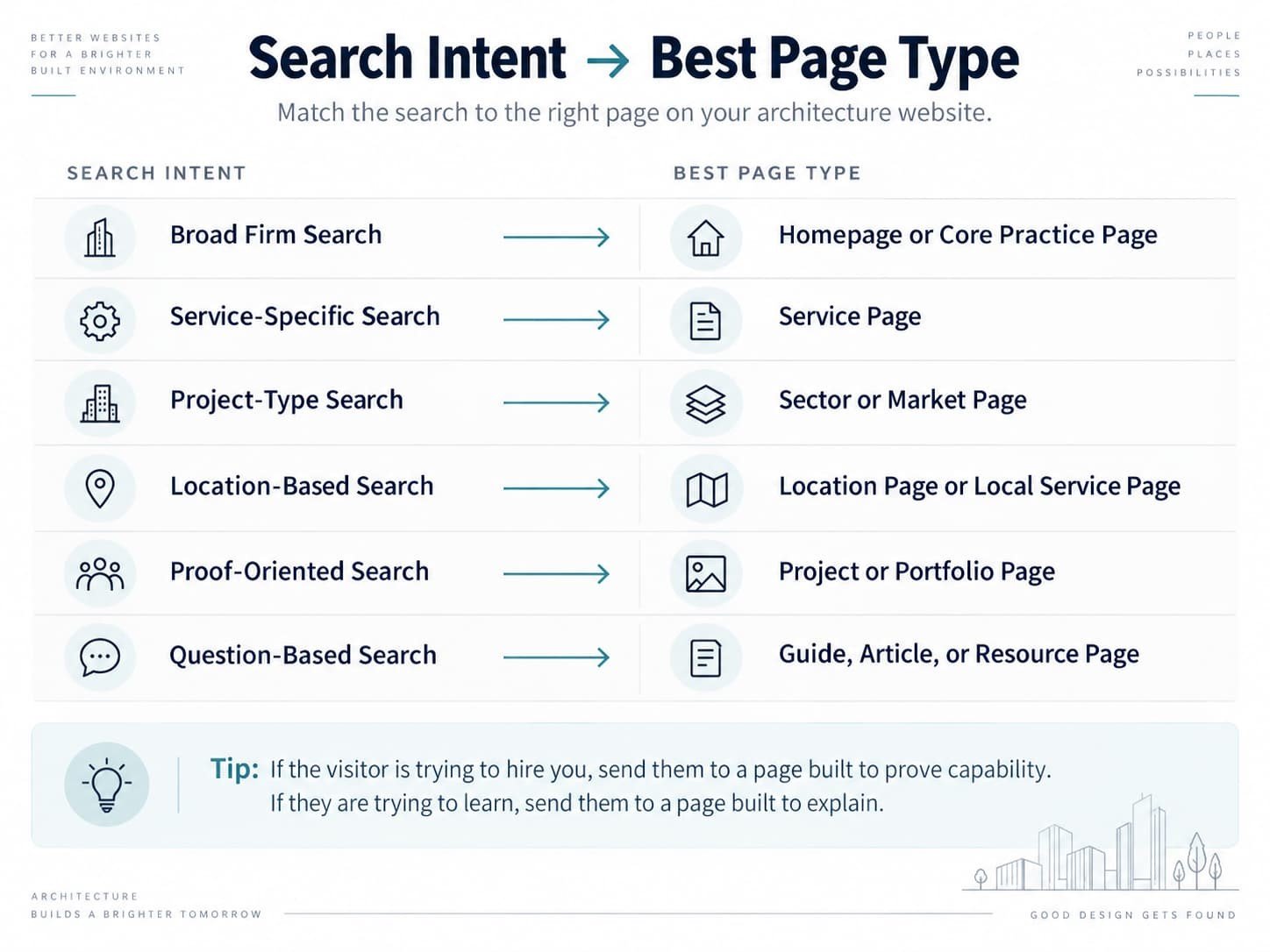
The key principle: match the search to the right page type
A practical architecture SEO strategy starts with matching search intent to the right kind of page.
- Broad firm searches >> homepage or core practice overview pages
- Service-specific searches >> service pages
- Project-type searches >> sector or market pages
- Location-based searches >> location pages or strongly location-relevant service pages
- Proof-oriented searches >> project and portfolio pages
- Question-based searches >> blog articles, resource pages, or guides
If your site has only a homepage, an about page, and a visual portfolio, you are forcing Google to guess which page should rank for which search. Usually, it guesses wrong.
Website structure for architecture firms
Architecture websites often prioritize visual impact, which makes sense. But from an SEO perspective, the site still needs a structure that explains relationships between topics. A strong architecture firm site often includes these content layers:
- Homepage
- About / firm profile
- Service pages
- Sector or project-type pages
- Location pages where appropriate
- Project/portfolio pages
- Resource or insights content
- Contact/inquiry page
The important thing is not having every possible page type. It is creating a structure in which the pieces support one another. For example:
- А commercial architecture page links to office, retail, and mixed-use projects
- А residential renovation architect page links to renovation case studies
- А Boston architect page links to local projects and relevant services
- A cost of hiring an architect article links to service and process pages
- Project pages link back to the service, sector, and location pages they support
This helps users navigate and helps search engines understand topical relevance.
Dedicated service pages for important architectural services
If an architecture firm wants to rank for a service, it usually needs a page dedicated to that service. This sounds obvious, but many firms bury all their services in a single paragraph or a dropdown menu. A strong service page for architects should answer five practical questions:
- What is this service?
- Who is it for?
- What kinds of projects does it apply to?
- How does your firm approach it?
- What proof shows you can deliver it?
Example: “Architectural Design Services” page
A useful page might include:
- overview of architectural design services
- client types served
- phases of work, such as pre-design, schematic design, design development, construction documents, and coordination
- project types covered
- representative project links
- how your process works
- locations or regions served
- a clear inquiry path
Example: “Architect for Home Renovation” page
This page might cover:
- when a renovation needs an architect
- common scopes such as additions, gut renovations, reconfiguration, historic homes, or kitchen-centered redesigns
- structural, permitting, and planning coordination issues
- examples of renovation projects
- how renovation work differs from new construction
When a page like this is specific, it can attract more qualified prospects than a generic “Services” page ever will.
Project and portfolio pages are major SEO assets
For architecture firms, project pages are often the most underused SEO asset on the site.
Many portfolio pages look beautiful but contain only:
- project name
- location
- a few images
- maybe one short caption
That may work for an already-warm referral. It does very little for search visibility.
A project page can rank, support other pages, build trust, and help a prospect self-qualify your firm. To do that, it needs enough context.
How to turn text-light portfolio pages into search assets
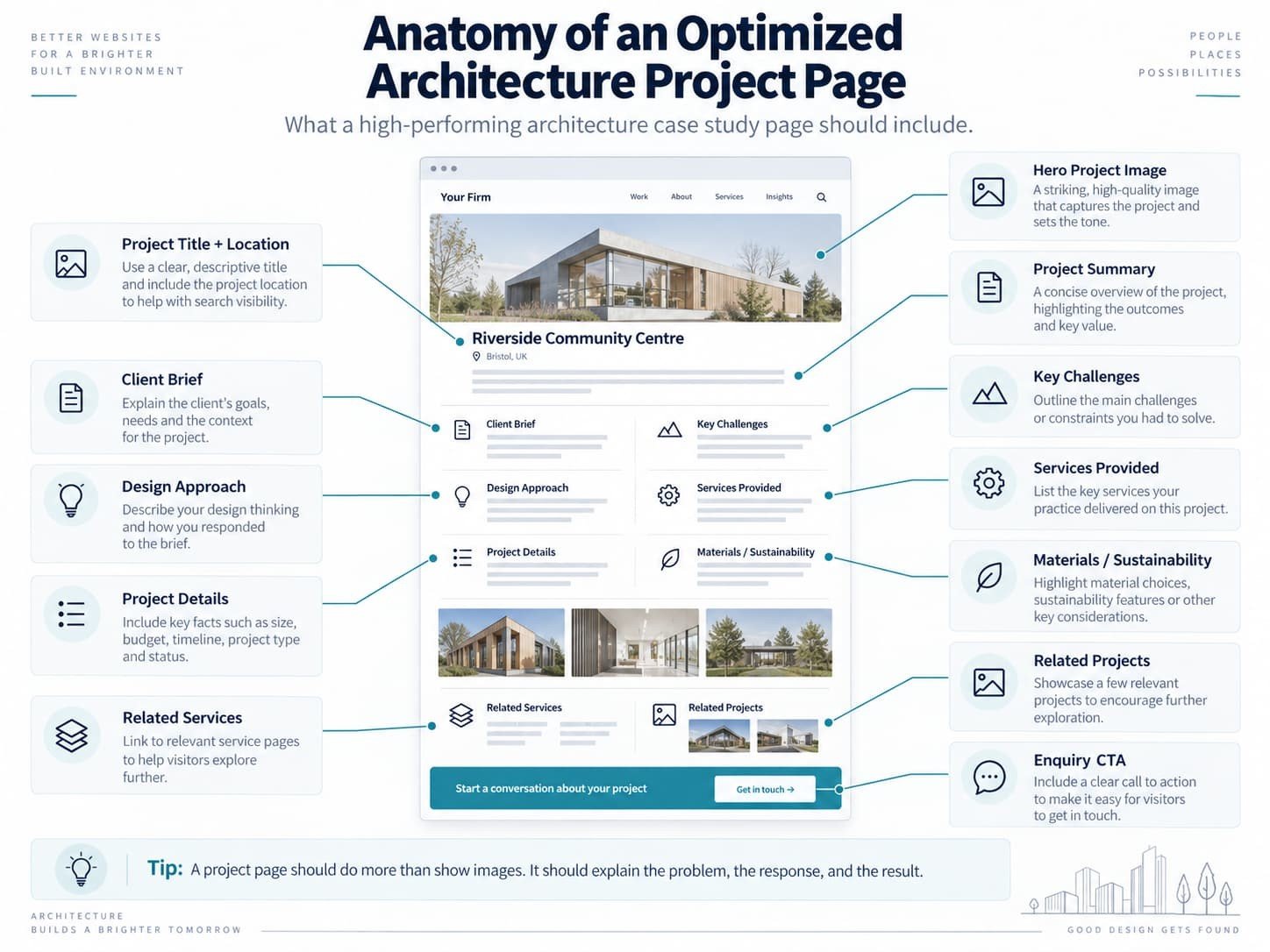
You do not need to turn every project into a long case study. But you do need enough text to explain what the project is and why it is relevant. Useful elements include:
- project type
- location
- client type, if appropriate
- scope of architectural services
- size or scale, if you are comfortable sharing it
- architectural challenge
- design goals
- site or planning constraints
- materials or systems, where relevant
- sustainability considerations, where relevant
- code, zoning, or adaptive reuse complexity, where relevant
- design approach
- outcome in non-promotional terms
Example structure for a stronger project page
Instead of:
“Maple Residence — Austin, Texas”
You might include:
- Custom residential renovation and addition in Austin;
- Scope included architectural design, interior architecture, and permitting coordination;
- Challenges included a narrow lot, daylight limitations, and the need to preserve portions of the original structure;
- The design focused on improved circulation, indoor-outdoor connection, and durable natural materials;
- Links to related pages: residential architecture, home renovation architect, Austin architect.
That gives both Google and the user meaningful signals.
Project pages should support service and sector pages
Your service page says what you do. Your project pages prove it.
If your firm wants visibility for “multifamily architect,” your multifamily page should link to relevant projects, and those project pages should link back to the multifamily page. The same logic applies to:
- luxury residential
- hospitality
- healthcare
- civic
- adaptive reuse
- sustainable design
- interior architecture
This connected structure is often more valuable than publishing large volumes of blog content unrelated to your actual work.
Don’t hide project details in images alone
Search engines do not interpret visual nuance the way design professionals do. A stunning image gallery does not automatically communicate:
- whether it was a renovation or ground-up project
- whether your role included interiors
- whether the building type was hospitality, mixed-use, or residential
- whether the project is in a target location
Text still matters. Also optimize the basics:
- descriptive image file names
- alt text that reflects the image and project context
- captions where helpful
- image compression and responsive formats so heavy pages still load efficiently
Local SEO for architecture firms
Local SEO is essential for many architecture firms, but it should be applied intelligently.
An architecture practice is not always a “local service business” in the same sense as a plumber or locksmith. Some firms serve one metro area. Others work regionally, statewide, or nationally. Some have one office but active projects in multiple markets. Your local SEO approach should reflect how clients actually evaluate your firm.
Google Business Profile matters
If you have a physical office where your business is established, your Google Business Profile can support visibility in map results and branded searches. That profile should be complete and accurate:
- business name
- address
- phone number
- website
- business category and relevant secondary categories where appropriate
- hours
- service descriptions
- photos
- updates if you use them
- reviews where ethically and practically appropriate
Google provides guidance on managing a profile through Google Business Profile Help. For architecture firms, this is especially useful for:
- branded searches
- “architect near me”
- “architecture firm + city”
- map pack visibility in core local markets
- trust signals when prospects evaluate your firm
Location relevance beyond your profile
Google Business Profile helps, but it is not enough on its own. Your website should reinforce local relevance through:
- city or regional service pages
- local project examples
- references to neighborhoods, regions, or jurisdictions where relevant
- consistent contact information
- local organization memberships, associations, or mentions
- publications and earned coverage tied to your market
When location pages make sense
Create a location page when:
- the location is strategically important
- you have real experience there or a credible service presence
- the page can say something useful beyond “we serve this city”
For example, a “Residential Architect in Houston” page could discuss:
- custom home and renovation work in Houston
- climate and site considerations
- neighborhood review or permitting realities where appropriate
- links to local projects
- related services such as renovation, custom homes, or interiors
When location pages do not make sense
Avoid creating dozens of city pages just to chase rankings if you have no meaningful relevance in those places. A page for every suburb, county, and nearby town with nearly identical text is one of the most common architecture SEO mistakes.
Technical SEO fundamentals for architecture websites
Technical SEO is not separate from design quality. It is part of how well your website works for both users and search engines. For architecture sites, the biggest technical issues often stem from highly visual builds, animations, custom transitions, video backgrounds, or JavaScript-dependent layouts.
Focus on these fundamentals.
Make sure pages can be crawled and indexed
Make sure important pages are accessible through standard navigation or internal links. If a critical page only appears through a complex interactive interface, search engines may have a harder time discovering or understanding it.
Keep site structure clean
Your navigation should make practical sense. A visitor should be able to move easily between:
- services
- sectors
- projects
- locations
- insights
If people have to click through a cinematic experience to find basic information, the site may be hurting both usability and SEO.
Improve load speed and performance
Architecture sites often suffer from oversized images, autoplaying videos, layered scripts, and fancy effects that slow down the experience. Performance matters because slow pages create friction, especially on mobile devices. Pay attention to:
- image compression
- next-gen image formats where supported
- lazy loading
- appropriately sized images
- limiting heavy third-party scripts
- avoiding unnecessary motion assets on key pages
Google’s PageSpeed Insights is a practical tool for evaluating performance.
Mobile usability
Many prospects first encounter your firm on mobile, even if they later review your portfolio more deeply on desktop. Your site should remain usable, legible, and navigable on smaller screens.
Indexation and duplication
Make sure the pages you want to rank are indexable, and avoid publishing multiple near-duplicate pages that target tiny keyword variations. For example, you usually do not need separate thin pages for:
- residential architect in City
- home architect in City
- custom home architect in City
Suppose all three pages say almost the same thing. One stronger page may be better.
Image SEO and performance for visually heavy architecture websites
Architecture SEO has a unique challenge: your best proof is visual, but visual content is often the site’s biggest technical burden. You need both beauty and accessibility.
Treat images as content, not decoration
For many firms, project imagery is the primary evidence of design capability. That means each image can contribute to relevance when properly handled. Practical image SEO steps include:
- use descriptive file names
- write useful alt text
- include project captions where appropriate
- organize images around clearly themed project pages
- avoid burying all context in hover effects or image overlays that disappear on mobile
Add surrounding text
An image of a hospitality lobby does not tell Google that the page is relevant to “boutique hotel architect in Charleston” unless the page text explains that context. Image SEO works best when the page also includes structured written context around the project.
Balance visual quality with speed
Do not upload enormous files when smaller responsive versions will do. The best architecture websites make image decisions deliberately:
- large enough to showcase detail
- compressed enough to avoid frustrating load times
- responsive for different devices
- prioritized so the most important visual content loads first
Building authority: links, mentions, publications, awards, and associations
Architecture firms build authority differently from many local businesses. You do not need random directory links or generic outreach blasts. More useful authority signals often come from the professional ecosystem around your work. Relevant sources of authority may include:
- design publications
- architecture associations
- local business journals
- chamber or economic development organizations
- industry partners
- university affiliations
- speaking engagements
- award listings
- project features
- conference profiles
- nonprofit boards or civic involvement where relevant
For example, if your project is featured in a recognized publication, or a respected industry body lists your firm, that mention can help both brand visibility and SEO. For professional credibility and standards context, architecture firms may also reference organizations such as the American Institute of Architects.
What to avoid
Avoid link-building tactics that look detached from your profession:
- buying links
- low-quality directories with no relevance
- mass guest posting on unrelated sites
- city-page networks
- artificial “top architect” badges with no editorial value
The best links for an architecture firm are usually the ones that make sense even if SEO did not exist.
Measuring SEO success for architecture firms
Architecture firms should not measure SEO success by traffic alone. The right metric is not “how many visits did we get?” It is “did organic search help us attract better opportunities?”
Useful metrics include:
- qualified inquiry volume from organic search
- consultation requests
- contact form submissions tied to target services
- RFP invitations or shortlist activity from organic discovery
- visibility for target service, sector, and location searches
- engagement with project and service pages
- growth in organic traffic to high-intent pages
- branded search lift over time
Use analytics and search performance tools to understand which pages attract the right visitors and which pages lead to meaningful action. Google provides free tools such as Google Search Console to review search queries, clicks, indexation, and page performance.
What to watch more closely than total traffic
A page that brings 50 relevant visitors a month and leads to serious residential inquiries may be more valuable than a blog post that brings 2,000 untargeted visits. Architecture SEO should be evaluated against:
- project fit
- service fit
- market fit
- lead quality
This is especially important for firms that don’t want more inquiries in general; they want more of the right inquiries.
Common SEO Mistakes Architecture Firms Make
Treating the Website as a Portfolio Only
Strong photography is essential, but images alone may not explain:
- What services the firm provides
- Where it works
- What role it played in a project
- What challenges it solved
- Why the work is relevant to a prospective client
The strongest sites combine visual proof with enough context to make that proof useful.
Hiding Services Behind Abstract Language
Words such as spaces, experiences, and environments may belong in the brand voice, but they should not replace clear descriptions of the services people search for.
Searchers still use terms such as:
- architect
- architecture firm
- residential architect
- commercial architect
- renovation architect
- architectural services
Good positioning and clear language can coexist.
Creating Thin Location Pages
Do not create dozens of city pages unless the firm can support them with meaningful local content and evidence. A page that exists only because a city name was inserted into a template rarely strengthens the website.
Ignoring Project Page Content
A project page with only images may miss opportunities to communicate project type, location, services, constraints, design thinking, and outcomes. The text does not need to be long. It needs to be specific.
Publishing Content Without Commercial Connections
Informational content should guide interested readers toward relevant services, projects, or next steps. Otherwise, the site may generate research traffic without helping prospective clients evaluate the firm.
Uploading Oversized Images
Architecture photography deserves high visual quality, but it doesn’t require sending unnecessarily large image files to every device. Plan image delivery as part of the website experience.
Making Unsupported Superiority Claims
Claims such as:
- best architect in Austin
- leading architecture firm
- award-winning architects without naming the award
Add little trust unless you support it with clear evidence. Specific proof is stronger than vague claims of superiority.
Neglecting Lead Quality
Growing traffic while attracting unsuitable projects is not a strong SEO outcome. Measure what happens after the inquiry.
Redesigning Without an SEO Migration Plan
Architecture firms often redesign sites more frequently than many other businesses because presentation matters so much. If URLs change or project pages disappear without proper redirects and migration planning, you can lose years of accumulated visibility during a visual upgrade.
FAQ
How long does SEO take for an architecture firm?
Timelines vary based on competition, the website’s starting point, the strength of the firm’s existing authority, and the work required. Some improvements may appear sooner, but meaningful growth in competitive service and location searches usually takes months, not weeks.
What should architects write about?
Focus on questions prospective clients ask while planning a project or deciding whether to hire an architect. Useful themes include process, feasibility, project planning, timelines, permitting, cost considerations, choosing an architect, and guidance tied to specific project types.
How is SEO different from Google Ads?
Google Ads can provide paid search visibility while a campaign is funded. SEO aims to build organic visibility over time through useful pages, technical quality, local relevance, project evidence, and authority. Some firms use both depending on goals and timing.
Conclusion
SEO for architects works best when it reflects how clients actually choose an architecture firm.
Prospective clients want to understand what the firm does, whether it has relevant experience, where it works, how it approaches projects, and whether the completed work proves the claims made on the website.
That means strong architecture SEO isn’t built around publishing more pages or stuffing more keywords. Start with the projects the firm wants more of, then build the search strategy around making that expertise easier to find and easier to trust.
The goal is not simply to attract more visitors. It is to help the right prospective clients discover the firm, recognize that its experience fits their project, and feel confident enough to start a conversation.