Local SEO for franchises focuses on making each franchise location visible in local search. The business information, branding, and optimisation are consistent across the entire network. It brings together Google Business Profiles, location pages, reviews, citations, and other local signals within a shared framework that can be managed at scale.
The challenge grows quickly as a franchise expands. Managing one location may be straightforward, but with dozens or hundreds of locations, profiles can become outdated, business information can drift, and responsibilities between the franchisor and franchisees may be unclear. An effective franchise local SEO strategy, therefore, requires more than optimising individual locations. It needs a system for managing them consistently while still giving each location enough local relevance to compete in its market.
Why Franchise Local SEO Requires a Different Approach
Local SEO becomes more complex as a franchise network grows. An outdated address, an unclaimed Google Business Profile, or a weak location page may be relatively easy to fix for one business. Still, across dozens or hundreds of locations, the same issues can quickly become difficult to identify and manage.
The main difference from conventional multi-location SEO is ownership. The franchisor typically controls the brand, website, and broader marketing strategy. At the same time, franchisees manage the individual locations and have access to the local information and customer relationships needed for effective local SEO.
| Single location | Multi-location business | Franchise system | |
| Execution ownership | Owner or one marketer | Central marketing team | Split between franchisor and franchisees |
| Page architecture | One site with few pages | One domain with location pages | Central location pages, sometimes alongside franchisee-managed sites |
| GBP structure | One profile | Multiple centrally managed profiles | Multiple profiles with shared or distributed management |
| Review management | Managed by the owner | Usually managed centrally | Shared between corporate and local teams |
| Marketing budget | One budget | Usually centralized | May be split between brand and local budgets |
How Google Ranks Local Results
Google identifies three main factors that determine local search rankings: relevance, distance, and prominence. Relevance describes how closely a business matches the search query; distance considers how far it is from the searcher or a specified location; and prominence reflects how established the business is, based on factors such as links, reviews, and information available across the web. You can find these factors in Google’s documentation on local rankings.
For franchise networks, this makes accurate and complete information at every location particularly important. Business categories, addresses, opening hours, reviews, and location-specific website content are signals to Google. With this info, Google can understand and rank individual locations.
Google does not publish the exact weight of individual local ranking signals. However, Whitespark’s 2026 Local Search Ranking Factors survey provides useful industry insights. The local SEO experts surveyed estimated that Google Business Profile signals account for around 32% of Local Pack ranking factors, followed by reviews at around 20% and on-page signals at around 15%.
For local organic results, on-page signals were considered the largest factor group. These figures are expert estimates rather than Google data, but they highlight why franchise SEO needs to address both Google Business Profiles and individual location pages.
Who Should Manage Local SEO in a Franchise?
One of the main challenges in local franchise SEO is determining who is responsible for each part of the process. The franchisor typically controls the brand, website, and broader marketing infrastructure. At the same time, franchisees have the local knowledge needed to keep opening hours, photos, reviews, and other location-specific information up to date.
Clear responsibilities are especially important for Google Business Profiles. For example, Google’s guidelines require businesses to use their real-world name consistently across locations in the same country. Standards such as naming, categories, and profile ownership are therefore easier to manage centrally, while information that changes at the location level can be maintained locally.
Franchise networks generally have three options for managing local SEO:
- Corporate-led: The franchisor manages profiles, location pages, reviews, and other local SEO activities centrally. This provides greater consistency but can make it harder to keep location-specific information up to date.
- Franchisee-led: Individual franchisees manage their own local presence. This provides more local control but makes it harder to maintain consistency across the network.
- Hybrid: The franchisor controls the infrastructure, standards, and core business information, while franchisees contribute and maintain location-specific information. This combines centralised oversight with local input.
For many franchise systems, the hybrid model provides a practical division of responsibilities:
| Corporate | Individual location | Shared responsibility |
| GBP ownership, naming standards, primary categories | Regular and holiday opening hours | Review responses and escalations |
| Location-page templates, schema, and domain | Photos and location-specific information | Citation management |
| Review-request process and guidelines | Customer relationships and review requests | Local links and sponsorship opportunities |
| Analytics and measurement infrastructure | Local marketing activities | New-location launch process |
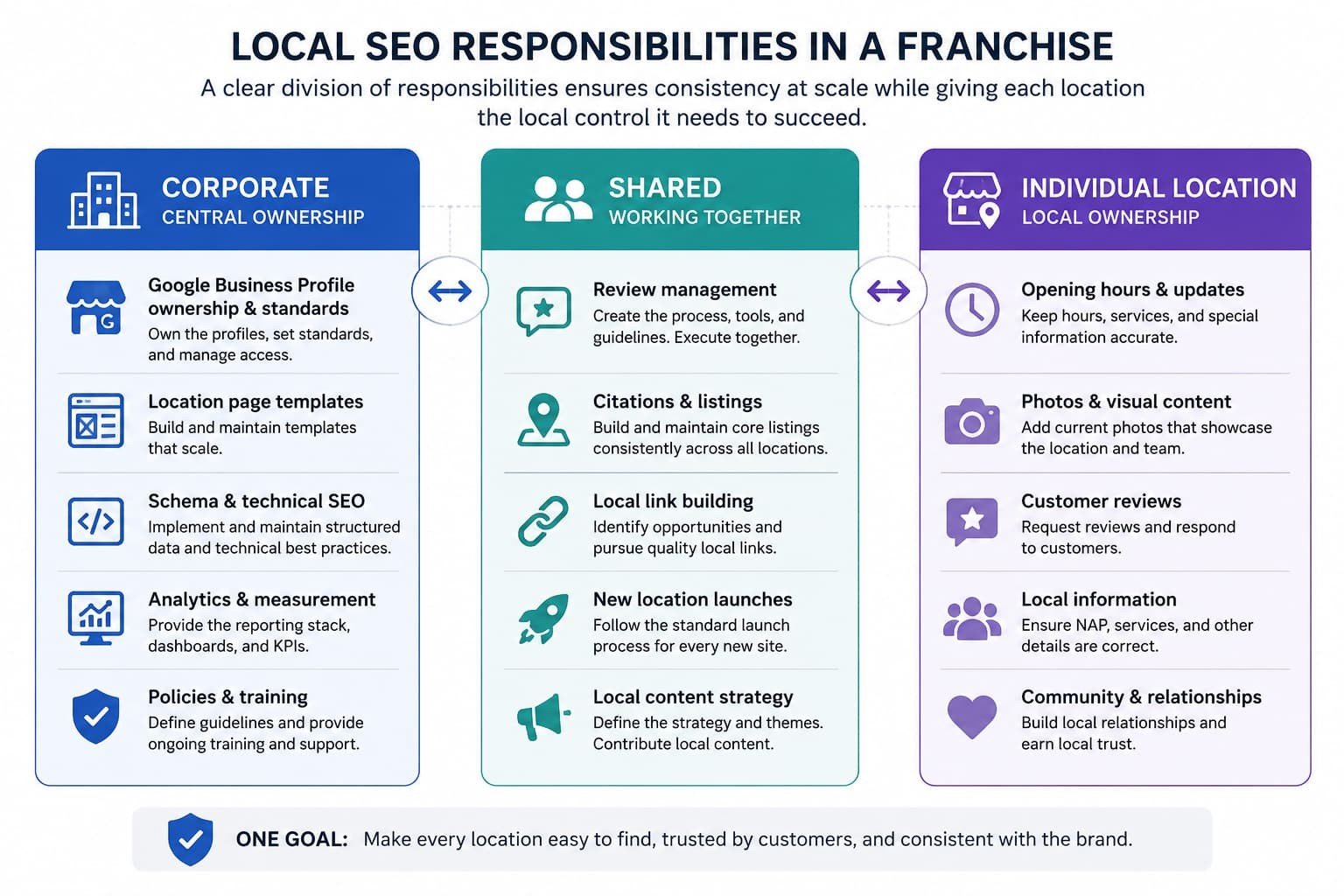
The goal is not to centralise every local SEO task, but to establish clear standards for the entire network while allowing individual locations to manage the information and activities that depend on local knowledge.
How to Manage Google Business Profiles Across Franchise Locations
Google Business Profiles are a core part of local visibility for franchise locations. As the network grows, managing them consistently becomes less about optimising individual profiles and more about establishing a structure for ownership, access, verification, and updates.
- Profile structure: Each eligible location should have its own verified Google Business Profile, while ownership and access are managed centrally where possible. Local managers can be granted access to maintain information, such as opening hours and photos, without taking ownership of the profile. For larger networks, store codes can also help keep locations organised during bulk management.
- Bulk verification: Businesses with 10 or more locations of the same brand may be eligible for bulk verification. Google requires locations to use consistent business names and categories, and the brand website should clearly list the locations being submitted. Service-area businesses are not eligible for this process. BrightLocal’s overview of bulk verification also notes that the process can take anywhere from several days to several weeks, depending on the account and verification requirements.
- Business names: Google’s Business Profile guidelines require the name on a profile to reflect the business’s real-world name. Adding city names, services, taglines, or other keywords solely for ranking purposes can violate these guidelines. Franchise networks should therefore establish a consistent naming standard rather than allowing individual locations to optimise their names independently.
Profile information also needs ongoing maintenance. Opening and holiday hours, categories, contact details, photos, and other location information should be reviewed regularly to ensure individual profiles do not become outdated as the network evolves.
Google has also changed some Business Profile features over time. The former Q&A feature, for example, was removed in late 2025, with answers increasingly generated from information available in the profile, reviews, photos, and website content.
Location Pages and Site Architecture
The structure of a franchise website affects both how easily individual locations can compete in local search and how efficiently the network can be managed as it grows. A clear architecture helps search engines understand the relationship between the brand and its locations while keeping authority, content, and technical SEO within a centrally controlled structure.
Each franchise location should have a dedicated page, supported by a central store locator that helps users and search engines find individual locations. Where possible, each Google Business Profile should link directly to its corresponding location page rather than a generic homepage.
Choose a URL Structure for Franchise Locations
There are three common ways to organise franchise locations, each with different SEO and management implications:
- Subdirectories: brand.com/locations/austin/. Keep location pages within the main website and allow the entire network to benefit from the same domain’s authority, internal linking, and technical infrastructure. They also make it easier to centrally manage templates, structured data, analytics, and site-wide SEO changes. For most franchise networks, this is the simplest and most scalable approach.
- Subdomains: austin.brand.com. Provide more separation between individual locations and may be useful when franchisees need greater control over their websites or technology. However, they create additional technical and SEO management requirements compared with keeping locations within the main site structure.
- Separate domains: brand-austin.com. give individual franchisees the greatest independence, but each website must build and maintain its own search visibility, content, links, tracking, and technical setup. Across a large franchise network, this can make SEO governance, reporting, and brand consistency considerably more difficult.
For most franchise brands, a subdirectory structure provides the best balance between local flexibility and centralised SEO management. It keeps individual location pages connected to the authority of the main brand website while allowing corporate teams to maintain consistent templates, technical standards, analytics, and internal linking across the network.
Build Useful Location Pages, Not City Variations
A location page should be useful to someone considering that specific franchise, not simply a copy of the same template with a different city name. The page should combine consistent brand information with details that distinguish the individual location, its services, and the market it serves.
For example, a plumbing franchise with a location in Austin could optimise the page around the services actually offered in that market:
- Title tag: Plumber in Austin, TX | [Brand Name]
- H1: Plumbing Services in Austin, TX
- URL: brand.com/locations/austin/
The rest of the page should then support that local relevance with information specific to Austin, rather than repeatedly inserting “Austin” into generic franchise copy.
A useful franchise location page can include:
- Location-specific services: Explain which services are available from that franchise. If the Austin location offers emergency plumbing, water heater repair, drain cleaning, and leak detection, those services can be described and linked to relevant service pages.
- Areas served: Mention relevant neighbourhoods, suburbs, or surrounding communities the location genuinely serves rather than creating a separate thin page for every geographic variation.
- Local team and experience: Introduce the franchise owner, local staff, certifications, years in business, and other details that help distinguish the location.
- Consistent business information: Display the business name, address, local phone number, and opening hours, keeping them consistent with the corresponding Google Business Profile.
- Location-specific reviews: Include genuine testimonials or reviews for that franchise rather than relying solely on brand-wide reviews.
- Local imagery: Use photos of the location, team, completed work, vehicles, or other relevant local material instead of relying entirely on corporate stock imagery.
- Directions and map: Provide an embedded map, directions, parking information, landmarks, or other details that genuinely help customers find the business where relevant.
- LocalBusiness structured data: Add LocalBusiness structured data using the most appropriate business type and information for that location.
- Clear conversion paths: Provide appropriate calls to action, such as click-to-call buttons, booking links, quote requests, or location-specific forms.
- Internal links: Connect the location page to relevant service pages, nearby locations where applicable, and the main store locator to ensure proper integration into the wider franchise website.
For example, instead of creating a generic paragraph such as “We provide professional plumbing services in Austin,” the page could explain that the Austin team provides emergency leak detection and water heater repair across specific service areas, introduce the local team, show recent work, and include reviews from customers served by that location. The template can remain consistent across the franchise network, while the information that makes each location useful and locally relevant varies from page to page.
Google’s spam policies identify pages created primarily to rank for similar city- or regional-level queries and funnel visitors elsewhere as doorway abuse. The objective is therefore not to make every sentence different simply for SEO, but to give each location page enough genuine local information to deserve its own page.
Citations and NAP Consistency
Each location’s name, address, and phone number (NAP) should remain accurate across the brand website, Google Business Profile, major directories, data aggregators, and relevant industry platforms.
Incorrect listings can also directly affect customers. In BrightLocal’s research on inaccurate business information, 62% of consumers said they would avoid using a business if they found incorrect information online.
Managing Reviews Across Franchise Locations
Reviews need to be managed at the location level rather than only as a network-wide metric. A franchise may have thousands of reviews overall while individual locations have few recent reviews or significantly lower ratings.
Recent reviews are particularly important to consumers. In the BrightLocal Local Consumer Review Survey 2026, 74% of respondents said they only consider reviews written within the previous three months. 47% of the respondents said they would not use a business with fewer than 20 reviews.
Review generation also needs clear compliance rules:
- Businesses can ask customers to leave genuine reviews, but offering incentives in exchange for reviews or purchasing them can violate Google’s policies on fake engagement.
- The FTC’s rule on fake reviews and testimonials prohibits practices such as fake reviews, certain paid reviews tied to a particular sentiment, and undisclosed reviews by company insiders. Franchise systems should ensure that corporate and individual locations follow the same review guidelines.
Local Keyword Strategy for Franchise SEO
Keyword research for a franchise network needs to account for both the services offered across the brand and the differences between individual markets. The same service may have different search demand, terminology, and competition from one city to another, so simply applying a single national keyword list across all locations can miss valuable opportunities.
Build the Keyword Strategy in Layers
A scalable franchise keyword framework can include several types of searches:
- Brand + location keywords: Searches such as [Brand] Austin or [Brand] near me help users find a specific franchise location. These queries should normally lead searchers to the relevant location page or store locator.
- Service + location keywords: These combine a service with a geographic modifier, such as water heater repair Austin, emergency plumber Austin, or drain cleaning in Austin. They often represent strong commercial intent and can be mapped to location or local service pages depending on the site’s structure.
- Category + location keywords: Broader searches such as “plumber Austin” or “plumbing company Austin” describe the overall type of business rather than an individual service. The primary location page is often a natural target for these terms.
- Problem-based searches: Customers do not always search for a service by name. They may search for the problem they are experiencing, such as why their water heater keeps turning off or why they have low water pressure in the house. These searches can identify useful informational topics that support service pages and introduce potential customers to the brand earlier in their decision process.
- Local competitor and market research: Competitor research can reveal services, terminology, content topics, and local search opportunities that established businesses are already targeting in a particular market. The objective is not simply to reproduce competitor keywords, but to identify gaps or patterns that deserve further research.
Map Keywords to the Right Pages
Once the keyword groups are identified, they should be mapped to specific pages rather than distributed across the website without a clear target.
For example, an Austin plumbing franchise might use the following structure:
| Search intent | Example keyword | Suggested page |
| Brand + location | [Brand] Austin | Austin location page |
| Category + location | plumber Austin | Austin location page |
| Service + location | water heater repair Austin | Local water heater service page, where justified |
| Service + location | emergency plumber Austin | Relevant local emergency plumbing page or Austin location page |
| Problem-based | why does my water heater keep turning off | Informational guide linked to the relevant service |
This mapping helps prevent several pages from targeting the same search intent and gives each location a clearer role within the wider website architecture.
Research Each Market Instead of Copying the Same Keyword List
The framework can be standardised across the franchise, but the final keyword set should be validated for each important market. Customers may describe the same service differently, certain services may have higher demand in particular regions, and local competitors may pose varying levels of difficulty.
For example, a national plumbing franchise might use the same service taxonomy across its website, but keyword research could show that water heater repair deserves greater prominence in one market while emergency leak detection or drain cleaning presents a stronger opportunity in another. The underlying franchise SEO framework remains consistent, while local search data determines which services and topics receive greater emphasis.
The goal is therefore not to create an entirely different SEO strategy for every franchisee. It is to establish a repeatable keyword framework centrally, then use local search data to adapt that framework to the opportunities in each market.
Measuring Performance Across Franchise Locations
Franchise SEO performance should be measured at both the individual-location and network level. Brand-wide averages can make it difficult to identify locations with declining visibility, incomplete profiles, weak pages, or other local issues. Tracking each location separately. This will make it easier to identify where improvements are needed and then compare performance across the network.
A practical measurement setup can include:
- Google Business Profile performance data: monitor interactions such as calls, direction requests, and website clicks for individual locations.
- UTM-tagged website links: add tracking parameters to GBP links to distinguish traffic generated by individual profiles in your analytics platform.
- Google Search Console: monitor queries, impressions, and clicks for individual location pages or groups of location URLs.
- Local rank tracking: measure rankings by location within the areas each franchise serves, rather than relying on a single ranking for the entire brand.
- Call tracking: where phone calls are an important source of leads, location-specific tracking can help attribute inquiries to individual locations.
AI Search and Franchise Visibility
AI-powered search is becoming another way consumers discover local businesses. In BrightLocal’s 2026 Local Consumer Review Survey, 45% of US consumers said they had used AI tools for local business recommendations, up from 6% in the previous year’s survey.
Changes to Google Business Profiles point in the same direction. After Google removed the former Q&A feature, answers to some business questions can instead be generated from information available across sources such as the Business Profile, reviews, photos, and the business website.
The practical approach is largely the same as for traditional local SEO:
- maintain accurate profiles,
- create useful location pages,
- keep business information consistent,
- build genuine reviews for each location.
AI visibility should be treated as an additional outcome of a strong local presence rather than a separate optimisation strategy.
What to Fix First in Franchise Local SEO
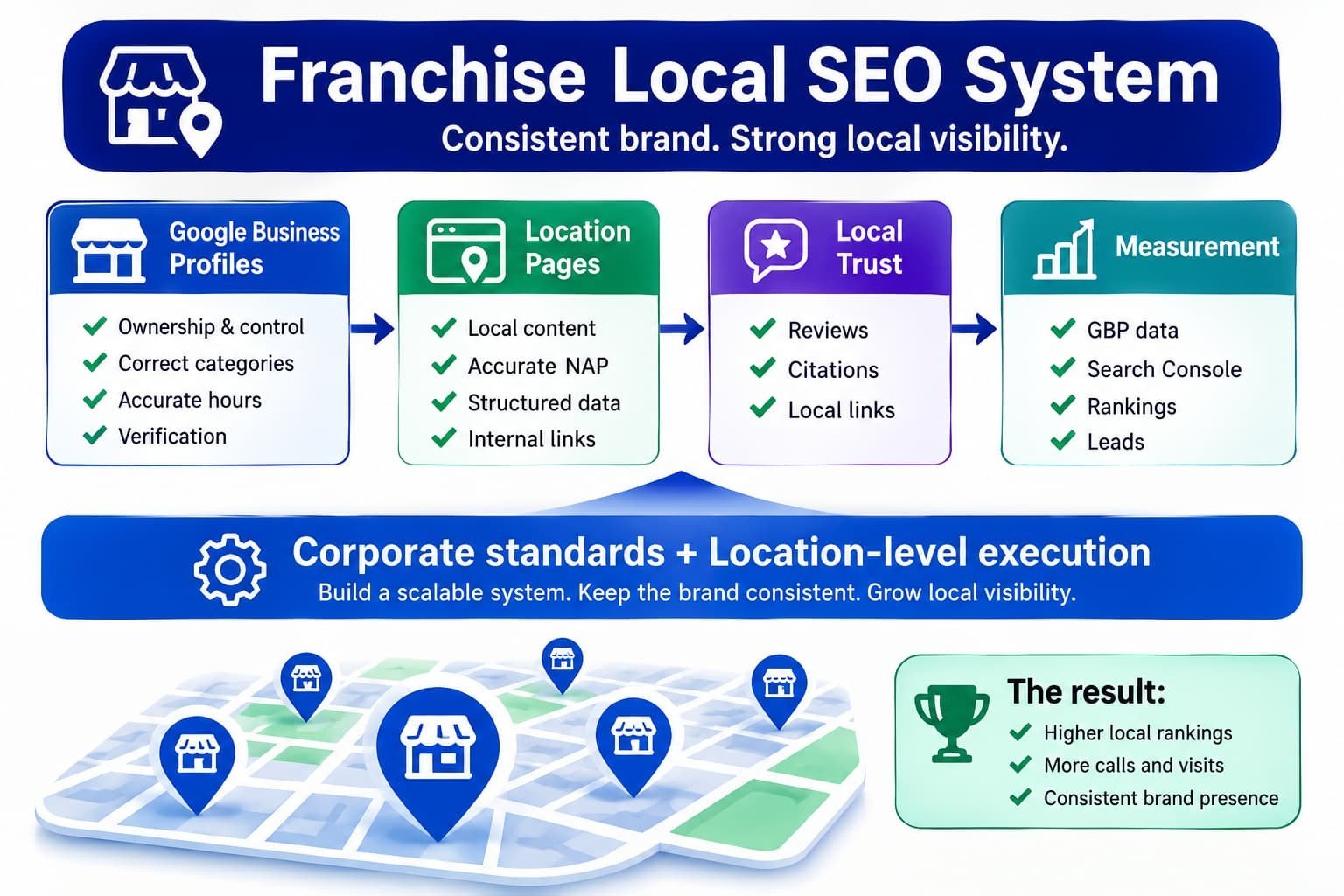
Common problems include:
- Duplicate or independently created Google Business Profiles that create confusion around the official listing and may split reviews between profiles.
- Inconsistent business information across the website, Google Business Profiles, and important directories.
- Weak or near-identical location pages that offer little information specific to each location.
- Uneven review activity that is hidden when performance is evaluated only at the brand level.
- Limited location-level measurement, making it difficult to identify underperforming locations.
FAQs
How long does Google Business Profile bulk verification take?
The process can take anywhere from several days to several weeks, depending on the account and verification requirements. Businesses with 10 or more locations of the same brand may be eligible for bulk verification. Google also expects consistent business information and a website that clearly lists the locations being submitted BrightLocal provides an overview of the bulk verification process and common requirements.
Can franchise location pages use the same template?
Yes. Using the same layout or page template across franchise locations is not inherently an SEO problem. The important part is that each page provides useful information about the individual location rather than simply changing the city or location name. Pages created primarily to rank for similar geographic searches and funnel users elsewhere may fall under Google’s doorway-abuse policy.