Online travel agencies (OTAs) typically take a 15 to 25 percent commission on every booking they deliver, and search is where the direct-booking alternative is won or lost. This SEO playbook for hotels helps you make three decisions well: what to fix first at your property, what to delegate, and how to prove results to ownership with numbers that hold up.
It is written for marketing managers at US independent hotels, boutique properties, and small chains, usually on teams of one to five people. Three things make it different: US market specifics with dated sources, honest criteria for when DIY makes sense and when it does not, and a one-page measurement scorecard you can put in front of a GM.
What Is SEO for Hotels?
SEO for hotels is the practice of making a property visible and bookable across the three Google surfaces guests use to find lodging: the local map pack, Google Hotel Search with its free booking links, and classic organic results. The goal is more direct bookings at a lower acquisition cost than the OTA channel.
Hotel SEO differs from generic SEO in three ways. First, hotels are a special local category in Google: the local pack draws its data primarily from your Google Business Profile (GBP), per Google’s help documentation. Hence, profile completeness is an eligibility issue rather than a nice-to-have. Second, the booking transaction usually occurs through a third-party booking engine, which introduces technical and measurement wrinkles that most industries never face. Third, in almost every query, your competition includes OTAs with enormous domain authority.
SEO sits alongside paid channels and OTAs in the distribution mix; it is the channel that compounds rather than stopping when spend stops.
In practice, hotels rarely replace OTA bookings with SEO overnight. The properties that succeed usually improve their channel mix gradually by capturing more branded searches, local intent, and repeat visitors.
Why Hotel SEO Pays: The Direct-Booking Economics
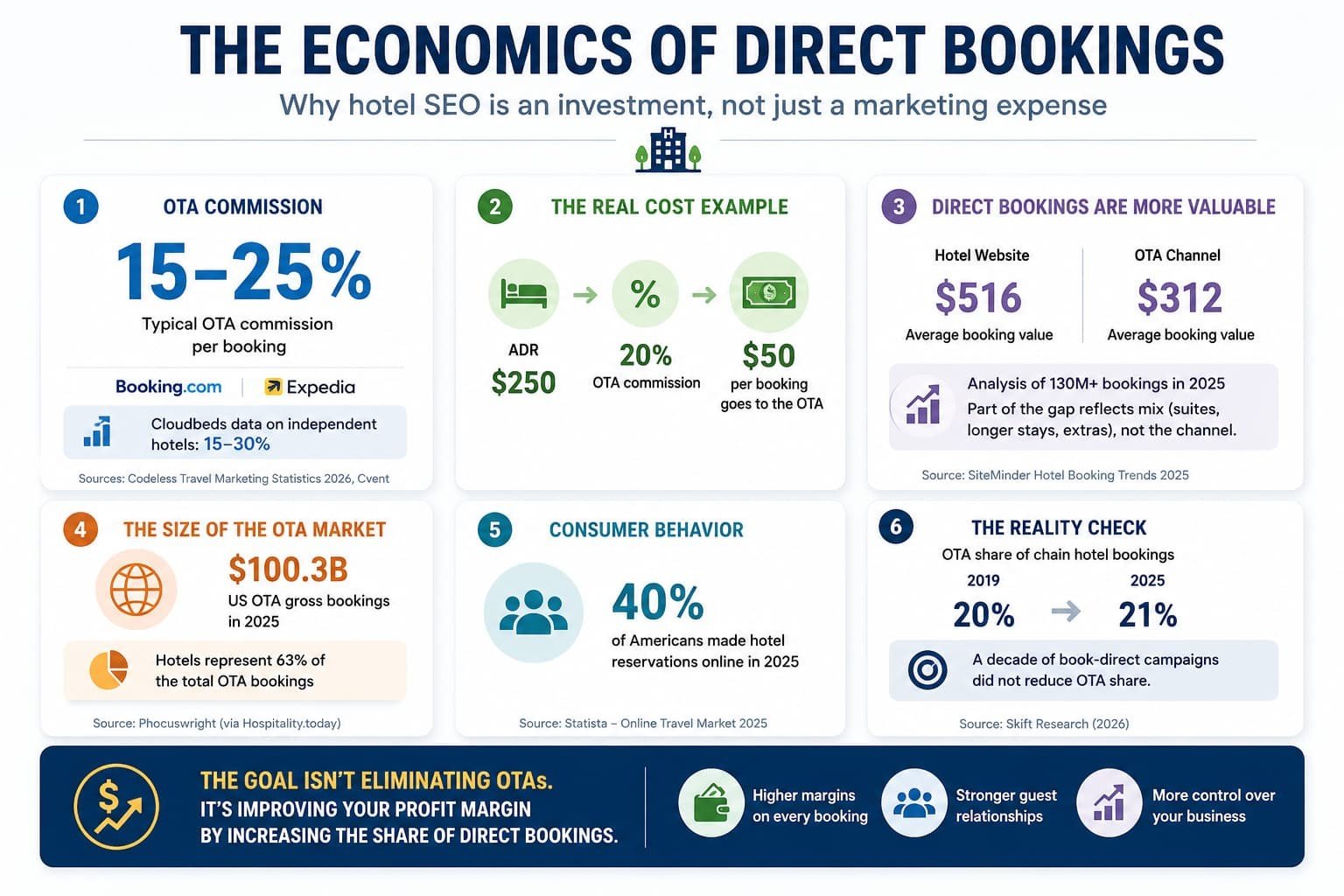
Start with the cost you already pay. Major OTAs such as Booking.com and Expedia typically charge 15 to 25 percent commission per booking, and Cloudbeds data on independent hotels puts the band at 15 to 30 percent, according to figures compiled in the Codeless Travel Marketing Statistics 2026 report and corroborated by Cvent. At a $250 average daily rate (ADR), a 20 percent commission hands $50 of every room night to a third party. To be fair, OTAs also drive discovery: a 2009 Cornell study estimated an OTA listing lifted a hotel’s own-channel reservations by 7.5 to 26 percent (the “billboard effect”), and a 2017 follow-up found 30 percent of direct bookers still began research on an OTA, as summarized by Cloudbeds.
The direct channel is also worth more per transaction. SiteMinder’s Hotel Booking Trends analysis of more than 130 million bookings found hotel websites averaged $516 per booking in 2025 versus $312 via OTAs. However, part of that gap reflects mix (suites, longer stays, extras), not the channel itself (SiteMinder).
US OTA gross bookings reached $100.3 billion in 2025, and hotels represent 63 percent of the OTA book, according to Phocuswright research reported by Hospitality.today. Nearly 40 percent of US consumers made hotel reservations online in 2025, per Statista.
Set expectations honestly: a decade of chain book-direct campaigns did not shrink OTA share, which held at about 20 percent of chain bookings in 2019 and 21 percent in 2025, per Skift (2026). The realistic goal of hotel SEO is better margins and a healthier channel mix, not eliminating OTAs. That mix is the business case for spending to increase direct hotel bookings. If you want a second opinion on where your property loses bookings in search, you can request a consultation about our hotel SEO services.
Where Should You Start?
If your time or budget is limited, resist the urge to tackle everything at once. The biggest gains usually come from fixing the parts of your search presence that directly influence bookings rather than adding more content.
- If your Google Business Profile is incomplete: start there before investing in broader SEO efforts.
- If your booking engine creates technical barriers: resolve crawlability and measurement issues before publishing new pages.
- If your visibility is already solid: expand into destination content, digital PR, and authority-building to capture additional market share.
Think of hotel SEO as a sequence of priorities. Hotels that establish strong local visibility and technical foundations first usually see better returns from later investments in content and authority building.
Most hotels do not struggle because they are doing too little. They struggle because they are trying to improve everything at once. The framework below outlines where to focus first to maximize the impact of direct bookings.
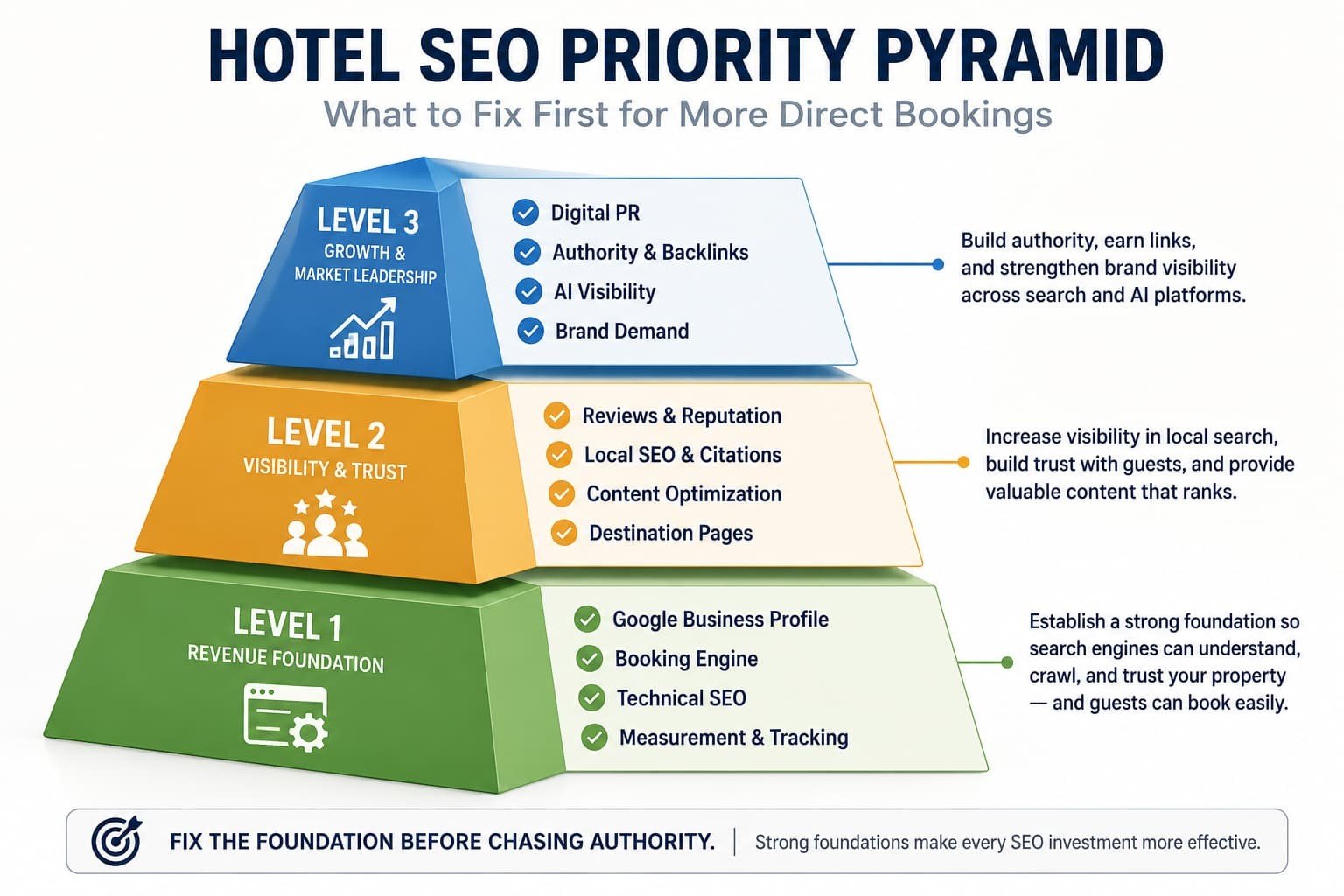
The rest of this guide follows the same progression, starting with the revenue foundation before moving into visibility and long-term growth.
Where Hotels Actually Win in Search
Before tactics, see the playing field: a hotel query in Google produces up to four distinct surfaces.
- The local pack: the map unit with roughly three listings, fed by Google Business Profile data. Usually the fastest surface for an independent property to influence.
- Google Hotel Search: the booking module where free booking links appear below paid hotel ads, ordered by relevance rather than auction, per Google’s product documentation as described by Metadesk.
- Classic organic results: the blue links, where your pages compete against OTAs and destination content.
Prioritization follows: branded queries and “hotels in [city]” head terms are contested by OTAs with massive authority. Local and long-tail queries, where your property’s specifics match what the guest typed, are where independents win first.
A Note on AI Answers
Travelers increasingly encounter AI-generated answers before any of these surfaces: 56 percent of US travelers used AI tools for at least one trip in the prior 12 months, per Phocuswright research from March 2026 as reported by RateGain. The practical takeaway is simple: the same inputs that drive classic SEO, meaning consistent business data, reviews, and clear site content, also feed AI answers. Doing the fundamentals well covers both.
Original destination guides, seasonal recommendations, and genuinely useful local content remain valuable because they help both search engines and AI systems understand why your property is a relevant recommendation for specific travelers.
Hotels that publish original local knowledge, maintain accurate business information, and earn authentic guest reviews are far more likely to be cited by AI-generated search experiences than properties relying on generic destination content.
Win the Local Pack: Google Business Profile and Reviews
For most US properties, the local pack is the highest-impact, fastest-moving surface. Google documents exactly three local ranking factors: relevance, distance, and prominence. Distance is a constraint, not a lever; Whitespark’s 2026 Local Search Ranking Factors survey, which reflects practitioner estimates rather than Google data, treats proximity as the largest influence, and you cannot move your building. So the work concentrates on relevance and prominence.
Set Up Google Business Profile Correctly
Choose the most specific primary category available, which Whitespark’s 2026 survey ranks as the top controllable GBP signal for the local pack. Complete the amenities, attributes, and booking link fields so guests land on your booking engine rather than an OTA. Photos matter commercially: listings with photos drew 42 percent more direction requests and 35 percent more website clicks than listings without, in a 2017 Google/Ipsos study cited by DAC Group.
- Claim and verify the profile
- Choose the most specific primary category
- Complete every amenity and attribute field
- Add the direct booking link
- Upload current photos and refresh seasonally
- Match name, address, and phone to your website exactly
- Set accurate check-in and check-out details
- Build a steady review flow and check monthly for unauthorized edits
If that list outgrows your team’s bandwidth, our Google Business Profile optimization service absorbs it.
For example, a boutique hotel with only 40 rooms may gain more visibility simply by replacing outdated winter photos with current seasonal imagery, completing every amenity field, and consistently replying to new reviews.
Build a Review Engine
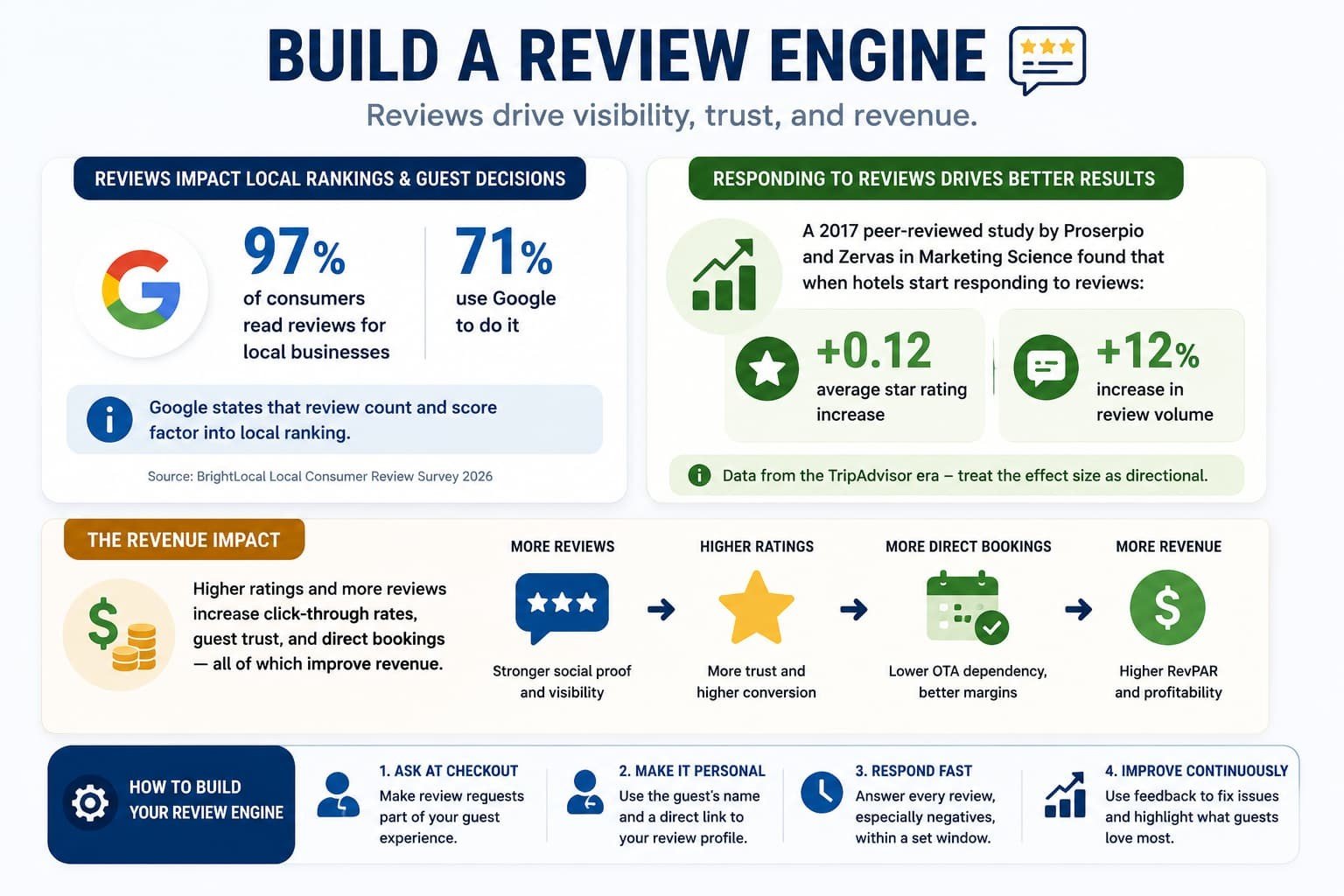
Google states that review count and score factor into local ranking, and guests notice: 97 percent of consumers read reviews for local businesses, and 71 percent use Google to do it, per the BrightLocal Local Consumer Review Survey 2026.
A 2017 peer-reviewed study by Proserpio and Zervas in Marketing Science found that when hotels start responding to reviews, ratings rise about 0.12 stars and review volume grows about 12 percent (abstract). The data are from the TripAdvisor era, so treat the effect size as directional. In practice, ask at checkout, make the ask personal, and respond to every negative review within a set window.
Keep Your Business Data Consistent
Google ties prominence to “information Google has about a business from across the web, like links, articles, and directories.” Consistent name, address, and phone (NAP) data is the input you control. Prioritize high-quality US sources, such as your state tourism site and local convention and visitors bureau, and do not expect citation cleanup alone to improve rankings.
For flagged properties: franchise marketers usually control GBP and reviews even when they cannot touch brand.com; that is where to start with hotel local SEO.
Win Google Hotel Search: Free Booking Links
- Google introduced free booking links in March 2021: unpaid booking slots inside the hotel booking module, below the paid hotel ads. Paid ads appear as featured options; free links sit under the broader list of booking options, ordered by relevance rather than bids, per Google’s announcement covered by TravelVoice. (Google Hotel Ads is the paid counterpart; we stay on the unpaid side here.)
- The dependency is connectivity: free booking links require rate and availability data flowing to Google through your booking engine or an integration partner, plus accurate pricing under Google’s Price Accuracy policy. Markup does not supply that feed, which is why “just add Offer schema” advice does nothing here.
If you are unsure whether your booking engine exposes room inventory, pricing, and booking pages in a search-friendly way, a technical SEO audit is usually the fastest way to identify hidden crawlability and indexing issues.
Pricing accuracy is also a legal question now: the FTC’s Rule on Unfair or Deceptive Fees, effective May 12, 2025, requires upfront total-price display, including mandatory fees, for short-term lodging, per law-firm analyses, including JD Supra’s. Confirm your obligations with counsel; this is not legal advice.
The surfaces where free booking links render have evolved since 2021, so verify current placement against Google’s Hotel Center help rather than any screenshot.
How to Decide Whether This Should Be Your Priority
Not every hotel will see the same return from improving Google Hotel Search visibility.
- Make it a high priority if your property already receives strong branded search demand but relatively few direct online bookings.
- Treat it as a medium priority if your biggest challenge is still local visibility or review generation.
- Move it lower on the list if your booking engine cannot yet provide reliable pricing, availability, or measurement data.
In other words, free booking links amplify an already healthy direct-booking strategy. They rarely compensate for weak local visibility or technical issues elsewhere.
Win Classic Organic: Keywords, Content, and Technical Foundations
Classic organic is where SEO for hotel websites compounds.
Build a Keyword Map Around How Guests Search
Hotel keyword research starts with a split: branded queries (your hotel’s name) versus non-branded ones. Non-branded demand sorts into intent tiers: location, amenity, experience, and event. Local intent converts: 76 percent of people who run a “near me” search on a smartphone visit a related business within 24 hours, per Think with Google research from 2016 to 2019, cited by BizIQ.
Map each keyword group to one page, as in this fictional example: the Riverhouse Inn, a 120-room independent hotel in Asheville, North Carolina.
| Example query | Intent tier | Target page |
| hotels in downtown Asheville | Location | Homepage or location page |
| pet friendly hotel downtown asheville | Amenity | Pet policy landing page |
| romantic getaways asheville nc | Experience | Romance package page |
| hotel near biltmore estate | Location/attraction | Biltmore area guide page |
| asheville fall foliage weekend | Event/seasonal | Seasonal events page |
Get the Pages and On-Page Basics Right
Every room, amenity, and location page needs a unique, descriptive title element (the title tag) mapping to search demand; Google documents this and may rewrite a poor title with one of its own choosing, per its title link guidance. One worked example:
- Before: “Home | The Riverhouse Inn”
- After: “Boutique Hotel in Downtown Asheville, NC | The Riverhouse Inn”
Link destination content to room and package pages so authority flows toward the booking pages.
Publish Destination Content That Earns Its Rankings
- The demand is upstream: 59 percent of travelers had no specific destination in mind, or were weighing several, when they began planning, and travelers viewed an average of 141 pages of travel content in the 45 days before booking (277 pages for US travelers), per Expedia Group’s 2023 Path to Purchase research.
- The guardrail: Google’s people-first guidance rewards demonstrable first-hand knowledge. A hotel’s real local expertise, meaning staff itineraries and current event details, qualifies; rewritten top-ten lists do not. Put event and seasonal pages on an annual refresh cycle: keep the URL, update, republish. See our guide to hotel content marketing.
Fix the Hotel-Specific Technical Basics
- Prioritize mobile: it accounts for roughly 70-80% of hotel website traffic, per the D-EDGE Hotel Distribution Report 2024 and Statista device data. Google’s Core Web Vitals give pass marks: LCP at or under 2.5 seconds, INP at or under 200 milliseconds, CLS at or under 0.1, measured at the 75th percentile of real users (web.dev); they largely act as a tiebreaker between comparable pages.
- Audit the booking engine: Google documents that JavaScript-rendered content is indexed with delay, links must be crawlable anchors, and content in third-party iframes is indexed under the iframe’s URL, not your page. Room and rate landing pages should be server-rendered with crawlable links into the booking flow; test with URL Inspection in Search Console. This is what a technical SEO audit covers.
Structured data exposes property facts in machine-readable form: schema.org’s LodgingBusiness and Hotel types carry properties such as checkinTime, checkoutTime, and amenityFeature, and markup must match visible content. One compact JSON-LD block for the example property:
{
“@context”: “https://schema.org”,
“@type”: “Hotel”,
“name”: “The Riverhouse Inn”,
“address”: {
“@type”: “PostalAddress”,
“streetAddress”: “123 River Street”,
“addressLocality”: “Asheville”,
“addressRegion”: “NC”,
“postalCode”: “28801”,
“addressCountry”: “US”
},
“telephone”: “+1-828-555-0123”,
“checkinTime”: “16:00”,
“checkoutTime”: “11:00”,
“amenityFeature”: [
{
“@type”: “LocationFeatureSpecification”,
“name”: “Free Wi-Fi”,
“value”: true
},
{
“@type”: “LocationFeatureSpecification”,
“name”: “Pet friendly”,
“value”: true
}
]
}
Remember that the booking engine is not just a reservation system. It is one of the most important SEO assets on a hotel website because every improvement to its crawlability, usability, and measurement directly affects your ability to generate more direct bookings.
Validate with Google’s Rich Results Test and re-check after template changes. Be clear about the payoff: hotel schema markup helps search engines parse property facts. Still, Google’s hotel surfaces are fed primarily by GBP and pricing feeds, so markup alone will not put you into hotel rich results.
Earn Links and Mentions
Among backlink factors, unique referring domains correlate most strongly with rankings, per an Ahrefs analysis of roughly 920 million pages (Ahrefs); that is correlation, not a confirmed Google weight. Hotel-realistic sources: local media, tourism boards, event and conference sites, and university visitor pages. One compliance line: comped stays and paid placements count as compensation, and those links should be qualified with rel=“sponsored” (or nofollow) per Google’s spam policies.
How Long Hotel SEO Takes and How to Measure It
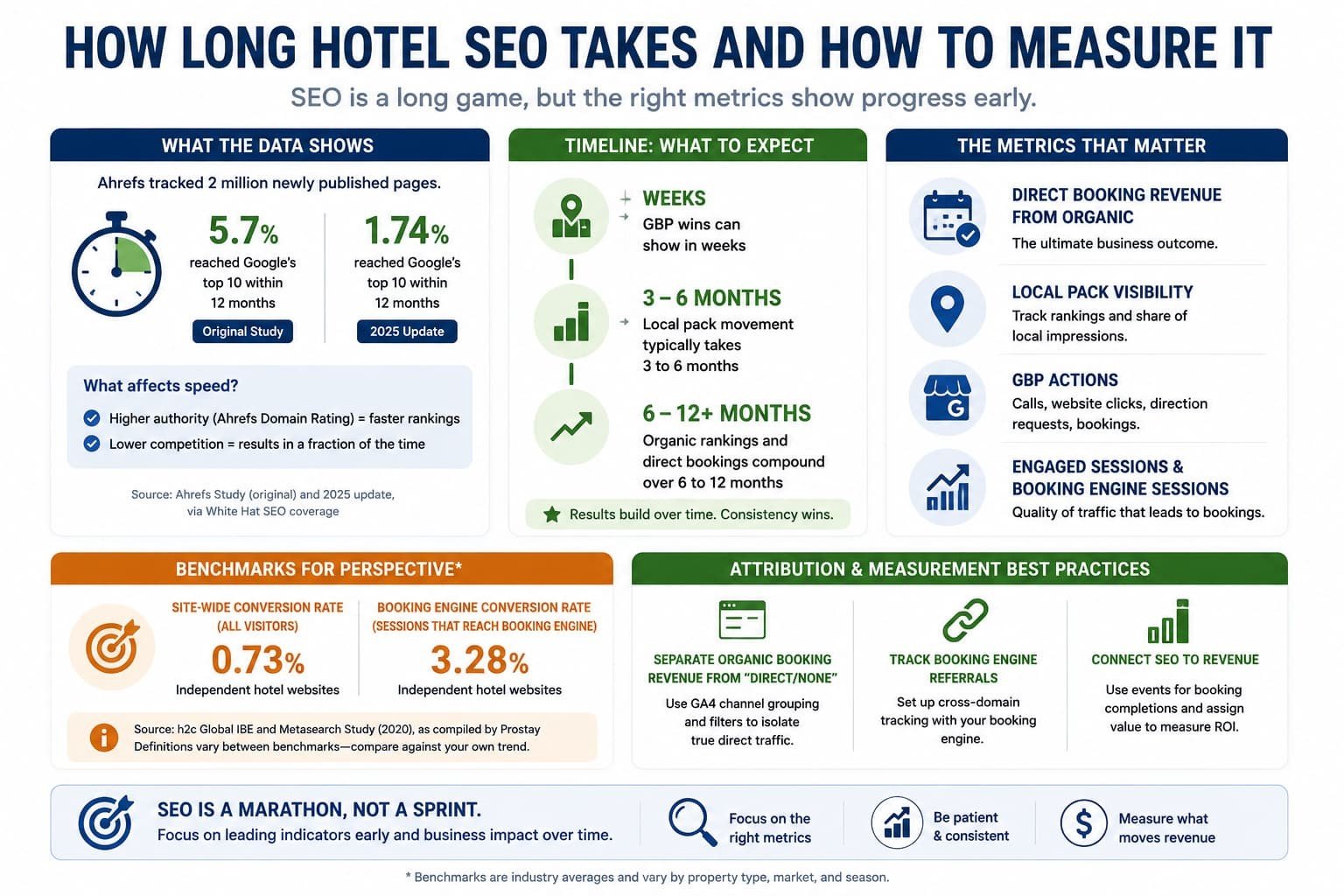
Ahrefs tracked two million newly published pages and found only 5.7 percent reached Google’s top 10 within a year; a 2025 update of the study puts the figure at 1.74 percent, per secondary coverage by White Hat SEO of the Ahrefs study. Speed depends on authority and competition: pages on high-Domain-Rating sites (an Ahrefs metric, not a Google one) ranked faster, and low-competition terms were reached in a fraction of the time.
Translated into hotel terms as industry convention, not a guarantee: GBP wins can show in weeks, local pack movement typically takes three to six months, and organic gains compound over six to twelve months.
The metrics that matter are direct booking revenue from organic, local pack visibility, and GBP actions, not raw traffic. For a baseline, the h2c Global IBE and Metasearch Study (2020), as compiled by Prostay, put independent hotel websites at about 0.73 percent site-wide conversion and about 3.28 percent for sessions reaching the booking engine; definitions vary between benchmarks, so compare against your own trend. On attribution: in GA4, separate organic direct bookings from “direct/none” traffic and use booking-engine referral tracking.
Review volume and average rating deserve a permanent place in your monthly SEO reporting because they influence both guest confidence and local search visibility over time.
A one-page monthly scorecard keeps ownership focused (see marketing reporting):
| Metric | Source | Direction you want |
| Organic sessions | GA4 | Up trend |
| Organic booking-engine entries | GA4 referral tracking | Up trend |
| Organic direct booking revenue | Booking engine reports | Up trend |
| Local pack presence for 3 tracked queries | Monthly check, rank tool, or Google Search Console | Present in more queries |
| GBP calls and direction requests | GBP performance reports | Up trend |
| Review count and average rating | GBP | Steady inflow, stable rating |
If only one metric improves while the others remain flat, avoid concluding too quickly. Hotel SEO works best when local visibility, bookings, reviews, and revenue improve together over time.
Should You Do Hotel SEO In-House or Hire an Agency?
A realistic in-house scope for a one-to-five-person hotel marketing team, alongside everything else the team owns:
- Google Business Profile management and photo hygiene
- Review responses and the checkout ask
- Basic on-page work: titles, headings, internal links
- Simple destination content from genuine staff knowledge
What usually belongs with a specialist or agency:
- Technical audits of booking engine indexation and rendering
- Structured data implementation and validation
- Link acquisition and digital PR
- Measurement architecture connecting organic sessions to booking revenue
Competent agency work has a recognizable shape: a documented process, hotel-specific technical checks, reporting tied to booking revenue rather than traffic, and realistic timelines.
Red flags in a hotel SEO proposal: guaranteed rankings, no hotel-specific references you can call, reporting built on traffic alone, and no plan for giving you direct access to your Search Console and GBP data. Cost, scope, and market drive the range, and we will not quote figures here.
If you are weighing hotel SEO agency vs in-house right now, that is exactly what a consultation is for: a look at your property’s search presence, an honest read on what your team can absorb, and what outside help would cover. Request a hotel SEO consultation.
A Simple Decision Framework
A useful rule of thumb is to separate execution from expertise.
- Keep recurring marketing tasks such as Google Business Profile updates, review responses, and content publishing in-house whenever possible.
- Bring in specialists for technical audits, booking engine SEO, structured data implementation, and measurement setup, areas where mistakes can directly affect bookings or search visibility.
If your internal team spends more time diagnosing technical SEO problems than executing marketing activities, it is usually a sign that outside expertise will generate a better return than additional internal effort.
Common Hotel SEO Mistakes
Two documented failure patterns come up most often:
- Mistake 1: Letting the booking engine hide your inventory. What it looks like: room and rate content sits in a third-party iframe or JavaScript-only flow, so Google indexes it under the engine’s URL, if at all. Why it happens: the engine was chosen for operations, not search. The fix: server-rendered room and rate landing pages on your domain with crawlable links into the booking flow.
- Mistake 2: Treating schema as a ticket into hotel rich results. What it looks like: a proposal promises LodgingBusiness markup alone will get your property into hotel rich results. Why it happens: schema gets conflated with the GBP, and pricing feeds that power hotel surfaces. The fix: implement Hotel markup for machine-readable property facts; measure success on rankings, bookings, and GBP performance, not markup alone.
FAQ
How much does hotel SEO cost?
It depends on scope and market: a single-property local engagement differs from a multi-property technical program, and competitive markets cost more to move. Any quote without an audit is a guess.
How long does SEO take for a hotel?
As industry convention, not a guarantee: GBP improvements in weeks, local pack movement in roughly three to six months, and organic gains compounding over six to twelve months (see the timeline section), Ahrefs data shows most new pages miss the top 10 in year one.
What is the difference between hotel SEO and SEM?
Hotel SEO earns unpaid visibility across the local pack, free booking links, and organic results, compounding over time. Search engine marketing (SEM) buys paid placements such as Google Hotel Ads and other metasearch inventory, which stop when spend stops.
Can a small independent hotel outrank Booking.com and Expedia?
Not on head terms like “hotels in [city],” where OTA authority and ad budgets dominate. Yes on local and long-tail queries tied to your property’s specifics. Free booking links also give you a booking surface with no cost per click, where your direct rate competes alongside the paid placements OTAs buy.
What schema markup should a hotel website use?
Start with Hotel or LodgingBusiness from schema.org for the property, then HotelRoom and Offer where relevant. Keep markup consistent with visible content; Google’s hotel surfaces are fed mainly by GBP and pricing feeds, so schema supports but does not replace them.
Conclusion
The hotels that consistently increase direct bookings are rarely the ones with the biggest marketing budgets. They are the ones that make it easier for Google, AI search engines, and potential guests to understand exactly what makes the property worth booking directly. SEO is simply the framework that connects those pieces over time.
If you want expert eyes on your property before you commit, request a consultation.