SEO can be a powerful growth channel for startups, but only when it is approached in the right order.
Early-stage companies often receive the same generic advice: publish consistently, optimize metadata, build backlinks, and wait for traffic to grow. For a startup with a small team, limited runway, and an evolving product, that approach can waste months on content that attracts visitors but does not bring in customers.
Startup SEO should begin much closer to the business. Before trying to become an authority in a broad topic, focus on the searches around your product, the problems it solves, the alternatives buyers compare, and the workflows that can lead to signups, demos, or revenue.
The goal is not to publish the most content. It is to build the right pages in the right order, learn which parts of organic search support growth, and expand when the evidence justifies it.
TL;DR
- Start narrow. Focus on searches connected to real customer problems and business outcomes rather than traffic for its own sake.
- Prioritize high-intent SEO. Product pages, comparisons, alternatives, integrations, use cases, and problem-solution pages often deserve attention before broad blog content.
- Do not judge opportunities by search volume alone. A low-volume keyword can be valuable when the searcher closely matches your ideal customer.
- Match SEO investment to the startup’s stage. Pre-PMF companies need a different strategy from startups with established positioning and recurring demand.
- Use an 80/20 approach. Fix issues that can prevent important pages from ranking, then concentrate resources on the opportunities closest to qualified demand.
- Use AI to accelerate execution, not replace expertise. Product knowledge, customer experience, original examples, and editorial judgment remain the real differentiators.
Should Startups Invest in SEO at All?
Not every startup should make SEO a major growth priority immediately.
SEO is usually a strong fit when:
- potential customers already search for the problem, category, or solution you address
- buyers compare tools, vendors, or approaches before making a decision
- your product supports recurring use cases that can be explained on dedicated pages
- organic search has the potential to become a compounding acquisition channel
- paid acquisition is expensive or becomes less efficient as the company grows
It may deserve less investment when:
- the category is so new that meaningful search demand barely exists
- growth currently depends mainly on outbound sales, partnerships, communities, or founder-led distribution
- your positioning and ideal customer profile are still changing frequently
- the website is being rebuilt every few weeks
- you need substantial pipeline within the next 30 days and have no organic search foundation
That does not mean ignoring SEO completely. It means matching the size of the investment to the maturity of the business.
For many early-stage startups, the right first move is not to build a large content engine. It is to make sure the website can capture the demand the company is already creating through product discovery, word of mouth, social media, sales conversations, communities, and referrals.
The Startup SEO Trap: Building a Content Factory Too Early
A common startup SEO process looks something like this:
- Buy an SEO tool.
- Export thousands of keywords.
- Turn them into a publishing calendar.
- Assign dozens of articles to freelancers or AI tools.
- Publish for several months.
- See little qualified traffic or pipeline.
- Conclude that SEO does not work.
In many cases, the problem is not SEO. The problem is sequencing.
Startups commonly waste resources on broad top-of-funnel topics with little connection to the product, highly competitive keywords, generic content, and large technical audits while their core commercial pages remain weak.
A better strategy starts with a different question. Instead of asking, “How much content can we publish?”, ask “Which pages would matter most if they ranked?”
Defensive SEO: Capture the Demand You Already Create
Before chasing large non-branded keywords, make sure other websites are not controlling the searches closest to your company.
Defensive SEO focuses on the search results around your brand, product, competitors, integrations, and specific use cases. Typical opportunities include:
- [Your Brand]
- [Your Product] reviews
- [Your Product] vs [Competitor]
- [Competitor] alternative
- [Your Product] + [Integration]
- [Your Product Category] for [Specific Use Case]
These terms may have far less search volume than broad category keywords, but the intent can be much stronger. Someone searching for a competitor alternative or a specific integration is much closer to evaluating a solution than someone reading a generic industry article.
These pages can also support sales and product marketing. When prospects ask how the product compares, integrates, or fits a particular workflow, your team already has a useful resource to share.
Stage-Based SEO for Startups
SEO priorities should change as the company matures. A pre-product-market-fit startup should not follow the same playbook as a company with established positioning, predictable acquisition, and a dedicated marketing team.
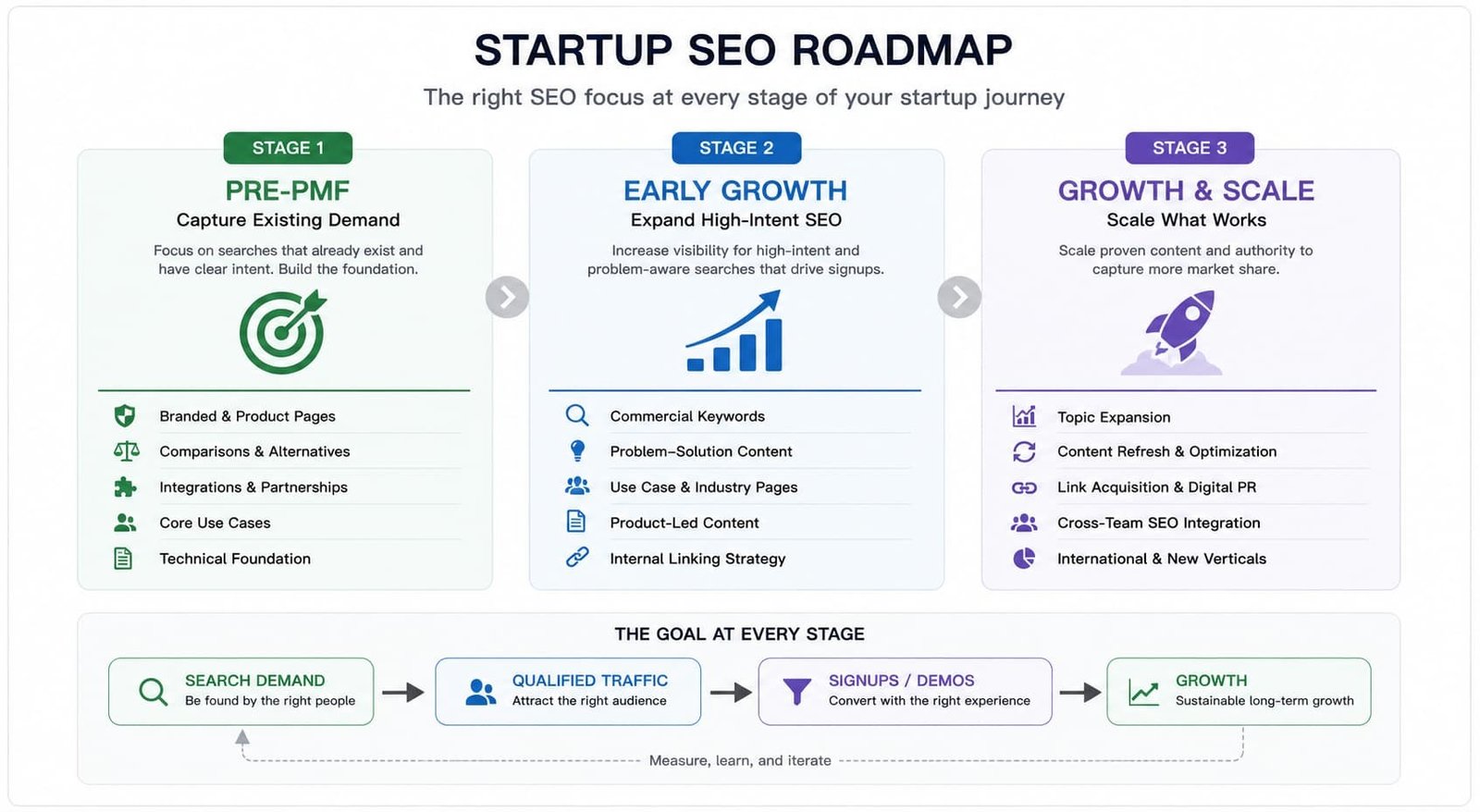
A practical way to avoid wasting resources is to match SEO investment to the stage of the business.
Stage 1: Pre-PMF and Very Early-Stage Startups
Before product-market fit, the goal is not to build a massive organic audience. It is to capture existing demand, support product evaluation, and use search behavior to better understand the market.
Start with a small set of pages that clearly explain:
- what the product does
- who it is for
- what problem it solves
- why someone might choose it instead of an alternative
Depending on the product, that foundation may include the homepage, core product or solution pages, use cases, pricing, comparisons, integrations, and documentation.
At this stage, keyword research can also act as market research. Look at how potential customers search for the category, specific problems, workflows, competitors, integrations, industries, and roles. This can reveal whether meaningful search demand exists and how buyers describe the problems you are trying to solve.
A startup with uncertain positioning rarely needs 50 blog posts. Ten pages closely aligned with buyer problems can be considerably more useful.
For example, a specialized analytics startup might get more value from pages targeting:
- [Competitor] alternative for product teams
- product analytics for B2B SaaS
- [Product] + Slack integration
- how to track feature adoption in SaaS
than from another broad article titled “What Is Data Analytics?”
Stage 2: Early Growth
Once positioning is more stable and you understand who buys the product and why, SEO can expand from demand capture into a more repeatable acquisition channel.
Prioritize searches according to where the user is in the buying process:
- Bottom of funnel: product categories, pricing, alternatives, competitors, comparisons, and vs searches
- Middle of funnel: use cases, workflows, implementation questions, templates, and problem-solution searches
- Top of funnel: broad educational questions, definitions, and industry topics
For most early-growth startups, bottom- and middle-of-funnel opportunities deserve more attention because they are easier to connect to trials, demos, product adoption, or sales conversations.
This is also where low-volume keywords can become especially valuable. A broad term such as project management software may attract thousands of searches but be extremely competitive and poorly matched to a specialized product. A phrase such as agile project management tool for hardware engineering startups may have a tiny audience but describe exactly the customer you want.
For startups, the better question is not “How much traffic can this keyword generate?” It is “If we rank for this search, are these the people we actually want?”
Turn Product Experience Into a Content Advantage
Startups usually cannot outspend established competitors on content production or authority. They can often outperform them on specificity.
Your team has access to information a generic writer does not: questions prospects ask during demos, implementation problems, support cases, technical edge cases, product usage patterns, and workflows that are more complicated in practice than they appear in theory.
Use that information. If your team analyzed 50 customer implementations and discovered a recurring problem, that insight is more valuable than another article summarizing what already ranks. Show real screenshots, examples, workflows, data, and lessons from building or using the product whenever they improve the answer.
Stage 3: Growth and Scale
Once SEO is producing meaningful traffic, signups, leads, or pipeline, the challenge changes. You are no longer trying to prove that organic search can work. You are deciding where it deserves to scale.
Use performance data to identify which topics attract qualified visitors, which page types contribute to conversions, which commercial terms are gaining visibility, and which opportunities no longer justify the investment.
When a topic works, build depth around it through supporting content, stronger internal linking, comparisons, integrations, documentation, templates, tools, or original insights. At the same time, review older content for overlapping intent, outdated positioning, weak pages, and topics that no longer match the ideal customer profile.
At this stage, SEO should also become more cross-functional. Sales hears how prospects describe their problems. Support sees recurring questions. Product understands workflows. Engineering knows the technical edge cases. Bringing those insights into SEO makes the content more useful and much harder for competitors to imitate.
How to Build a Startup SEO Strategy From the Ground Up
Once the stage and priorities are clear, the next step is turning them into an execution plan. The sequence matters: start with the business and the buyer, then move into keywords, pages, technical foundations, and measurement.
1. Start With the Business Model, Not the Keyword Tool
Before opening Ahrefs, Semrush, or another keyword platform, answer a few basic questions:
- Who actually buys the product?
- What problem are they trying to solve?
- How do they describe that problem?
- Do they search for the problem, the solution, the product category, or all three?
- What alternatives do they currently use?
- Is the buying motion self-serve, sales-led, or hybrid?
A B2B SaaS company selling workflow software to RevOps teams should not have the same SEO strategy as a consumer subscription startup, marketplace, or developer tool. Keyword research becomes much more useful once you know what you are actually looking for.
2. Define the Core Pages Before Building a Content Library
Identify the pages the website needs before committing to a large publishing schedule. For many startups, the core set includes:
- homepage
- primary product or solution pages
- core feature pages
- use-case pages
- industry or persona pages where they add genuine value
- comparison and alternative pages
- integration pages
- documentation or help-center content
This prevents a common imbalance: a startup with 100 blog posts but only a few weak pages explaining what the product does, who it serves, and why someone should choose it.
3. Research Keywords by Intent
A giant keyword spreadsheet is not a strategy. Group searches according to the problem or decision they represent.
- Category: product analytics software, customer support platform, password manager for teams
- Problem-aware: reduce churn in SaaS, how to manage feature flags, automate invoice approval workflow
- Comparison and alternatives: [Competitor] alternatives, [Product A] vs [Product B], best [category] software for [use case]
- Integrations: searches that combine tools, platforms, or workflows your product supports
- Templates and workflows: repeatable processes such as onboarding checklists, bug triage templates, or sales forecast templates
- Branded: your company, product, features, reviews, pricing, and other searches directly associated with the brand
Each group represents different intent and often requires a different page type. Separating them makes it easier to decide what deserves to be built first.
4. Score Opportunities Ruthlessly
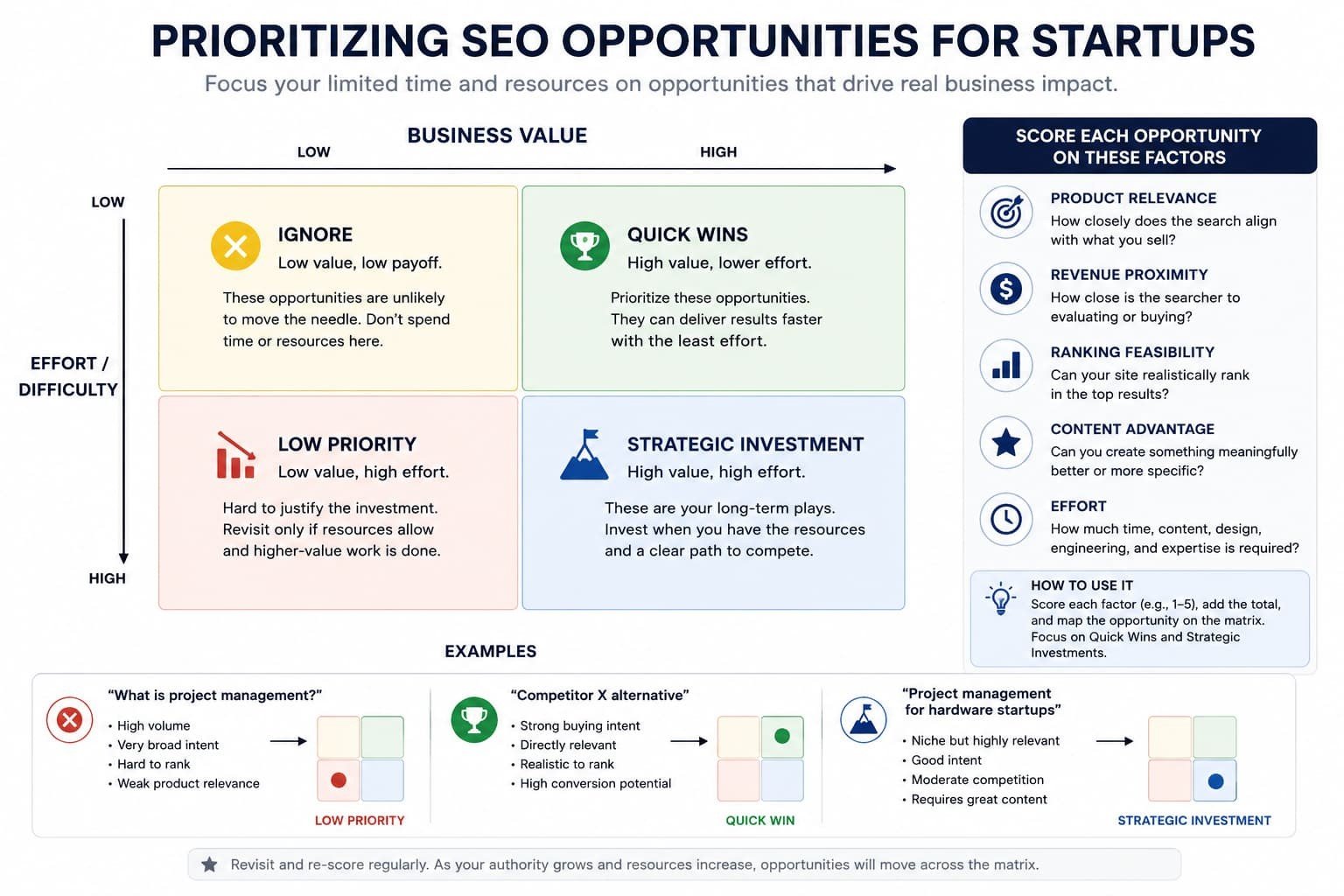
Startups need prioritization more than completeness. A simple scoring system can consider:
- Product relevance: How directly does the search connect to what you sell?
- Revenue proximity: How close is the searcher to evaluating or buying a solution?
- Ranking feasibility: Can your current site realistically compete?
- Content advantage: Can your team create something meaningfully better or more specific than what already ranks?
- Effort: How much writing, design, engineering, data, or expert input will the page require?
A keyword with lower volume but strong product relevance, commercial intent, and realistic competition may deserve priority over a much larger term.
5. Build Pages That Deserve to Rank
Once you know which opportunities matter, do not simply ask what keywords to include. Ask what page would genuinely help the person making that search.
Depending on the query, a strong page might include:
- a clear explanation of the problem or use case
- specific examples and real-world scenarios
- screenshots or product workflows
- implementation steps
- limitations and tradeoffs
- comparison tables
- templates or checklists
- original data or internal findings
- answers to questions prospects repeatedly ask
This is where a startup can compete with much larger websites. You may not have their authority or publishing budget, but you often have better access to the product, customers, technical details, and real problems behind the search.
Use that advantage instead of producing a slightly longer version of whatever already ranks.
Technical SEO for Startups: Fix What Can Actually Hold You Back
Technical SEO matters, but early-stage companies can easily spend too much time polishing issues that have little effect on growth.
The objective is not to achieve a perfect audit score. It is to make sure search engines can discover, understand, index, and rank the pages that matter.
Start With Crawlability and Indexing
Check whether:
- important pages are blocked by robots.txt
- valuable pages contain accidental noindex directives
- XML sitemaps contain the correct canonical URLs
- canonical tags point to the intended pages
- important content can be discovered through internal links
- staging, test, filter, or parameter URLs are creating unnecessary indexation
- redirects and status codes behave correctly
Google Search Console and a crawler can reveal most of the technical problems that matter at this stage.
Keep Site Architecture Simple
Early-stage websites often become unnecessarily complicated because every campaign, feature launch, or experiment creates another disconnected page.
A simple structure might include:
- Product or Solutions
- Use Cases
- Industries or Personas, where appropriate
- Integrations
- Comparisons and Alternatives
- Resources
- Documentation or Help Center
The exact architecture depends on the business, but important pages should not be buried several levels deep or accessible only through search, JavaScript interfaces, or obscure footer links.
Protect SEO During Website Changes
Rebrands, CMS migrations, redesigns, new navigation, and URL changes are normal for startups. They are also common ways to lose existing organic visibility.
During major website changes:
- preserve valuable URLs whenever possible
- redirect removed URLs to the closest relevant replacements
- update internal links and canonical tags
- regenerate XML sitemaps where necessary
- compare indexation and organic performance before and after launch
A redesign that improves the brand but accidentally removes pages generating qualified search traffic is not an SEO improvement.
Watch JavaScript and Performance Without Chasing Perfection
JavaScript-heavy websites are not automatically bad for SEO, but important content, links, metadata, canonical tags, and status codes should remain accessible and behave correctly.
The same principle applies to performance. Fix obvious problems such as oversized images, unnecessary scripts, slow server responses, heavy third-party widgets, and disruptive layout shifts. The goal is a fast, stable experience, not a perfect laboratory score at the expense of more important growth work.
SEO Traffic Needs a Conversion Path
Ranking is only the beginning. A page that attracts the right visitor but gives them nowhere useful to go is an incomplete acquisition asset.
Every important SEO page should have a logical next step based on the visitor’s intent. That might be:
- starting a free trial
- booking a demo
- viewing a relevant product feature
- exploring an integration
- using a template or tool
- reading a relevant comparison
- signing up for a product-led experience
A visitor reading a technical tutorial may not be ready for a sales call. Someone searching for [Competitor] alternative may be. The conversion path should reflect that difference.
Make the Product Part of the Answer
One reason startup blogs generate traffic without revenue is that the product is treated as something separate from the content.
If the product genuinely helps solve the problem discussed on the page, show how. An article about customer onboarding, for example, could include a real workflow, screenshot, relevant template, or demonstration of the feature that addresses the problem.
This makes the product part of the answer rather than an advertisement attached to the end of the article.
Content Strategy: Publish in the Right Order
Once the core commercial pages and technical foundation are in place, content can expand the number of problems and searches the startup can address. The order still matters.
Priority 1: Commercial and High-Intent Pages
Start with searches closest to product evaluation: category pages, use cases, comparisons, alternatives, integrations, and relevant industry- or role-specific solutions.
Priority 2: Problem-Solution Content
Next, cover problems your target customers experience before they begin actively comparing products. Good ideas often come from sales calls, support tickets, customer interviews, onboarding, implementation challenges, community discussions, and queries already appearing in Google Search Console.
Priority 3: Templates, Tools, and Useful Assets
Some of the strongest SEO assets are not traditional articles. Templates, calculators, checklists, free tools, benchmarks, datasets, and technical resources can attract search traffic, earn links, and introduce potential customers to the product.
Priority 4: Broader Educational Content
Broader informational topics become more useful once the startup has established stronger commercial coverage and knows which areas of the market matter. At that point, they can expand visibility, reach buyers earlier, support internal linking, build brand recognition, and earn mentions.
Broad educational publishing should be an expansion strategy, not the automatic starting point.
Use AI to Accelerate SEO Without Removing the Expertise
AI can make a small startup team significantly faster, especially when it is used for repetitive and structured work.
Useful applications include:
- organizing and clustering keyword exports
- summarizing research
- generating initial outlines
- cleaning and formatting datasets
- creating first drafts from expert notes
- producing schema markup templates
- identifying gaps in existing content
The problem begins when AI becomes a substitute for the knowledge that makes the content worth reading. If dozens of companies can generate essentially the same article from the same prompt, publishing another version creates little competitive advantage.
The strongest startup content combines AI-assisted efficiency with information competitors cannot easily reproduce: firsthand product experience, customer examples, original data, technical expertise, real screenshots and workflows, implementation lessons, and opinions supported by evidence or experience.
Use AI for speed and structure. Use the people closest to the product and customers for substance.
Link Building for Startups
New domains often need external authority to compete for meaningful search results, but startups rarely have the resources for large-scale link acquisition campaigns.
A more sustainable approach is to connect link earning with work the company already needs to do.
Turn Company Activity Into Link Opportunities
Product launches, original research, datasets, industry reports, integrations, partnerships, and other meaningful company developments can create opportunities for relevant coverage and mentions.
The announcement itself is not enough. The strongest opportunities usually come from giving journalists, partners, customers, or industry publications something genuinely useful or noteworthy to reference.
Use Partnerships and Integrations
If your product participates in another company’s ecosystem, look for legitimate opportunities to appear in integration directories, marketplaces, partner pages, customer stories, and joint educational resources.
These links are particularly useful because they can help users discover the product as well as strengthen its authority.
Create Assets Worth Referencing
Original research, benchmarks, free tools, datasets, technical resources, and useful templates can earn links because other people have a reason to cite them.
For many startups, creating a small number of genuinely useful assets is a stronger long-term strategy than producing generic guest posts solely to acquire links.
Measure SEO Like a Growth Channel
Traffic and rankings are useful diagnostic metrics, but they should not be the final measure of startup SEO success. The real question is whether organic search contributes to business growth.
Track Search Performance
Monitor impressions, clicks, ranking trends, indexation, and branded versus non-branded visibility. These metrics show whether search engines are discovering and surfacing the right parts of the site.
Connect Organic Traffic to Business Outcomes
Track meaningful actions such as:
- free-trial registrations
- demo requests
- account creation
- qualified leads
- product activation
- pipeline or revenue, where attribution allows it
This makes it possible to distinguish between a page that generates thousands of low-value visits and one that attracts a much smaller audience of potential customers.
A low-traffic comparison page that regularly contributes to demos may be more valuable than a high-traffic educational article with almost no commercial impact. Over time, SEO investment should follow those business outcomes rather than traffic alone.
A Practical SEO Workflow for a Small Startup Team
A startup does not need a large SEO department to make progress. It needs a repeatable process that keeps high-value work moving and regularly tests whether the strategy is producing results.
Monthly
- Review Google Search Console for meaningful changes in visibility and indexation.
- Check the performance of important commercial pages.
- Look for new queries that reveal customer problems or content opportunities.
- Publish or substantially improve a small number of priority pages.
- Review internal links to important product, use-case, comparison, and integration pages.
- Check organic conversions such as trials, demos, registrations, or qualified leads.
Quarterly
- Revisit keyword and topic priorities as positioning and customer demand evolve.
- Identify content that should be updated, consolidated, redirected, or removed.
- Review technical health and major changes to the website.
- Look for new use cases, integrations, comparisons, and product-led opportunities.
- Identify topics where existing performance justifies deeper investment.
- Collect new insights from sales, support, product, engineering, and customer success.
The process is simple:
Research → Build → Measure → Learn → Improve → Expand
This keeps SEO investment tied to evidence instead of committing the company to an enormous content strategy before knowing what works.
Common Startup SEO Mistakes
Most startup SEO failures are not caused by obscure technical issues. They come from investing in the wrong work at the wrong time.
- Chasing traffic instead of customers. Search volume means little when the audience has weak relevance to the product.
- Publishing too much, too early. Scale content production after you know which audiences, topics, and page types are producing value.
- Ignoring commercial pages. Product, use-case, comparison, alternative, and integration pages often deserve attention before a large blog library.
- Targeting keywords you cannot realistically win. Start with narrower opportunities where the product has a genuine advantage and expand as authority grows.
- Publishing generic content. Use customer questions, product knowledge, data, workflows, technical expertise, and real experience to create something competitors cannot easily reproduce.
- Overinvesting in technical perfection. Fix problems that materially affect crawling, indexing, rankings, or user experience before minor audit warnings.
Startup SEO FAQs
How long does SEO take for a startup?
There is no universal timeline. Results depend on the market, competition, website authority, existing content, resources, and the searches being targeted. Narrow branded, comparison, integration, and long-tail opportunities may produce useful visibility earlier than highly competitive category terms.
Rather than waiting for SEO to suddenly “work,” look for progressive signals: important pages being indexed, relevant impressions increasing, rankings improving, qualified organic visitors arriving, and eventually more conversions.
Should a startup hire an SEO agency?
It depends on the stage of the company. Before product-market fit, a large ongoing SEO engagement may be premature if positioning, target customers, and the product are still changing rapidly. Focused strategic or technical help may make more sense.
Once positioning is clearer and organic search has demonstrated business potential, external specialists can help scale technical improvements, content systems, migrations, authority building, and measurement.
How much should an early-stage startup spend on SEO?
There is no universal budget. Early-stage companies are usually better served by funding a small number of high-impact activities than by immediately building a large content operation.
Increase investment when organic search begins to show evidence that it can produce qualified demand.
Do startups still need blog content?
Often yes, but every piece of content should have a purpose. A blog can capture problem-aware searches, answer customer questions, support commercial pages, demonstrate expertise, and earn links.
What startups do not need is generic content published simply because competitors have blogs.
Can AI write startup SEO content?
AI can accelerate research, organization, outlining, drafting, and other repetitive parts of production. The competitive advantage, however, usually comes from what the company adds: real product knowledge, customer experience, examples, original data, technical expertise, screenshots, and editorial judgment.
If AI makes production faster, use that advantage to create better content rather than simply more content.
Is SEO Still Worth Investing in as AI Search Grows?
Yes, but generic informational content is becoming a weaker foundation for an SEO strategy. Basic questions can increasingly be answered directly by search engines and AI systems without requiring users to visit another website.
More defensible opportunities exist where people need deeper evaluation or firsthand information: comparisons, alternatives, workflows, implementation details, product experience, original research, technical documentation, and specific problem-solving content.
The same expertise that makes a page genuinely useful in traditional search also gives other discovery systems clearer information about the company, its product, and the problems it can solve.
Conclusion: Build the SEO Engine Before You Try to Scale It
Startup SEO is not a race to publish the most articles or rank for the largest keywords. It is a process of finding where search demand overlaps with a real customer problem and building the strongest path between that search and your product.
Early on, focus on the fundamentals: make the site crawlable, explain the product clearly, capture branded and high-intent demand, build pages around real use cases and buyer decisions, and measure whether organic visitors actually become users or customers.
As evidence accumulates, expand carefully. Build depth around topics that produce qualified demand, turn product and customer knowledge into content competitors cannot easily reproduce, earn authority through useful assets and relationships, and keep improving the pages that contribute to growth.
Think of SEO less like switching on a traffic source and more like building an engine. Publishing more content is pressing the accelerator. Before you do that, make sure the engine is connected to the wheels.
For a startup with limited runway, that distinction matters. The objective is not more SEO activity. It is an organic growth system that becomes more valuable as the company learns, the product matures, and the market becomes clearer.