
Wholesale SEO operates under very different rules from consumer ecommerce. Buyers are often procurement managers, distributors, or business owners. Sales cycles can stretch across weeks or months, and even low-volume keywords may represent significant commercial opportunities. At the same time, wholesale websites often contain large product catalogs. They have thousands of SKUs, similar variants, limited product content, and faceted navigation that can generate far more URLs than search engines need to index.
This article focuses on the SEO challenges that matter most for wholesale businesses. How to find the terms B2B buyers actually use. The logical structuring of large catalogs so search engines can understand them. How to deal with faceted navigation, optimizing category and product pages properly. How to measure performance when the real conversion is often a quote request or sales inquiry rather than an online purchase.
Why Wholesale SEO Differs from B2C SEO
A consumer looking for a pair of headphones might search, compare a few options, and complete a purchase in a single session. A wholesale buyer searching for an industrial packaging supplier may spend weeks. He will evaluate vendors by comparing specifications and pricing, verifying certifications. Often, this involves several people in the decision-making process before a quote is requested or a sales representative is contacted.
For wholesale SEO, this means attracting more traffic is not the primary goal. The priority is to build visibility for the searches that indicate genuine business demand and guide potential buyers to the vendor website.
Keyword Strategy for Wholesale Markets
Wholesale keyword research should prioritize commercial relevance over raw search volume. A keyword with only a few dozen searches per month may still represent a valuable opportunity if the people using it are procurement teams, distributors, or business owners looking for products in bulk. The goal is not simply to find popular keywords, but to identify the language qualified buyers use when researching products and suppliers.
Find Keywords in Your Product and Sales Data
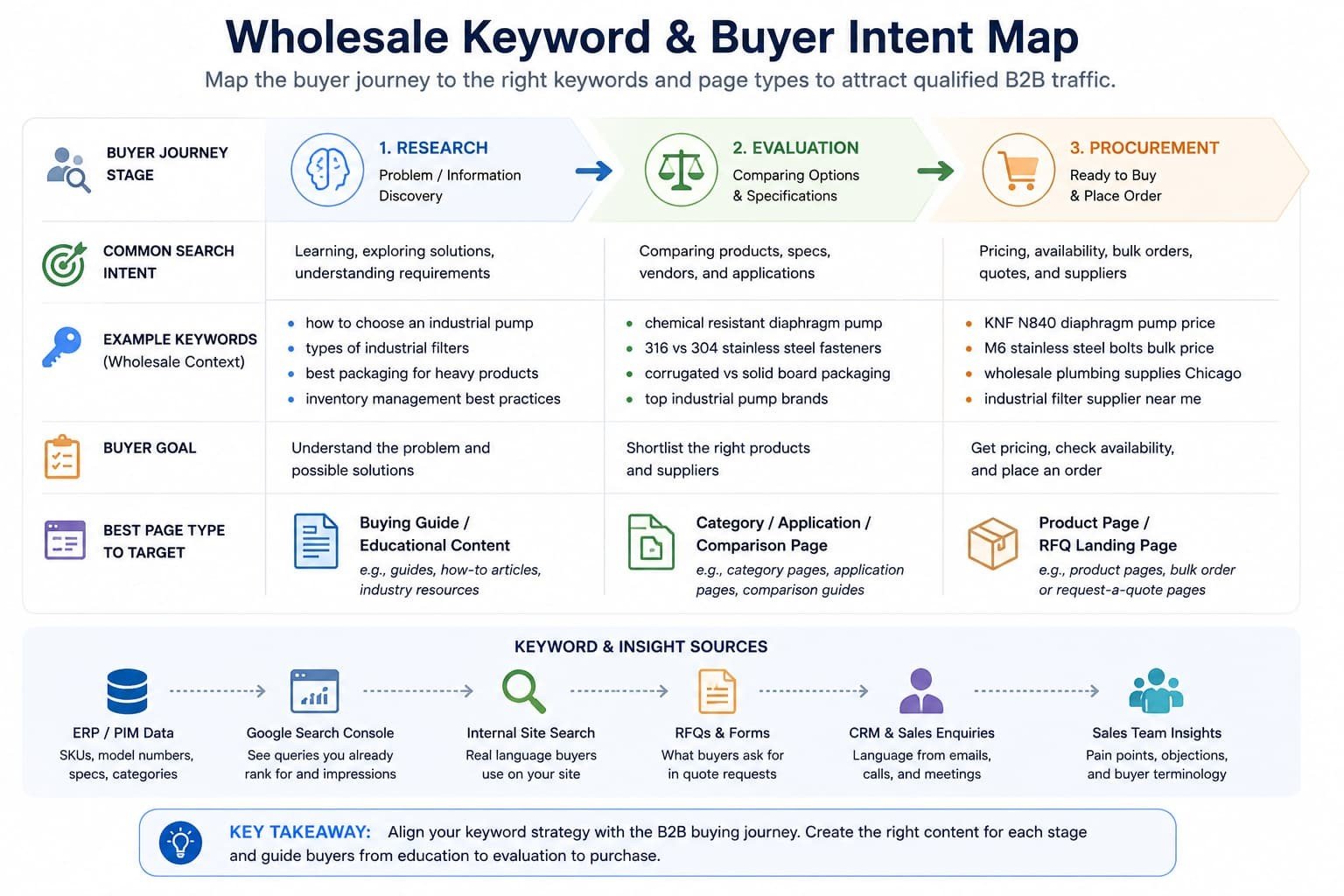
Start with the terminology already used inside the business. Product catalogs, ERP or PIM data, RFQs, technical documentation, CRM records, and conversations with the sales team can reveal search terms that traditional keyword tools may overlook.
- Extract product names, SKUs, model numbers, part numbers, materials, dimensions, certifications, and other technical specifications from your catalog.
- Review Google Search Console for queries that include those terms to identify products and specifications that are already generating impressions or clicks.
- Analyze internal site search, RFQs, CRM notes, support tickets, and sales inquiries to see how customers describe products and requirements in their own language.
- Use keyword research tools to identify related queries, competing pages, and variations around your most commercially important product categories and specifications.
This is particularly important in technical industries, where a buyer may search for “316 stainless steel fasteners” or a specific model number without ever using an obvious B2B term such as “wholesale” or “supplier.”
Identify Wholesale and Procurement Intent
For broader product terms, look for language that signals commercial purchasing intent. Common modifiers include “wholesale,” “bulk,” “supplier,” “distributor,” “trade,” and “B2B.” A coffee distributor, for example, may find considerably more commercial value in “wholesale coffee beans,” “bulk coffee bean supplier,” or “coffee beans for cafes” than in the broader term “coffee beans.”
Buyer intent can also be reflected in quantities, specifications, availability, pricing, certifications, shipping requirements, or requests for quotes. These signals can be more valuable than search volume because they indicate what the buyer is actually trying to accomplish.
Segment Keywords by Buying Stage
- Research: Category and problem-solving searches such as “how to choose a packaging supplier” or “best material for food packaging.”
- Evaluation: Supplier, comparison, application, and specification searches such as “corrugated box suppliers,” “packaging distributor for food manufacturers,” or “316 vs 304 stainless steel fasteners.”
- Procurement: Product, SKU, quantity, pricing, availability, and quote-related searches such as “bulk corrugated boxes quote” or “[model number] bulk price.”
Map Keywords to the Right Page Type
Once the keyword set is organized, map each group to the page best suited to satisfy its intent. SKU- and model-specific searches usually belong on product pages; broader product searches on category or subcategory pages; application searches on dedicated use-case pages; and comparison or specification questions in buying guides and technical resources. Procurement-focused searches may justify dedicated supplier, bulk-order, or request-for-quote landing pages.
This approach also helps prevent multiple pages from competing for the same queries. Instead of creating content for every keyword variation, prioritize commercially important categories and products, then expand where search demand, buyer intent, and business value justify a dedicated page.
Catalog Architecture That Search Engines Can Navigate
A large product catalog can be one of a wholesale website’s biggest SEO assets, but only if search engines can understand how the products relate to one another. Poor architecture can leave important products buried several levels deep, create multiple pages targeting the same searches, and produce thousands of low-value URLs that compete for crawling and indexing.
The goal is to organize the catalog around the way buyers search and browse. Broad product families should lead to increasingly specific categories, subcategories, and products, giving both buyers and search engines a clear path through the inventory.
Build a Clear Category Hierarchy
Category and subcategory pages should target broader product demand, while individual product pages capture searches for specific models, SKUs, specifications, or configurations. Depending on the catalog, the basic hierarchy might look like this:
- Main category: Industrial Pumps
- Subcategory: Diaphragm Pumps
- Application or product type: Chemical-Resistant Diaphragm Pumps
- Product: Individual model or SKU
Additional landing pages may be useful when buyers regularly search by brand, manufacturer, material, application, industry, or other attributes that represent distinct search demand. These pages should exist because they serve a meaningful buyer need, not simply because the ecommerce platform can generate them automatically.
Match Page Types to Search Intent
Different levels of the catalog should target different types of searches. A category page might be the best destination for “wholesale LED lighting,” while a product page may be more appropriate for a query containing an exact model number.
An application page could target searches such as “LED lighting for warehouses,” while a manufacturer page may serve buyers specifically looking for products from a particular brand.
Avoid creating multiple indexable pages that essentially serve the same intent. If a category, filter page, tag, and product collection all target the same set of products and keywords, search engines may struggle to determine which URL best represents that topic.
Make Category and Product Pages Worth Indexing
Category pages should provide more than a product grid. Include information that helps a business buyer understand the available product range, important specifications, applications, purchasing options, and how to choose between relevant product types.
Product pages should provide the details buyers need to evaluate or specify an item, such as technical specifications, compatible applications, model or part numbers, minimum order quantities, packaging options, certifications, documentation, and, where appropriate, availability.
Manufacturer descriptions can be useful as source material, but relying on the same stock copy used by every distributor gives search engines little reason to treat the page as a uniquely useful result.
Keep Important Products Within Easy Reach
Internal linking should reinforce the catalog hierarchy. Category pages should link to relevant subcategories and products, while product pages can link back to their parent categories and to related products, compatible components, applications, or technical resources.
Important categories and commercially valuable products should not depend on internal search or dozens of paginated pages to be discovered. XML sitemaps can help search engines find URLs, but they do not replace a crawlable internal linking structure. If an important product is difficult to reach via normal navigation, it usually indicates that the catalog architecture needs attention.
Technical SEO: Controlling Faceted Navigation at Scale
Faceted navigation is one of the biggest technical SEO challenges for wholesale websites with large catalogs. Filters for brand, material, size, application, specification, availability, and other attributes. They help buyers narrow thousands of products to a useful shortlist. But when every filter and filter combination creates a crawlable URL, a catalog with a few thousand products can quickly generate many more URLs with duplicated content.
The objective is not to eliminate faceted navigation. Buyers need it. The SEO task is to decide which filtered pages deserve to become search landing pages. Which combinations should remain part of the browsing experience, but without creating unnecessary indexable URLs.
Decide Which Faceted Pages Deserve to Be Indexed
Do not apply the same indexing rule to every filter. Some filtered combinations may correspond to real searches and deserve dedicated, indexable landing pages. Others simply reorganize the same inventory without adding meaningful search value.
- Index and optimize: Filter combinations with clear search demand and real buyer intent. If buyers regularly search for “wholesale stainless steel fasteners,” for example, that combination may justify a dedicated crawlable URL with its own title, heading, supporting content, and internal links.
- Consolidate: When several URLs represent essentially the same product selection or search intent, choose a preferred URL rather than allowing multiple versions to compete for indexing. Canonical tags can be appropriate for duplicate or near-duplicate URLs, but they should not be used as a substitute for controlling unnecessary URL generation.
- Keep out of the index: Filter combinations with little or no standalone search value should generally not become search landing pages. Depending on the platform and crawl strategy, this may involve noindex directives, limiting crawlable links to parameter combinations.
- Block crawl traps: Sorting parameters, session IDs, endless combinations, and other URL patterns that can create effectively unlimited crawl spaces may require stricter crawl controls. Robots.txt can be useful in specific cases, but blocking a URL also prevents Google from crawling the page and seeing directives such as noindex or canonical tags.
Separate Buyer Filters from SEO Landing Pages
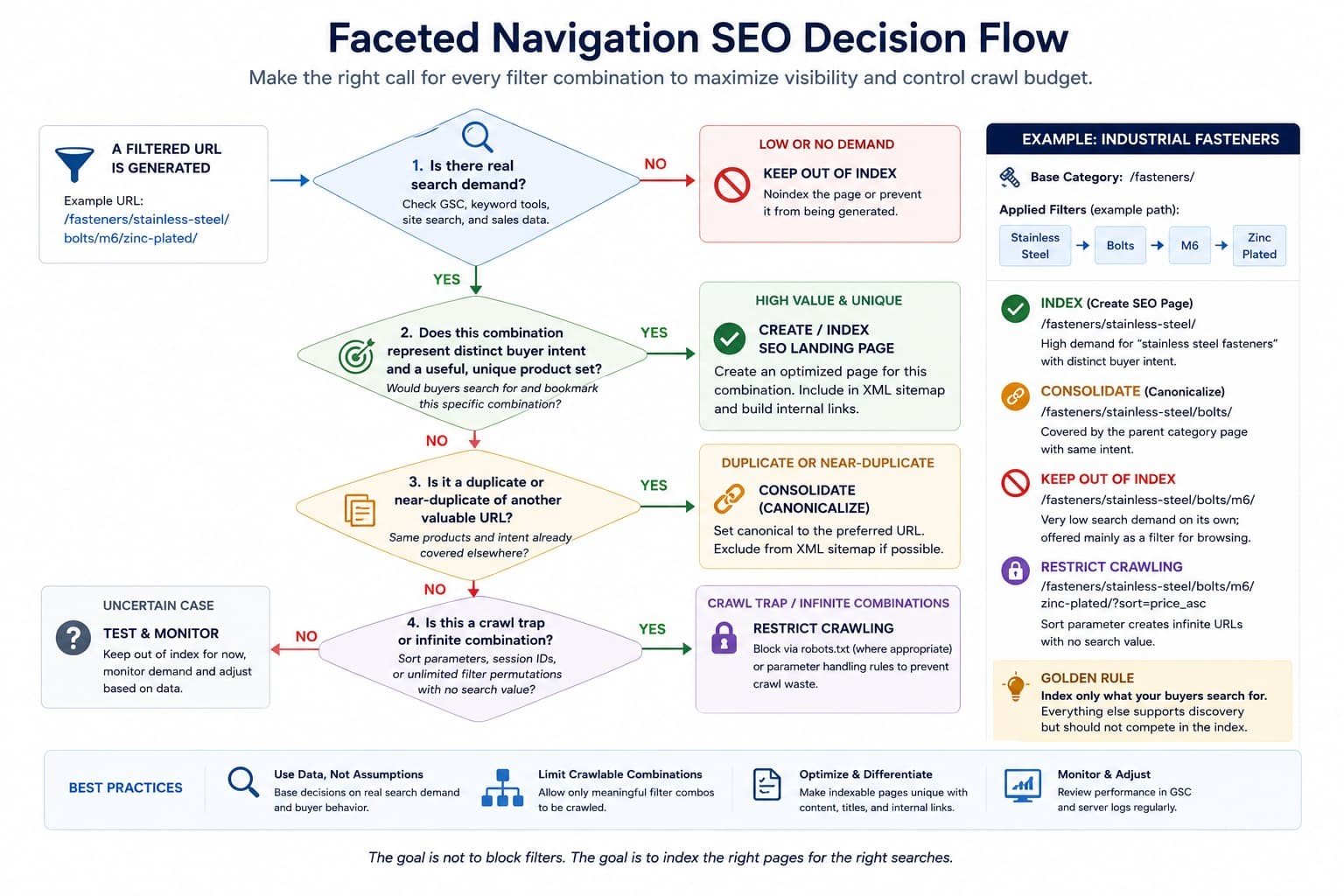
A useful distinction is to treat filtering and SEO landing pages as two different systems. Buyers might need dozens of filters to navigate the catalog, but that does not mean every filtered state needs to become an indexable page.
Where an attribute has proven search demand, consider creating a stable landing page rather than relying on an automatically generated parameter URL. For example, an indexable category such as /fasteners/stainless-steel/ can provide a cleaner, more controllable search destination than a URL with multiple filter parameters.
This gives you control over titles, headings, introductory content, internal links, canonicals, and inclusion in XML sitemaps, while leaving the remaining filters primarily available to users.
Use Sitemaps and Crawl Data to Reinforce Your Index Strategy
XML sitemaps should focus on the canonical URLs you actually want search engines to discover and index, including important categories, subcategories, products, and intentional faceted landing pages. Low-value parameter combinations and URLs that you do not want indexed should not be included simply because the platform generates them.
For very large catalogs, separating XML sitemaps by page type can make technical monitoring easier. Product, category, brand, and other important page groups can be tracked independently to identify indexing problems or sections where discovery is weaker than expected.
Google Search Console can show which filtered URLs receive impressions and which URL patterns Google is discovering or excluding. For larger sites, server log analysis adds another layer by showing where Googlebot is actually spending crawl activity. Tools such as Screaming Frog or Sitebulb can then help quantify how many parameter combinations are internally crawlable and where they originate.
Use a Page-Type Indexing Framework
| Page Type | Typical Strategy | Reason |
| Primary category or subcategory | Index | Targets broad product and commercial searches |
| Individual product or SKU | Index when valuable and sufficiently useful | Can capture model, specification, and procurement searches |
| High-demand filtered category | Index as a dedicated landing page | Captures distinct long-tail or attribute-based demand |
| Duplicate or near-duplicate filtered URL | Consolidate | Reduces competing URLs for essentially the same intent |
| Low-value filter combination | Keep out of the index | Prevents unnecessary index expansion |
| Sort, session, or crawl-trap URL | Restrict crawling where appropriate | Prevents crawler resources from being consumed by effectively unlimited URL variations |
Before changing faceted navigation rules, audit what is already working. Check Google Search Console for filtered URLs that receive impressions and clicks, crawl the existing parameter structure, and review server logs where scale warrants it. The goal is not to index as few URLs as possible. It is to make sure the URLs search engines spend time crawling and indexing correspond to pages that can actually satisfy buyer demand.
Local SEO for Wholesalers with Physical Locations
Local SEO can be valuable for wholesalers that serve defined geographic markets or operate locations where customers can visit, collect orders, or interact with the business. Proximity can be an important purchasing factor when buyers need faster delivery, lower freight costs, local inventory, or convenient pickup, particularly for bulky, heavy, time-sensitive, or perishable products.
Optimize Eligible Physical Locations
If a location is eligible for a Google Business Profile, keep its business name, address, phone number, opening hours, website, and other business information accurate and consistent. Do not create profiles simply because the company owns warehouses or distribution facilities. Locations should meet Google’s eligibility requirements, particularly when they are not staffed or accessible to customers during stated business hours.
Each important physical location should also have a useful page on the website when there is a genuine reason for buyers to search for it. Rather than publishing a thin page with only an address and phone number, include information such as available products or categories, geographic coverage, pickup options, delivery capabilities, opening hours, contact details, and any services specific to that facility.
Target Regional Buyer Intent
Location-specific keywords are useful when geography forms part of the purchasing decision. Depending on the market, buyers might search for terms such as “wholesale plumbing supplies Chicago,” “industrial packaging supplier Illinois,” or “electrical distributor near me.“
Keyword research should determine whether buyers search at the city, metropolitan, state, or regional level. Avoid creating dozens of near-identical city pages simply to capture every geographic variation. A dedicated location or regional page should represent the market the business genuinely serves and provide information useful to buyers in that area.
Build Relevant Local and Industry Signals
Make sure business information is accurate across relevant industry associations, manufacturer or distributor directories, chambers of commerce, and established B2B platforms where potential customers may look for suppliers.
Depending on the industry and market, platforms such as Thomasnet or Kompass may also provide useful visibility and referral traffic.
Relevance matters more than the number of directory listings. A profile in a respected industry association or manufacturer directory can be considerably more useful to a wholesale business than dozens of generic directory submissions.
Example: Turning a Distribution Center into a Local Search Asset
Imagine a plumbing wholesaler with a distribution center in Chicago that offers contractor pickup and same-day delivery across the metropolitan area. Instead of relying solely on a generic contact page, the company could create a dedicated Chicago location page that describes its plumbing product ranges, trade pickup process, delivery coverage, opening hours, and contact details.
That page could target relevant searches such as “wholesale plumbing supplies Chicago” while linking buyers directly to major product categories and the information needed to place or collect an order. If the physical location is eligible for a Google Business Profile, the profile and location page can work together to connect local search visibility with a real purchasing option for contractors and other business customers.
Content for the B2B Buying Journey
Wholesale content should support buyers before they are ready to request a quote. Focus on the questions and problems that arise during product research and supplier evaluation. A cleaning-supplies wholesaler might publish guidance on inventory planning for facility managers, while an industrial components distributor might explain material standards, compatibility, or certification requirements.
Buying guides, product comparisons, application guides, technical explainers, and industry resources can support these searches and direct buyers to relevant categories and products. Prioritize topics aligned with real customer questions, sales conversations, and search demand, and keep key resources up to date as specifications, regulations, products, or market conditions change.
Measuring SEO Success Beyond Traffic and Rankings
Traffic and rankings provide useful context, but they do not tell a wholesaler whether organic search is generating business. A category page attracting 200 procurement-focused visits can be more valuable than an article receiving 5,000 visits from consumers who will never request a quote. Measurement should therefore connect SEO performance to qualified inquiries and, where possible, the sales pipeline.
Track Actions That Represent Buying Intent
Set up conversion tracking for the actions that move a potential buyer into the sales process. Depending on the business, these may include:
- Request for Quote (RFQ) submissions
- Trade or wholesale account registrations
- Product or sample inquiries
- Calls and emails originating from organic landing pages
- Catalog, specification sheet, or technical document downloads
Where CRM data is available, connect these conversions to later sales stages. This makes it possible to distinguish between a form submission and a genuinely qualified opportunity, and eventually between an organic lead and revenue.
Evaluate SEO by Page and Search Intent
Measure important categories, products, and commercial landing pages separately from informational content. Track their visibility for relevant searches alongside organic inquiries and assisted conversions. For educational resources, evaluate whether visitors continue to product or category pages, return via branded search, or later complete a commercial action, rather than judging success solely by traffic or engagement.
Example: Traffic vs. Business Value
Imagine an industrial pump distributor receives 4,000 organic visits per month to an article about how pumps work, but those visits generate only 2 product inquiries. At the same time, a category page for chemical-resistant diaphragm pumps receives just 250 organic visits but generates 12 RFQs, four of which become qualified sales opportunities.
The article drives more traffic, but the category page contributes more directly to the sales pipeline. If CRM data later shows that two of those opportunities became customers, the business can connect SEO performance all the way from the original search and landing page to actual revenue. That is a much more useful measure of wholesale SEO success than reporting organic sessions or keyword positions alone.
Conclusion: Build Your SEO Like a Wholesale Distribution System
Think of wholesale SEO like running a distribution center. Having thousands of products in stock means little if they are poorly organized, difficult to locate, or disconnected from the routes buyers use to find them. Your website works the same way. Categories create the aisles, product and specification data identify what is available, internal links provide the routes through the catalog, and controlled faceted navigation prevents search engines from getting lost among thousands of unnecessary variations.
The goal is not to generate the largest possible catalog or the most organic traffic. It is to make the right products easy to find when a qualified buyer searches for them, and to provide a clear path from that search to an RFQ, a sales inquiry, or a wholesale order. When catalog structure, buyer intent, technical SEO, and measurement work together, organic search becomes part of the distribution system rather than simply another traffic channel.