Ranking an insurance brokerage website has never been easy. National carriers such as Geico, Progressive, and State Farm dominate broad insurance keywords with massive advertising budgets, while lead-generation websites compete aggressively for the remaining visibility.
Fortunately, independent insurance brokers are not competing on the same terms. Their biggest strengths are local expertise, access to multiple carriers, and the ability to provide personalized advice. These advantages align perfectly with what both search engines and AI platforms increasingly reward: trustworthy expertise, local relevance, and content that genuinely helps users make informed decisions.
Search has also evolved beyond Google’s traditional organic results. Prospective clients now discover businesses through Google AI Overviews, Bing Copilot, ChatGPT, Gemini, Perplexity, and voice assistants. Success no longer depends solely on ranking in search results. Your brokerage also needs to be understood, trusted, and cited by AI systems.
That requires three complementary disciplines:
- SEO to improve traditional organic rankings.
- GEO (Generative Engine Optimization) to increase your visibility across AI-powered search platforms.
- AEO (Answer Engine Optimization) to make your content easier for AI systems to reference and cite when answering user questions.
This guide explains how insurance brokers can combine all three approaches into one practical strategy. You’ll learn how to strengthen your local presence, create content that attracts qualified prospects, improve your technical SEO, and build the authority needed to earn both Google rankings and AI citations. Throughout the guide, you’ll also find practical examples you can apply directly to your own brokerage.
The Search Landscape Has Changed: SEO, GEO, and AEO
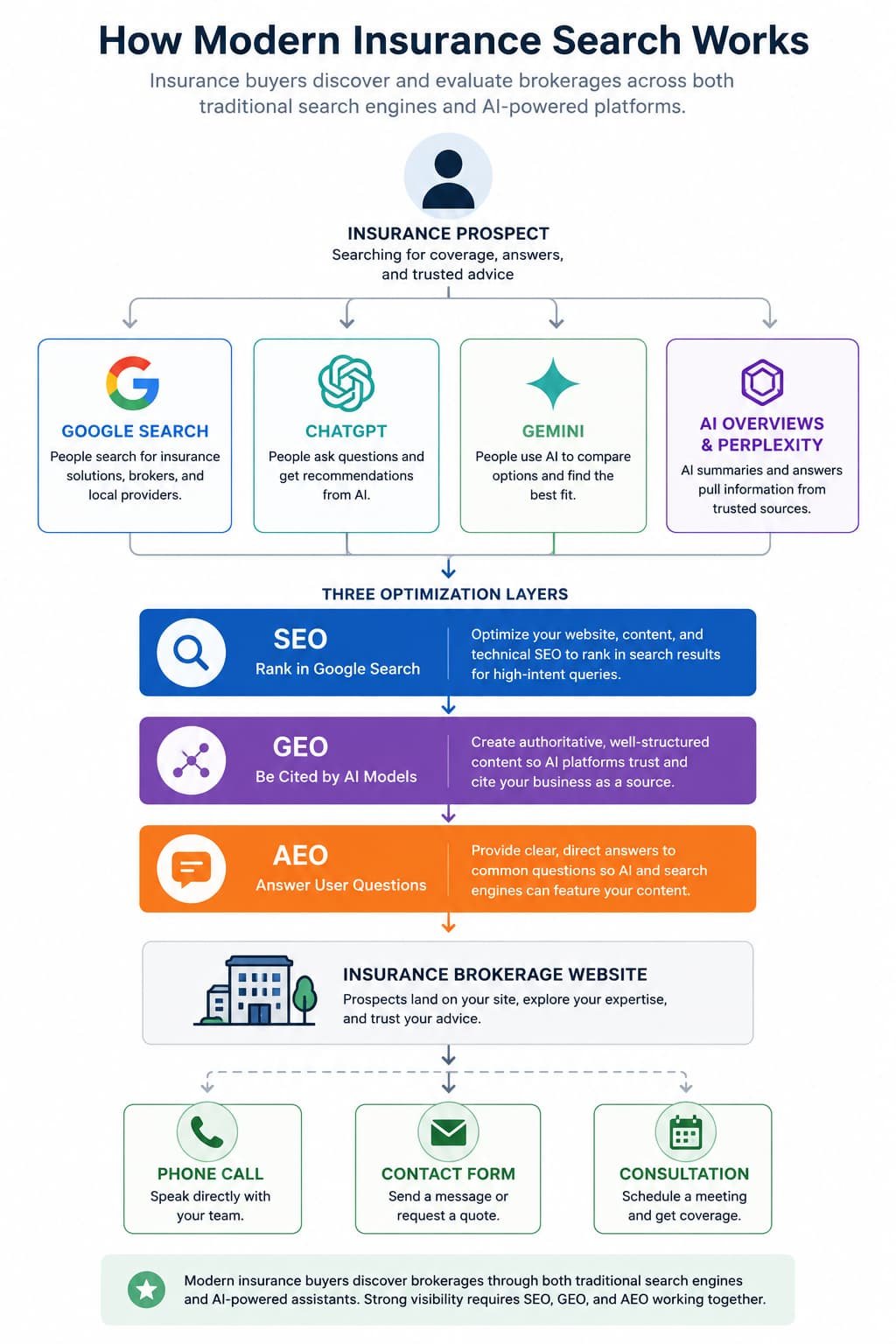
For years, SEO focused on one objective: ranking higher in Google’s organic search results. That is still important, but it is no longer the only way prospects discover insurance brokers.
Today, someone looking for insurance may search Google, ask ChatGPT for recommendations, read a Google AI Overview, or use a voice assistant on their phone. Instead of simply typing “business insurance,” they are more likely to ask complete questions such as “What insurance does a small construction company need?” or “Who is the best commercial insurance broker near me?”
To stay visible throughout this new search journey, insurance brokers should think beyond traditional SEO and understand three closely connected disciplines.
- SEO (Search Engine Optimization) helps your website rank in Google’s and Bing’s traditional organic search results, as well as in local map listings, images, and videos.
- GEO (Generative Engine Optimization) improves your visibility across AI-powered search platforms, including ChatGPT, Gemini, Perplexity, Grok, and Google AI Overviews. The goal is to make your brokerage a trusted source AI systems recognize and use.
- AEO (Answer Engine Optimization) structures your content so AI systems can easily extract, understand, and cite it when answering user questions.
Think of them as three parts of the same strategy rather than separate marketing channels.
| Discipline | Primary Goal | Example |
| SEO | Rank in Google Search | Appear on page one for “Commercial Insurance Broker Dallas.” |
| GEO | Become a trusted AI source | ChatGPT recognizes your brokerage as an authority on contractor insurance. |
| AEO | Earn AI citations | Google AI Overview references your article when explaining cyber liability insurance. |
The encouraging news is that you do not need three separate strategies. Most of the signals that improve traditional SEO also improve AI visibility:
- Helpful, experience-driven content.
- Clear page structure and headings.
- Accurate schema markup.
- Consistent business information.
- Strong customer reviews.
- High-quality backlinks and industry mentions.
In other words, if your website is genuinely useful, technically sound, and trusted within your market, it is more likely to rank well in Google and be referenced by AI systems.
Why AI Search Matters for Insurance Brokers
Insurance is one of the industries where AI search is growing fastest because customers often need explanations before they are ready to request a quote.
Instead of contacting a broker immediately, they ask AI questions such as:
- “What’s the difference between an insurance broker and an insurance agent?”
- “Does general liability insurance cover subcontractors?”
- “How much commercial insurance does a landscaping company need?”
- “Should I buy umbrella insurance?”
If your website provides the clearest, most accurate answer, AI platforms are far more likely to use your content when generating responses. Instead of discovering your brokerage through a traditional Google result, prospects may first encounter your brand inside an AI-generated answer, then visit your website or search specifically for your business.
This matters even more because many searches now end without a click. Google AI Overviews often answer simple questions directly, reducing traffic to traditional search results. Being cited inside those AI responses keeps your brokerage visible, even when users never scroll through Google’s organic listings.
How Insurance Brokers Can Optimize for GEO and AEO
Optimizing for AI search is not about using a new tool or following a separate SEO strategy. It is about creating content that is easier for both people and AI systems to understand, trust, and reference.
The same improvements that strengthen your Google rankings often improve your visibility in ChatGPT, Google AI Overviews, Gemini, and other AI-powered search platforms.
- Answer questions immediately. Begin each section with a concise answer before expanding on the topic. AI systems prefer content that clearly answers a question without requiring several paragraphs of context.
Example:
Question: What’s the difference between an insurance broker and an insurance agent?
Strong answer: An insurance broker represents the client and compares policies from multiple insurance companies, while a captive insurance agent represents a single insurer and only sells that company’s products.
After providing the direct answer, explain the details, benefits, and real-world scenarios. - Write headings that match real customer questions. Modern searches are increasingly conversational. Instead of optimizing for isolated keywords, create headings that mirror how prospects naturally ask questions.
| Less Effective | Better |
| Commercial Insurance Cost | How Much Does Commercial Insurance Cost for a Small Business? |
| Workers’ Compensation | Does My Business Need Workers’ Compensation Insurance? |
| Cyber Insurance | Is Cyber Liability Insurance Worth It for Small Businesses? |
- Use real-world examples. Generic advice is easy for AI to generate. Real experience is not. Include practical scenarios that demonstrate your expertise.
For example, instead of saying:
“Businesses should purchase commercial insurance.”
write:
A landscaping company with five employees typically needs general liability insurance, commercial auto coverage for work vehicles, workers’ compensation, and equipment coverage. Depending on the projects they perform, an umbrella policy may also be advisable.
Examples like these make your content more valuable for readers while providing AI systems with concrete, citation-worthy information. - Implement structured data. Schema markup helps search engines and AI systems understand your content more accurately.
| Schema Type | Purpose |
| InsuranceAgency / LocalBusiness | Business information and local relevance |
| Article | Educational content |
| FAQPage | Question-and-answer sections |
| Review | Ratings and testimonials |
Maintain consistent business information. AI systems gather information from multiple sources. Your business name, address, phone number, website, and business categories should remain consistent across your website, Google Business Profile, Bing Places, industry directories, and social media profiles.- Build trust signals beyond your website. Strong Google reviews, local citations, professional associations, carrier partnerships, awards, certifications, and mentions from reputable industry websites all reinforce your brokerage’s credibility. These signals influence both traditional search rankings and AI-generated recommendations.
The key takeaway is simple: don’t build content for search engines or AI platforms. Build the best resource available for your ideal client. When your content is accurate, well-structured, and backed by real expertise, it becomes easier for Google to rank it and for AI systems to cite it.
What SEO Means for Insurance Brokers
SEO helps your brokerage appear when prospective clients search for insurance solutions online. The higher your website ranks for relevant searches, the more opportunities you have to generate quote requests, phone calls, and new clients.
Google evaluates hundreds of ranking signals, but for most insurance brokers, success comes down to four fundamentals:
- Create helpful content that answers real customer questions.
- Build strong local authority through your Google Business Profile and consistent business information.
- Demonstrate expertise across the insurance products you offer.
- Provide a fast, technically sound website that’s easy for both users and search engines to navigate.
While broad keywords such as “car insurance” or “business insurance” are dominated by national carriers and comparison websites, local and niche searches offer a much better opportunity.
For example, instead of trying to rank for:
- Car insurance
- Home insurance
- Business insurance
focus on searches such as:
- Independent insurance broker in Tampa
- Commercial insurance for restaurants in Austin
- Medicare insurance broker near me
- Cyber liability insurance for law firms in Denver
These searches attract prospects with much stronger buying intent while facing significantly less competition.
This is where independent brokers have a genuine advantage. Unlike captive agents who represent a single insurer, brokers compare policies from multiple carriers and recommend coverage based on the client’s needs. That independent expertise creates valuable content opportunities that national insurance companies often struggle to replicate.
Instead of simply promoting individual policies, your website should demonstrate how you help clients compare options, identify coverage gaps, and choose the right protection for their specific situation. That expertise benefits both traditional SEO and AI-powered search.
Why SEO Is Worth the Investment for Insurance Brokers
SEO requires consistency rather than quick wins, but for most insurance brokerages, it becomes one of the lowest-cost lead-generation channels over time.
Today’s insurance buyers rarely contact the first brokerage they find. They research online, compare providers, read reviews, ask AI tools questions, and evaluate multiple options before requesting a quote. If your brokerage isn’t visible during that research process, you’re unlikely to be part of the final decision.
Compared with paid advertising, SEO offers several long-term advantages.
| Paid Advertising | SEO |
| Traffic stops when the budget ends. | Content continues generating leads for months or years. |
| High cost per lead in competitive insurance markets. | Lower long-term acquisition cost. |
| Every click must be purchased. | Organic visibility compounds over time. |
| Limited long-term value. | Each new page strengthens your overall authority. |
SEO also compounds. Every helpful article, location page, review, backlink, and service page strengthens your website’s authority, making future content easier to rank.
For example, a comprehensive guide to commercial insurance for contractors may continue to generate qualified traffic several years after publication. At the same time, it helps related pages-such as workers’ compensation, commercial auto insurance, and general liability-perform better through internal linking and topical authority.
That doesn’t mean SEO replaces paid advertising. Many successful brokerages use both. Paid campaigns generate immediate leads, while SEO builds a sustainable source of organic traffic that reduces customer acquisition costs over time.
The biggest mistake is expecting immediate results. Google Business Profile improvements may produce leads within a few weeks, but competitive organic rankings typically require several months of consistent work. Brokerages that stay committed usually benefit from steadily increasing visibility, lower marketing costs, and a growing stream of qualified leads.
The Insurance SEO Formula: Local Authority + Content + Backlinks
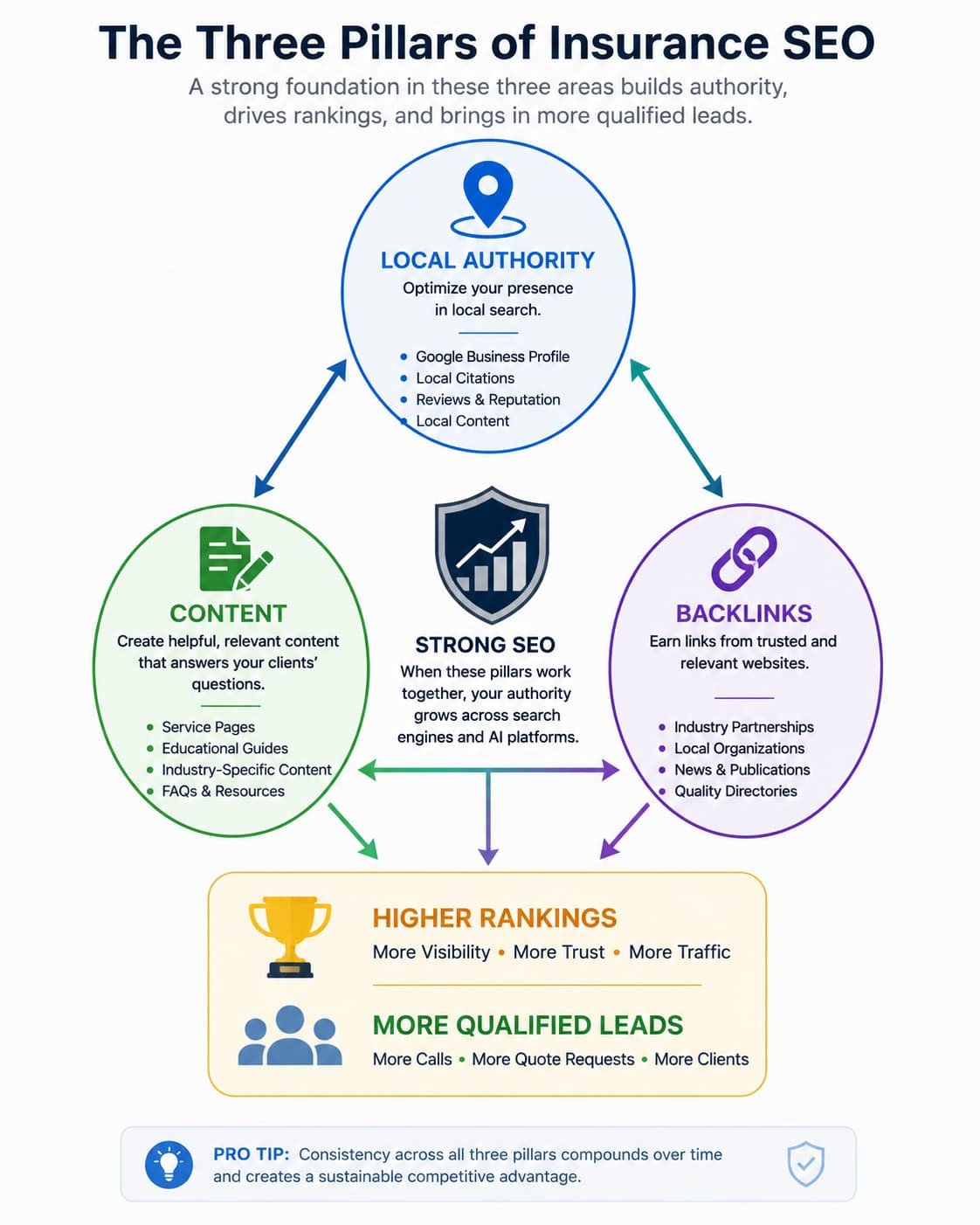
Successful insurance SEO can be simplified into three core pillars:
- Local authority helps Google understand where your brokerage operates and which communities you serve.
- Expert content demonstrates your knowledge and answers the questions prospects ask before requesting a quote.
- Backlinks build authority by showing that other reputable websites trust your business.
These three elements work together. Strong content earns backlinks, backlinks strengthen your authority, and local signals improve your visibility for nearby searches.
| Ranking Factor | Why It Matters |
| Local Signals | Help your brokerage appear in Google Maps and local search results. |
| Content | Demonstrates expertise across the insurance products and industries you serve. |
| Backlinks | Increase your website’s authority and trustworthiness. |
For most independent brokers, local authority should be the priority. Ranking first for “Insurance Broker in Tampa” is significantly more valuable than appearing on page three for “Business Insurance.”
Start by dominating your primary market before expanding into neighboring cities or additional insurance specialties.
This approach also aligns with how Google and AI search evaluate expertise. Demonstrating deep knowledge within a clearly defined geographic area is far more effective than trying to cover every insurance product nationwide.
The same principle applies to specialization. A brokerage known for contractor insurance, healthcare practices, trucking companies, or restaurants often builds topical authority faster than one attempting to target every possible industry equally.
A Practical Example
Imagine a brokerage located in Denver that specializes in commercial insurance.
Instead of creating one generic service page, they build dedicated resources such as:
- Commercial Insurance Broker in Denver
- Contractor Insurance in Denver
- Restaurant Insurance in Denver
- Cyber Liability Insurance for Colorado Businesses
- Workers’ Compensation Insurance in Denver
Each page targets a specific audience while reinforcing the brokerage’s expertise across commercial insurance. Together, these pages create a strong topical cluster that benefits both traditional SEO and AI-powered search.
This focused strategy is far more effective than publishing dozens of thin pages targeting broad national keywords.
Google Business Profile: Your Most Valuable Local SEO Asset
If you only implement one recommendation from this guide, make it your Google Business Profile.
For local insurance brokers, no other SEO activity delivers a better combination of visibility, lead quality, and return on investment.
Your Google Business Profile determines how your brokerage appears in Google Maps and the Local Pack-the group of businesses displayed above traditional organic search results for local searches.
For searches such as “insurance broker near me” or “commercial insurance Denver”, appearing in this section often generates more phone calls than ranking lower in the standard organic listings.
An additional benefit is visibility. When your brokerage appears in both the Local Pack and Google’s organic results, potential clients see your business twice on the same search results page, increasing trust and improving click-through rates.
Google Business Profile Optimization Checklist
| Task | Why It Matters |
| Verify your business | Required before your profile can reach its full visibility. |
| Select accurate business categories | Helps Google understand the services you provide. |
| Keep your NAP consistent | Builds trust across Google and local directories. |
| Define your service areas | Expands visibility across the communities you serve. |
| Add high-quality photos | Improves profile engagement and credibility. |
| Collect Google reviews regularly | One of the strongest local ranking signals. |
| Respond to every review | Shows engagement and builds customer trust. |
| Publish Google Posts | Keeps your profile active with fresh content. |
Rather than asking for reviews occasionally, build review collection into your normal customer process. The best opportunities usually come immediately after successfully placing coverage, resolving a claim issue, or helping a client save money during renewal.
For example, sending a short follow-up email with a direct Google review link typically produces far better results than making a general request weeks later.
Finally, monitor your Questions & Answers section. Adding answers to common questions before customers ask them helps control your messaging while providing another useful source of information for Google and AI-powered search.
Keyword Research for Insurance Brokers
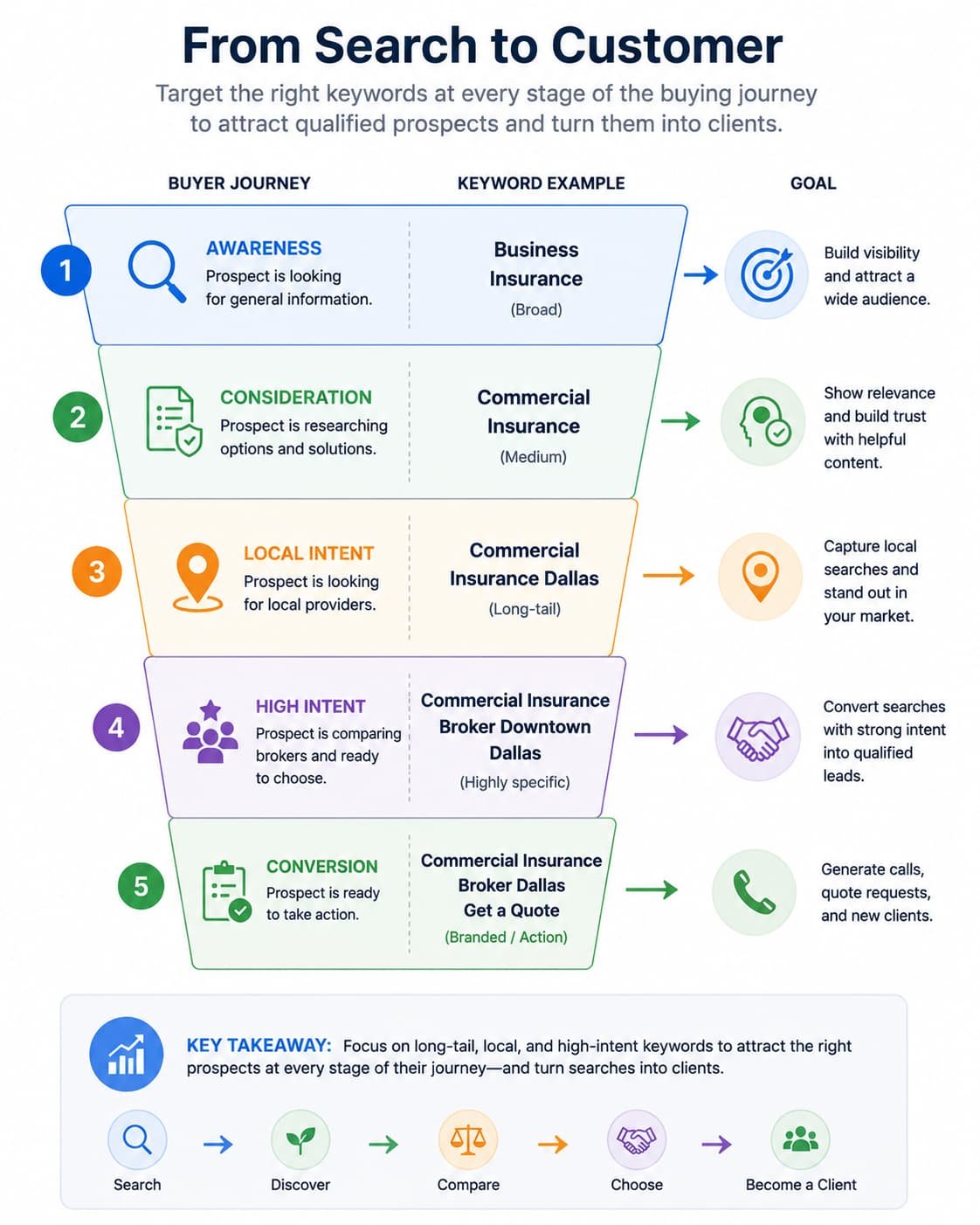
Keyword research helps you identify the searches your ideal clients use before requesting a quote. Choosing the right keywords means attracting prospects who are actively looking for the insurance products and expertise your brokerage provides.
Rather than chasing the highest search volume, focus on keywords that demonstrate clear buying intent and match your services.
Prioritize Search Intent
Prospects search differently depending on where they are in the buying journey.
| Search Intent | Example Search | Recommended Content |
| Informational | What does general liability insurance cover? | Educational guides and blog posts |
| Comparison | Insurance broker vs insurance agent | Comparison articles |
| Commercial | Commercial insurance broker Dallas | Service and location pages |
| Transactional | Get business insurance quote | Landing pages with clear CTAs |
An effective SEO strategy targets all four stages, guiding prospects from research to requesting a quote.
Focus on High-Value Keyword Groups
Most insurance broker keywords fall into four categories.
| Keyword Type | Examples |
| Local Services | Insurance broker Denver, Commercial insurance Dallas, Medicare broker near me |
| Insurance Products | General liability insurance, Workers’ compensation, Cyber liability insurance |
| Industry Niches | Insurance for restaurants, Contractors insurance, Trucking insurance |
| Questions | How much business insurance do I need? What does umbrella insurance cover? |
Local service keywords usually generate the highest-quality leads because they combine purchase intent with geographic relevance.
Target Long-Tail Keywords
National brands and comparison websites dominate broad insurance keywords. Independent brokers are far more likely to succeed by targeting long-tail searches.
| Highly Competitive | Better Opportunity |
| Business insurance | Commercial insurance broker in Dallas |
| Car insurance | Independent auto insurance broker in Tampa |
| Cyber insurance | Cyber liability insurance for healthcare providers |
| Contractor insurance | General liability insurance for roofing contractors |
Although long-tail keywords attract fewer searches individually, they usually convert significantly better because users know exactly what they’re looking for.
Useful Keyword Research Tools
You don’t need expensive software to begin researching keywords.
- Google Search Console reveals the searches already generating impressions and clicks.
- Google Keyword Planner provides keyword ideas and approximate search volumes.
- Google Autocomplete, People Also Ask, and Related Searches help uncover real customer questions.
- Ahrefs, Semrush, and Ubersuggest offer deeper competitor and keyword analysis as your SEO strategy grows.
Create a Keyword Map
Every important keyword should have one dedicated page.
For example:
| Keyword | Target Page |
| Commercial Insurance Denver | Commercial Insurance Service Page |
| Contractor Insurance Denver | Industry Landing Page |
| Cyber Liability Insurance Colorado | Dedicated Service Page |
| Insurance Broker vs Agent | Educational Blog Article |
This simple keyword map prevents multiple pages from competing for the same search term while making your website easier for both Google and AI systems to understand.
Content Strategy: Build Authority, Not Just Articles
Publishing more content doesn’t automatically improve your rankings. The goal isn’t to produce the most articles-it’s to become the most trusted insurance resource in your market.
Every page should answer a real customer question, demonstrate genuine expertise, and help prospects move one step closer to requesting a quote.
Google’s Helpful Content system and modern AI search reward content written by people with real experience. As an insurance broker, your competitive advantage isn’t AI-generated text-it’s your daily experience helping clients compare policies, solve coverage problems, and navigate claims.
Use AI as a writing assistant, not as the expert. The knowledge, examples, and recommendations should come from your brokerage.
1. Create Strong Location Pages
Location pages are often the highest-converting pages on an insurance broker’s website because they target prospects actively looking for local services.
Avoid creating dozens of nearly identical pages that only replace the city name. Instead, build pages with genuinely useful local information.
A strong location page should include:
- Insurance products available in that market.
- Industries commonly served.
- Local risks or regulations.
- Frequently asked questions.
- Testimonials from local clients.
- A clear call to request a quote.
Example:
Commercial Insurance in Denver
- General Liability
- Workers’ Compensation
- Commercial Auto
- Cyber Liability
- Coverage for contractors and construction companies
This provides significantly more value than publishing the same generic page for twenty different cities.
2. Build Dedicated Service Pages
Every major insurance product deserves its own page.
Rather than listing every service on a single page, create comprehensive resources covering:
- Who needs the coverage.
- What it protects.
- Common exclusions.
- Typical policy limits.
- Factors affecting cost.
- Frequently asked questions.
These pages become your primary landing pages for commercial-intent searches.
3. Publish Educational Guides
Educational content helps prospects during the research stage while building topical authority.
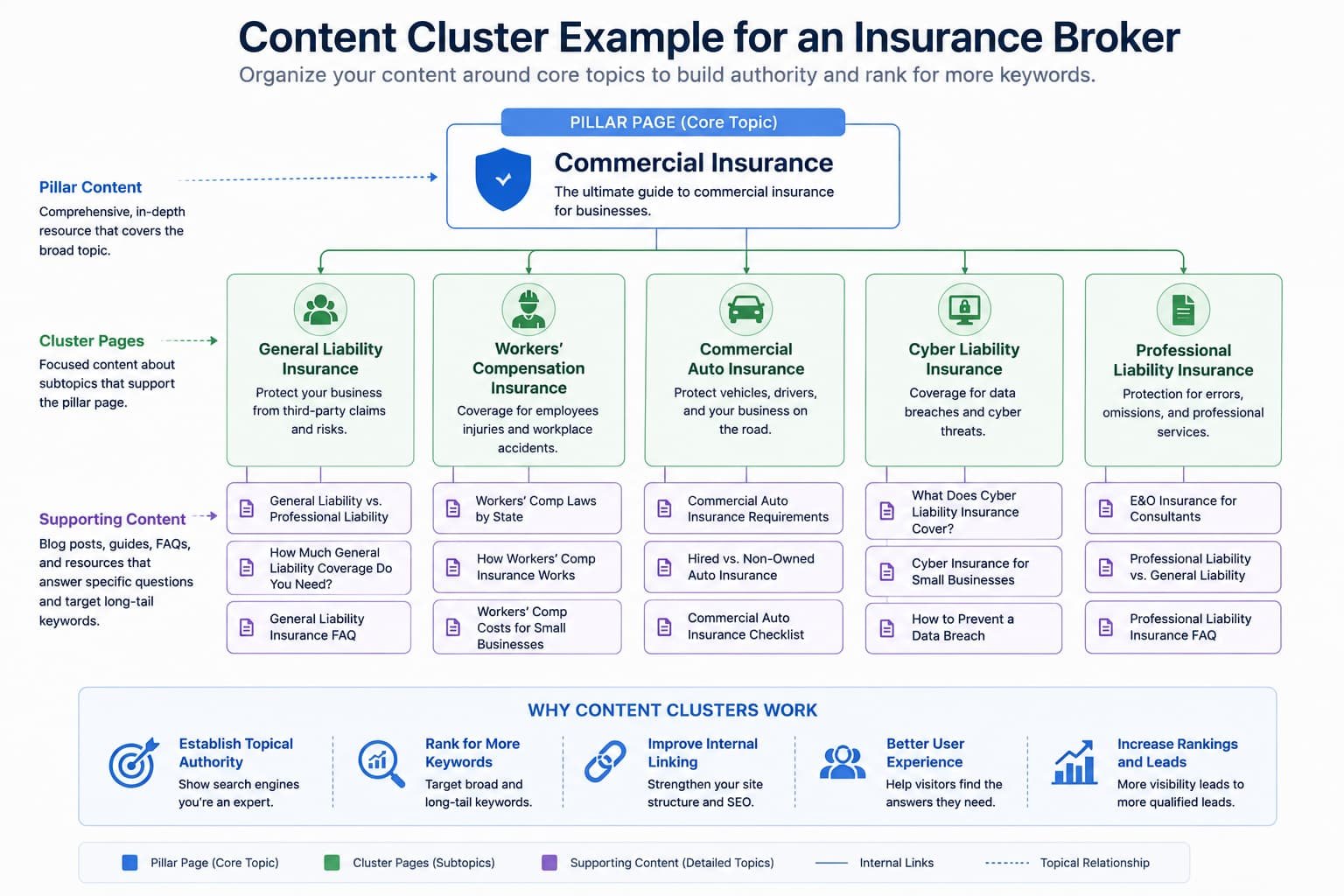
Instead of writing short blog posts covering dozens of unrelated subjects, organize your content into topic clusters.
For example:
| Pillar Page | Supporting Articles |
| Commercial Insurance Guide | General Liability
Workers’ Compensation Commercial Auto Cyber Liability Business Owner’s Policy (BOP) |
| Homeowners Insurance Guide | Flood Insurance
Umbrella Insurance Replacement Cost Home Insurance Claims |
Each supporting article links back to the pillar page, while the pillar links to every supporting resource. This structure strengthens topical authority and makes your website easier for both search engines and AI systems to understand.
4. Create Industry-Specific Content
One of the biggest advantages independent brokers have is specialization.
Instead of publishing generic insurance articles, create content for the industries you serve most often.
Examples include:
- Insurance for Contractors
- Insurance for Restaurants
- Insurance for Medical Practices
- Insurance for Law Firms
- Insurance for Trucking Companies
- Insurance for Property Managers
Industry-specific content usually ranks faster because it targets highly specific searches with lower competition.
5. Publish “Predict and Prevent” Content
Most insurance websites only explain policies. Great broker websites help clients reduce risk before a claim happens.
Examples include:
- Preparing Your Business for Hurricane Season
- Winter Risk Checklist for Commercial Properties
- How Restaurants Can Reduce Liability Claims
- Cybersecurity Tips for Small Businesses
- What To Do Immediately After a Commercial Vehicle Accident
This type of content positions your brokerage as a trusted advisor rather than simply an insurance seller. It also tends to attract backlinks and performs well in AI-generated search results because it provides practical guidance rather than promotional content.
Quality Always Beats Quantity
Publishing one exceptional article each month is far more effective than publishing several short, generic posts.
Every piece of content should answer a specific question, demonstrate real expertise, include practical examples, and naturally guide readers toward requesting professional advice when appropriate.
As your content library grows, your authority grows with it. That authority benefits every page on your website through stronger internal linking, improved topical relevance, and greater trust from both Google and AI search platforms.
On-Page and Technical SEO
Even the best content won’t perform well if your website is difficult to crawl, slow to load, or frustrating to use. On-page and technical SEO ensure that both search engines and visitors can easily access, understand, and navigate your website.
The good news is that most improvements are straightforward and provide long-term benefits for both traditional SEO and AI-powered search.
Optimize Every Important Page
Every service page, location page, and blog post should follow the same optimization checklist.
| Element | Best Practice |
| Title Tag | Include the primary keyword naturally near the beginning. |
| Meta Description | Write a compelling summary that encourages clicks. |
| H1 Heading | Use one clear H1 that describes the page’s topic. |
| Subheadings | Organize content with logical H2 and H3 headings. |
| URL | Keep URLs short, descriptive, and keyword-focused. |
| Internal Links | Link related service pages, guides, and location pages together. |
| Images | Compress images and write descriptive alt text. |
Consistency across your website makes it easier for search engines to understand your content while improving the user experience.
Improve Website Performance
Fast websites rank better, keep visitors engaged longer, and generate more inquiries.
Focus on these priorities:
- Compress and properly size images.
- Use reliable, high-performance hosting.
- Minimize unnecessary plugins and scripts.
- Enable browser caching.
- Use a Content Delivery Network (CDN) if you serve multiple regions.
Google’s PageSpeed Insights is an excellent free tool for identifying performance issues and prioritizing improvements.
Optimize for Mobile Users
Most insurance-related searches now happen on mobile devices. Your website should provide the same experience on a smartphone as it does on a desktop.
Check that:
- Text is easy to read without zooming.
- Buttons are large enough to tap comfortably.
- Navigation is simple.
- Quote request forms work flawlessly on mobile devices.
- Phone numbers are clickable.
Small usability improvements often have a significant impact on conversion rates.
Build a Clear Website Structure
A well-organized website helps both users and search engines understand how your content is connected.
A simple structure might look like this:
- Home
- Commercial Insurance
- General Liability
- Workers’ Compensation
- Commercial Auto
- Cyber Liability
- Personal Insurance
- Auto Insurance
- Home Insurance
- Umbrella Insurance
- Industries
- Locations
- Resources
- Contact
This logical hierarchy improves crawlability while strengthening your topical authority through internal linking.
Use Schema Markup
Schema markup provides structured information that helps search engines and AI platforms interpret your content more accurately.
For most insurance broker websites, these schema types provide the greatest value.
| Schema | Purpose |
| InsuranceAgency / LocalBusiness | Business details and local relevance. |
| Article | Educational blog posts and guides. |
| FAQPage | Frequently asked questions. |
| Review | Customer ratings and testimonials. |
| Breadcrumb | Helps search engines understand site structure. |
Most modern CMS platforms and SEO plugins allow you to implement schema without writing code, making it one of the easiest technical improvements with long-term benefits.
Essential SEO Tools
You don’t need dozens of SEO tools to maintain a healthy website. Start with these essentials:
- Google Search Console – Monitor indexing, search performance, and technical issues.
- Google PageSpeed Insights – Improve loading speed and Core Web Vitals.
- Google Analytics – Measure user behavior and conversions.
- Ahrefs or Semrush – Analyze backlinks, competitors, and keyword performance.
Combined, these tools provide nearly everything needed to monitor and improve your brokerage’s SEO performance.
Local Citations and Link Building
Strong local SEO depends on more than your website. Search engines also evaluate how consistently your brokerage appears across the web and whether reputable websites recommend your business.
That’s where local citations and backlinks become essential.
Build Consistent Local Citations
A local citation is any online mention of your brokerage’s name, address, and phone number (NAP). Consistent citations help Google verify that your business is legitimate and serves a specific geographic area.
Your NAP should be identical everywhere. Even small differences in your business name, address format, or phone number can create confusion for search engines.
Start by claiming and updating your listings on the platforms that matter most.
| Directory | Priority |
| Google Business Profile | ★★★★★ |
| Bing Places | ★★★★★ |
| Apple Business Connect | ★★★★☆ |
| Yelp | ★★★★☆ |
| Facebook Business | ★★★★☆ |
| Better Business Bureau | ★★★★☆ |
| Insurance industry directories | ★★★★★ |
| Local Chamber of Commerce | ★★★★★ |
Rather than creating hundreds of low-quality directory listings, focus on building a smaller number of accurate, trusted citations. Quality and consistency matter far more than quantity.
Earn High-Quality Backlinks
Backlinks remain one of Google’s strongest ranking signals because they act as recommendations from other websites.
However, not all backlinks have the same value. One relevant link from a respected local organization can be worth far more than dozens of links from low-quality directories.
For insurance brokers, some of the best backlink opportunities include:
| Source | Why It Helps |
| Local Chamber of Commerce | Builds local authority and trust. |
| Business Associations | Relevant local business citations and backlinks. |
| Insurance Carrier Directories | Highly relevant industry links. |
| Professional Organizations | Demonstrates expertise and credibility. |
| Local News Websites | Strong authority and local relevance. |
| Industry Publications | Excellent topical authority. |
| Community Sponsorships | Natural local backlinks. |
Create Content Worth Linking To
The most sustainable way to earn backlinks is by publishing resources people genuinely want to reference.
Examples include:
- Industry-specific insurance guides.
- Local business risk checklists.
- Claims preparation guides.
- Coverage comparison articles.
- Annual insurance cost reports.
- Interactive calculators and downloadable templates.
Content like this attracts links naturally while strengthening your brokerage’s reputation as a trusted industry resource.
Avoid Black-Hat SEO
Buying backlinks, participating in link schemes, or using private blog networks (PBNs) may produce short-term gains but pose significant long-term risks.
Instead, focus on earning links through useful content, local partnerships, community involvement, and professional relationships. These backlinks are more valuable, more sustainable, and fully aligned with Google’s quality guidelines.
Measuring SEO Success
SEO should ultimately be measured by business growth, not rankings alone.
Higher rankings only matter if they generate qualified leads, quote requests, and new clients.
Monitor both your website’s visibility and your business outcomes.
| Metric | Why It Matters |
| Organic Traffic | Shows whether your visibility is increasing. |
| Keyword Rankings | Tracks progress for priority searches. |
| Google Business Profile Views | Measures local visibility. |
| Phone Calls | Direct lead indicator. |
| Quote Requests | Measures qualified inquiries. |
| Conversion Rate | Shows how effectively visitors become leads. |
| New Policies Sold | The most important business KPI. |
Google Search Console and Google Analytics should form the foundation of your reporting. Together, they show how prospects find your website, what they do after arriving, and which pages generate the most inquiries.
For local SEO, regularly monitor your Google Business Profile performance, including calls, website visits, direction requests, and review growth.
If you’re investing in AI-focused content, periodically test questions in ChatGPT, Gemini, Perplexity, and Google AI Overviews to see whether your brokerage appears as a cited source. While AI visibility is still difficult to measure precisely, it is becoming an increasingly valuable indicator of authority.
Review your SEO performance every month, but focus on long-term trends rather than weekly ranking fluctuations. Consistent growth in qualified leads is a much stronger measure of success than reaching a specific keyword position.
A Realistic SEO Timeline and 90-Day Action Plan
SEO is a long-term investment. While some improvements-such as Google Business Profile optimization-can generate results within weeks, building sustainable organic visibility takes consistent effort over several months.
The exact timeline depends on your market, competition, and the current state of your website, but the following expectations are realistic for most insurance brokerages.
| Timeframe | Typical Results |
| First Month | Google Business Profile improvements, technical fixes, better local visibility. |
| 2–4 Months | Location pages and service pages begin ranking for local searches. |
| 3–6 Months | Educational content starts generating consistent organic traffic. |
| 6–12 Months | Growing topical authority, more qualified leads, stronger local rankings. |
| 12+ Months | SEO becomes a predictable, long-term source of new business. |
Rather than trying to improve everything at once, focus on the activities that deliver the greatest long-term impact.
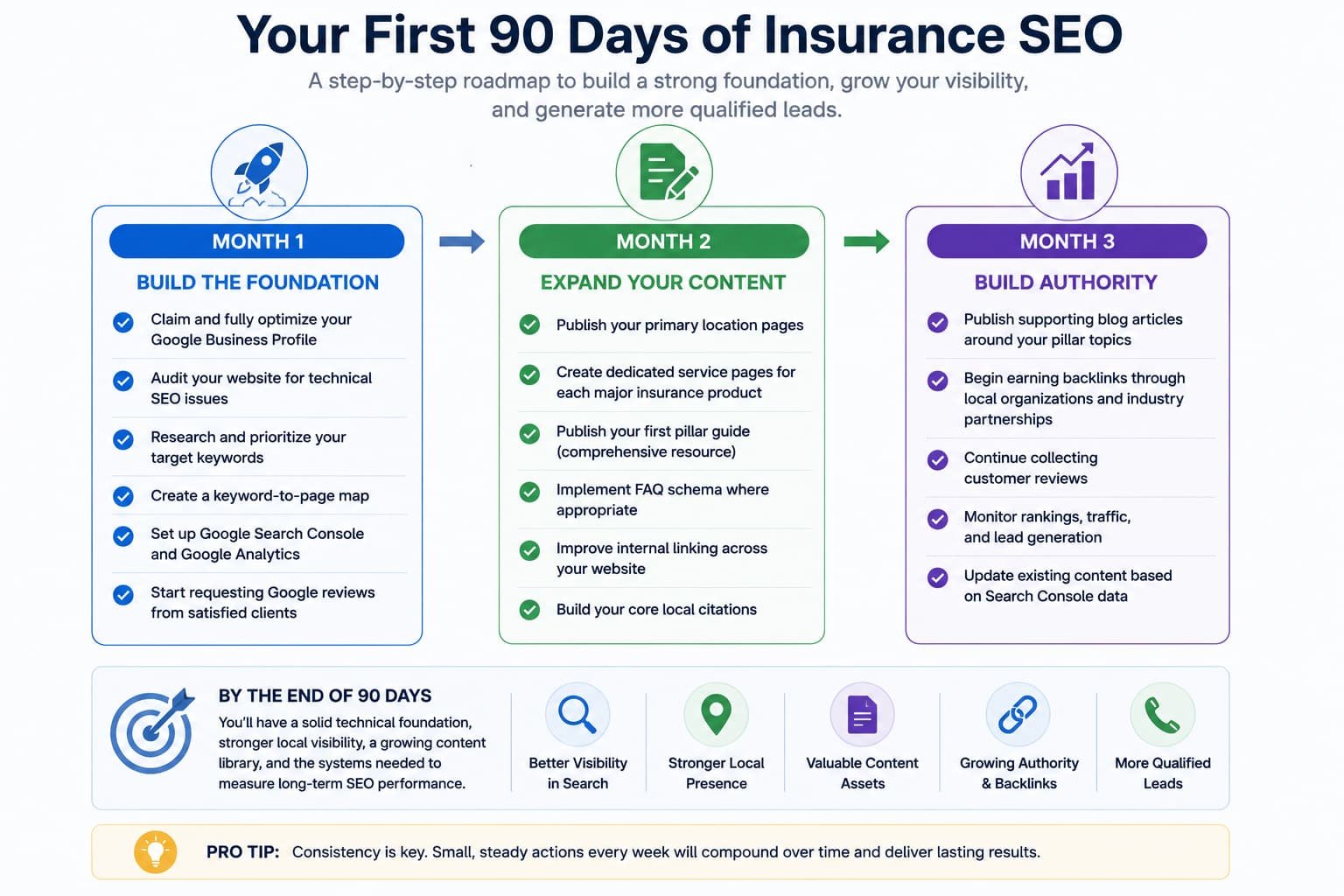
Days 1–30: Build the Foundation
- Claim and fully optimize your Google Business Profile.
- Audit your website for technical SEO issues.
- Research and prioritize your target keywords.
- Create a keyword-to-page map.
- Set up Google Search Console and Google Analytics.
- Start requesting Google reviews from satisfied clients.
Days 31–60: Expand Your Content
- Publish your primary location pages.
- Create dedicated service pages for each major insurance product.
- Publish your first pillar guide.
- Implement FAQ schema where appropriate.
- Improve internal linking across your website.
- Build your core local citations.
Days 61–90: Build Authority
- Publish supporting blog articles around your pillar topics.
- Begin earning backlinks through local organizations and industry partnerships.
- Continue collecting customer reviews.
- Monitor rankings, traffic, and lead generation.
- Update existing content based on Search Console data.
By the end of the first 90 days, you’ll have a solid technical foundation, stronger local visibility, a growing content library, and the systems needed to measure long-term SEO performance.
Should You Manage SEO Yourself or Hire an Agency?
Many insurance brokers successfully manage the basics of SEO themselves. Others prefer to outsource technical work while focusing on serving clients. The right approach depends on your available time, experience, and growth goals.
| DIY SEO | Hire an SEO Professional |
| Google Business Profile management | Technical SEO audits |
| Collecting customer reviews | Advanced keyword research |
| Writing expert insurance content | Link-building campaigns |
| Basic page updates | Large website migrations |
| Publishing blog posts | Ongoing SEO strategy and reporting |
A hybrid approach often delivers the best results. Your brokerage provides the industry expertise and real-world examples, while SEO specialists handle technical optimization, strategy, and performance analysis.
If you hire an agency or consultant, avoid anyone who guarantees first-page rankings or promises hundreds of backlinks every month. Sustainable SEO is built on expertise, useful content, and long-term authority-not shortcuts.
Conclusion
Insurance brokers don’t need to compete with national carriers on massive advertising budgets. Instead, they should focus on what independent brokerages do best: serving local markets, providing expert advice, and helping clients compare coverage across multiple insurance companies.
That competitive advantage aligns perfectly with modern search.
By combining traditional SEO with GEO and AEO, your brokerage can increase visibility across Google, Google AI Overviews, ChatGPT, Gemini, Perplexity, and other AI-powered search platforms.
Start by building a strong Google Business Profile, creating helpful location and service pages, publishing expert content, and earning trust through reviews, backlinks, and consistent local authority. As your content and reputation grow, your brokerage becomes easier for both search engines and AI systems to discover, trust, and recommend.
SEO isn’t a one-time project-it’s a long-term investment that compounds over time. The brokers who consistently publish helpful content and build genuine authority will be the ones generating qualified leads for years to come.
Frequently Asked Questions
Is SEO worth it for insurance brokers?
Yes. SEO helps insurance brokers generate qualified local leads, reduce reliance on paid advertising, and build a long-term marketing asset that continues producing results over time.
How long does SEO take to produce results?
Google Business Profile improvements may generate leads within a few weeks, while competitive organic rankings typically require several months of consistent work. Most brokerages see meaningful growth within six to twelve months.
What’s the most important SEO activity for an insurance broker?
Optimizing your Google Business Profile is usually the highest-impact starting point. Combined with strong location pages, customer reviews, and expert content, it forms the foundation of local SEO.
Can independent brokers compete with large insurance companies?
Yes. Rather than targeting broad national keywords, independent brokers should focus on local searches, niche insurance products, and industry-specific expertise where they can provide more value than national carriers.
How does AI search affect insurance SEO?
More prospects now use AI platforms to research insurance before contacting a broker. Creating well-structured, experience-driven content improves the likelihood of being referenced by AI-powered search engines alongside traditional Google rankings.
Sources and Research
- Nationwide AgentBlog – SEO for Insurance Agents
- Sonant AI – SEO for Insurance Companies and Agents
- Insurance Advertising Masters – SEO for Insurance Agents Guide
- Advisor Evolved – SEO for Insurance Agents
- Pinnacle Financial Services – How to Do SEO
- Google Search Central – Creating Helpful, Reliable, People-First Content
- Google Search Central – How Search Works
- Google Search Central – Understanding E-E-A-T and Quality Rater Guidelines
- Google – Core Web Vitals and Page Experience
- Google Business Profile – Official Help Center