

Choosing a financial advisor is rarely an impulsive decision. Prospective clients may spend weeks researching retirement strategies, investment management, tax planning, and wealth preservation before they contact a professional. During that process, search engines often become one of their primary sources of information.
This creates a valuable opportunity for financial advisors. By appearing prominently when potential clients search for answers, your firm can establish familiarity and credibility long before the first consultation. A useful article about retirement planning, for example, may introduce your business to someone who later needs professional help managing their assets or preparing for retirement.
However, SEO for financial advisors is more complex than publishing a few blog posts or adding location-based keywords to a website. Financial content can influence decisions involving investments, retirement savings, taxes, and long-term financial security. As a result, accuracy, transparency, and demonstrable expertise are particularly important.
An effective strategy must therefore balance search visibility with professional trust. Your website needs to help search engines understand your services while giving prospective clients enough reliable information to feel confident about taking the next step.
Why SEO Matters for Financial Advisors
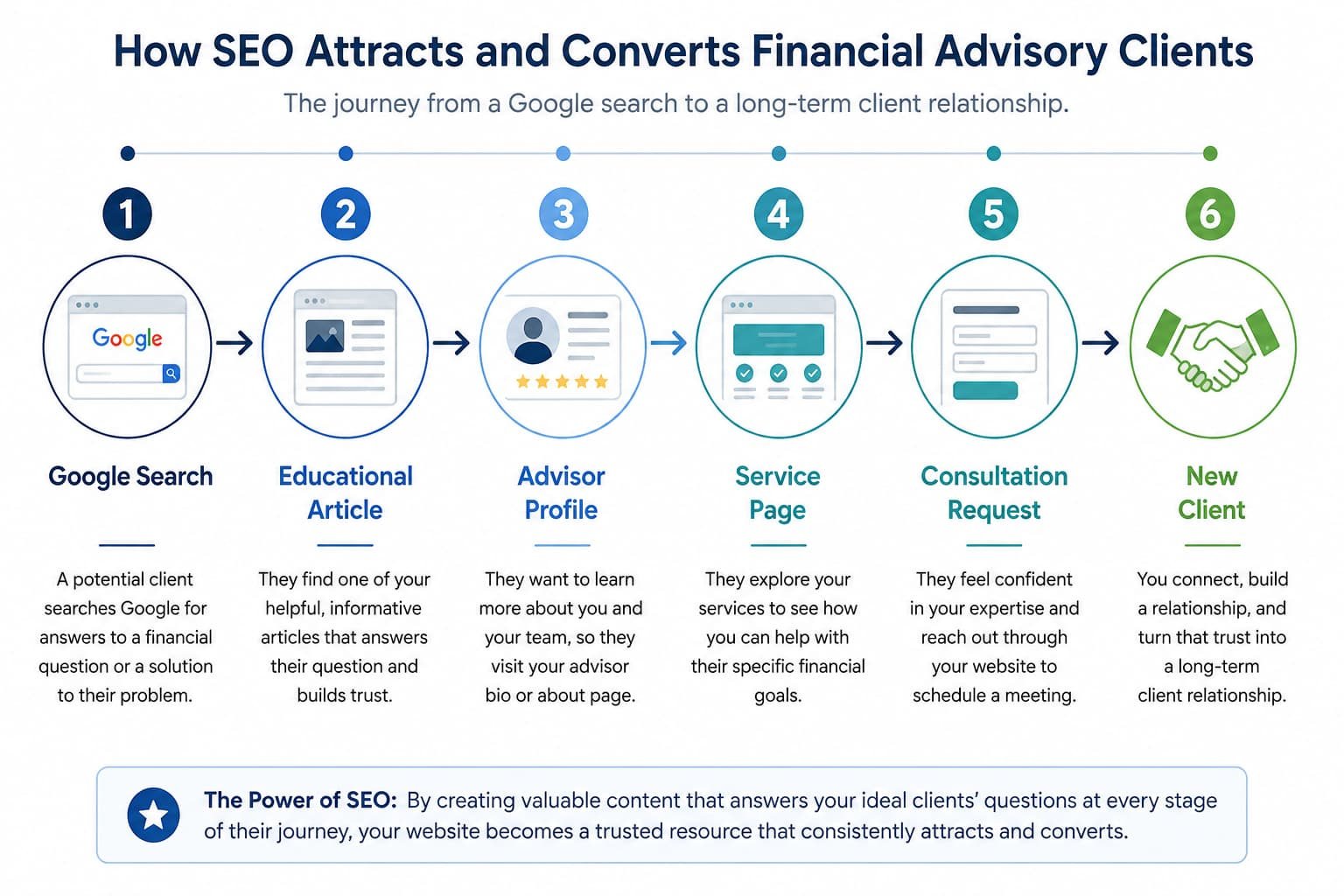
Most people do not search for a specific advisory firm unless they already know its name. Instead, they search for a service, a financial concern, or an advisor who works with clients in a particular location or at a particular life stage.
Typical searches may include:
- financial advisor near me
- fiduciary financial advisor in Chicago
- retirement planner for small business owners
- wealth management services
- how much money do I need to retire?
- financial advisor for high-net-worth families
Ranking for searches like these gives your firm access to people who are already considering financial advice. Unlike broad advertising campaigns, SEO can place your website in front of prospective clients while they are actively researching a problem or comparing potential solutions.
Prospective Clients Research Advisors Online
Before scheduling a consultation, a prospective client may review your services, professional background, credentials, investment philosophy, fee structure, and client profile. They may also compare your firm with several competitors and verify your professional history through resources such as FINRA BrokerCheck or the SEC Investment Adviser Public Disclosure database.
Your website is therefore more than a digital brochure. It is often an important part of the client’s due diligence process. Pages that contain vague claims, limited information, outdated biographies, or unclear service descriptions can weaken trust even when the firm itself is highly experienced.
SEO encourages you to answer the questions people ask during this research process. When these answers are clear, useful, and supported by genuine expertise, they can improve both search visibility and conversion potential.
Organic Visibility Can Produce Long-Term Value
Paid advertising can generate immediate visibility, but that visibility typically ends when the campaign budget stops. SEO works differently. A well-developed service page or educational guide can continue attracting relevant visitors long after it is published, provided the information remains accurate and the page is maintained.
This does not mean SEO produces instant results. Competitive financial keywords may require significant improvements to website authority, content depth, technical performance, and local relevance. However, rankings earned through a consistent strategy can become a durable source of website traffic and qualified inquiries.
The cumulative effect is particularly valuable. Each strong service page, local landing page, educational article, and professional profile adds another potential entry point for a prospective client to discover your firm.
SEO Supports Trust Before the First Conversation
Financial advice requires a high level of trust. Prospective clients may be considering whether to give an advisor access to sensitive information and responsibility for decisions that affect their future financial security.
Your search presence can begin building that trust before direct contact occurs. Detailed articles demonstrate how you approach financial questions. Advisor biographies introduce the people behind the firm. Transparent explanations of services, fees, and client eligibility help visitors determine whether the relationship may be suitable.
These elements also align with Google’s guidance on creating helpful, reliable, people-first content. Google recommends making it clear who created the content, how it was produced, and why it exists. For financial advisory websites, this means identifying qualified authors, reviewing content for accuracy, and publishing information primarily to help the intended audience rather than to capture search traffic.
How People Search for Financial Advisors
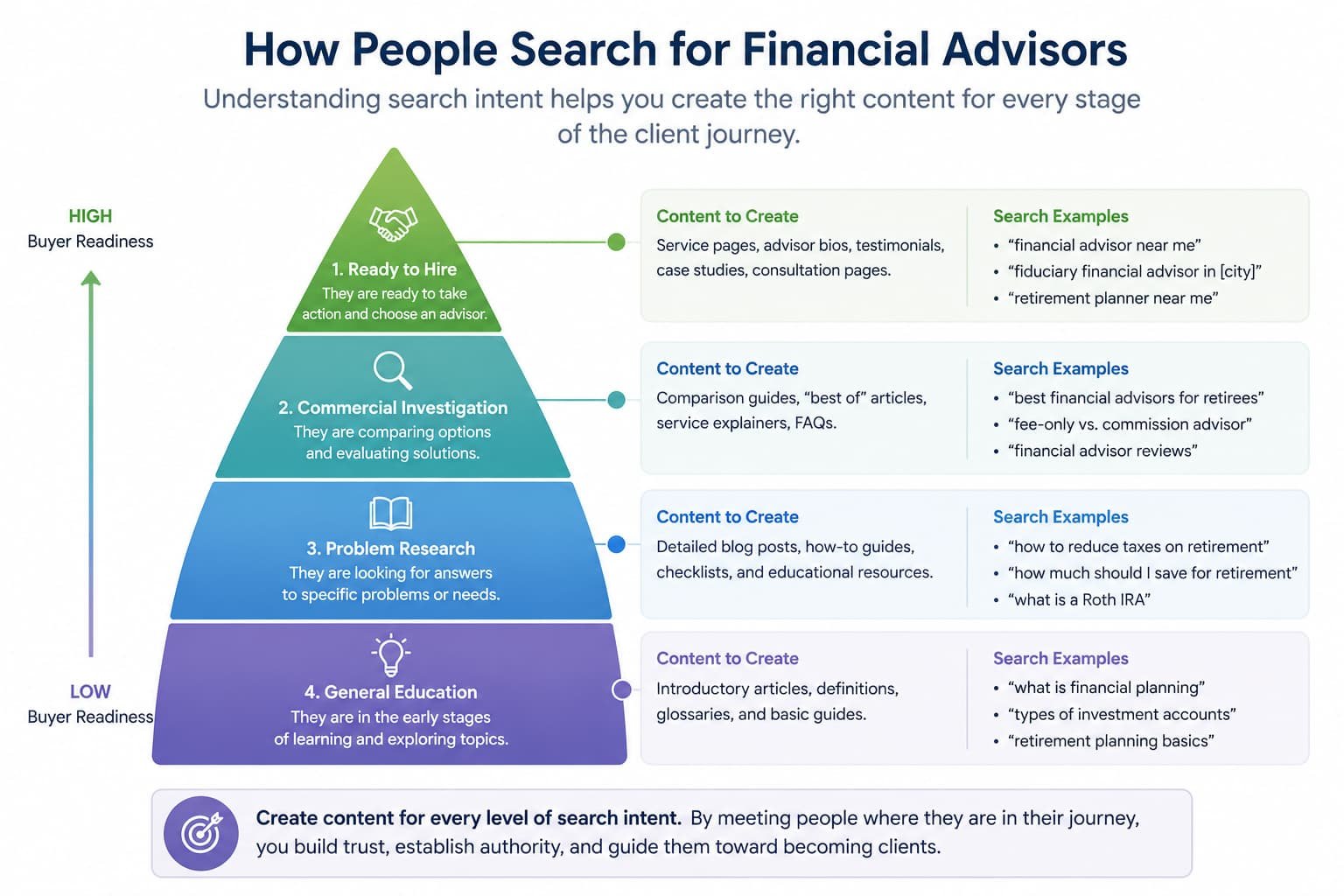
A successful SEO strategy begins with understanding search intent. Two people may use similar financial terms but expect very different results. One may want a general explanation, while another may be ready to schedule a consultation.
Financial advisor searches can generally be divided into three groups: informational, commercial, and local.
Informational Searches
Informational searches occur when someone is researching a financial question but may not yet be looking for an advisor. Examples include:
- When should I start planning for retirement?
- What is the difference between a Roth IRA and a traditional IRA?
- How does fiduciary financial advice work?
- How much should I save for retirement?
- What happens to my 401(k) when I change jobs?
These searches are usually best served by educational articles, guides, checklists, videos, calculators, and clearly written explanations. Although the visitor may not convert immediately, useful content introduces your firm early in the decision-making process.
Informational content can also support your service pages. A retirement planning service page, for example, can link to detailed resources about Social Security timing, retirement income, required minimum distributions, and healthcare costs. Together, these pages create a stronger topical structure than a single general service page could provide.
Commercial Searches
Commercial searches indicate that the user is comparing services or evaluating whether to hire a professional. Examples include:
- best financial advisor for retirement planning
- fee-only financial advisor
- financial planner for business owners
- wealth management firm for high-net-worth individuals
- financial advisor fees and services
These visitors need more than an educational definition. They want information that helps them compare providers and understand what makes a particular firm relevant to their situation.
Pages targeting commercial searches should clearly explain the services offered, the types of clients served, the advisor’s qualifications, the planning process, fee arrangements, and the next step for requesting a consultation. Unsupported promotional claims should be replaced with specific and verifiable information.
Local Searches
Many prospective clients prefer an advisor who understands their regional market or is available for in-person meetings. They may therefore search using phrases such as:
- financial advisor near me
- financial planner in Austin
- retirement advisor in Tampa
- wealth management firm in Boston
- fiduciary advisor near Denver
Google may display map results, local business profiles, directories, review platforms, and traditional organic listings for these searches. To compete effectively, financial advisory firms need consistent business information, a complete Google Business Profile, relevant client reviews, locally optimized service pages, and accurate citations across trusted directories.
Informational, commercial, and local searches should not be treated as isolated opportunities. They represent different stages of the same client journey. A person may first discover your firm through an educational article, return later through a local search, and finally visit a service page before requesting a consultation.
The Biggest SEO Challenges in Financial Services
Financial services are among Google’s most closely evaluated content categories because the information published can influence important life decisions related to investments, retirement planning, taxes, insurance, and wealth management. As a result, financial advisory websites face higher expectations than many other industries when it comes to demonstrating expertise, credibility, and trustworthiness.
This does not mean financial advisors cannot compete in organic search. It means successful SEO requires a stronger emphasis on quality, accuracy, transparency, and user experience than simply publishing large volumes of content.
Google Holds Financial Content to Higher Standards
Google classifies financial advice as Your Money or Your Life (YMYL) content. These are topics that could potentially affect a person’s financial stability, health, safety, or overall well-being.
Because of this, Google’s ranking systems evaluate much more than keywords. They also consider whether the content appears reliable, whether the website demonstrates genuine expertise, and whether users can clearly understand who created the information.
Google’s Helpful Content guidance encourages publishers to create content that demonstrates first-hand experience, expertise, authority, and trust. These principles are commonly referred to as E-E-A-T (Experience, Expertise, Authoritativeness, and Trustworthiness).
For financial advisors, this means content should not simply explain financial concepts. It should also demonstrate why readers can trust the information and the professionals behind it.
Example: Consider two financial advisors who both publish an article titled “How to Prepare for Retirement.” The first article provides general advice but does not identify the author, explain the advisor’s qualifications, or reference reliable financial sources. The second article is written by a Certified Financial Planner (CFP®), includes the author’s professional background, cites guidance from the SEC and FINRA, and was recently reviewed to reflect current retirement contribution limits. The second article gives readers more confidence in the information and provides stronger signals of expertise and trustworthiness, which aligns with Google’s recommendations for high-quality financial content.
Building Trust Takes Time
Unlike many industries where visitors may purchase immediately, financial advisory relationships often develop over weeks or even months. Prospective clients typically compare several firms, research credentials, review educational content, and evaluate whether an advisor appears knowledgeable and transparent.
Your website should support that research process by providing detailed service descriptions, advisor biographies, professional certifications, educational resources, FAQs, and clear contact information.
Displaying recognized credentials, such as CFP®, CFA®, or other relevant licenses where applicable, can further strengthen credibility. Any certifications or regulatory affiliations should always be presented accurately and in accordance with applicable compliance requirements.
Competition Is Strong in Nearly Every Market
Large wealth management firms, national investment companies, banks, insurance providers, and established local advisors often compete for the same high-value keywords.
Trying to rank immediately for extremely broad terms like “financial advisor” or “wealth management” can be difficult, particularly for smaller independent firms with newer websites.
A more effective strategy is to build topical authority around the services you actually provide. Instead of focusing on a handful of highly competitive keywords, develop comprehensive content covering the questions, services, and financial situations that matter most to your ideal clients.
For example, a retirement planning specialist could build a content cluster covering:
- Retirement income planning
- Social Security optimization
- Required Minimum Distributions (RMDs)
- 401(k) rollovers
- IRA contribution strategies
- Healthcare costs in retirement
- Retirement tax planning
This approach helps both search engines and users recognize your expertise within a specific area rather than presenting your website as a collection of unrelated articles.
Core SEO Strategies for Financial Advisors
Successful SEO combines multiple disciplines rather than relying on a single optimization tactic. Strong rankings typically result from consistent improvements in keyword research, content quality, technical performance, local visibility, and website authority.
Perform Keyword Research Around Client Intent
Keyword research should begin with the problems prospective clients are trying to solve, not with search volume alone.
Someone searching for how much should I save for retirement has different intentions than someone searching for retirement planner near me. Both searches may eventually lead to the same advisor, but they require different types of content.
A balanced keyword strategy should include:
- Service-based keywords
- Location-specific keywords
- Problem-focused searches
- Question-based searches
- Long-tail keywords with clear intent
Long-tail keywords often have lower search volume, but they can attract highly qualified visitors because the search intent is much more specific.
Examples include:
- financial advisor for physicians
- retirement planning for small business owners
- fiduciary advisor for retirees
- tax-efficient retirement withdrawals
- estate planning financial advisor
Keyword research tools such as Ahrefs, Semrush, Google Search Console, and Google’s autocomplete suggestions can all help identify opportunities that align with your services and target audience.
Create Helpful Financial Content
Educational content remains one of the strongest long-term SEO assets for financial advisory firms.
Rather than publishing articles solely to increase page count, focus on creating resources that answer genuine client questions. Each article should solve a specific problem, explain complex topics in plain language, and guide readers toward an appropriate next step.
Examples of valuable content include:
- Retirement planning guides
- Investment strategy overviews
- Tax planning articles
- Estate planning basics
- College savings strategies
- Market update articles
- Financial planning checklists
- Frequently asked questions
Whenever appropriate, support your explanations with references to authoritative organizations such as the Internal Revenue Service (IRS), the U.S. Securities and Exchange Commission (SEC), or other official regulatory bodies. Citing trustworthy sources can improve both user confidence and perceived content quality.
Content should also be reviewed regularly. Financial regulations, tax rules, retirement contribution limits, and investment guidance evolve, making periodic updates essential to maintaining content accuracy.
Optimize Every Important Page
High-quality content alone is rarely enough to achieve strong rankings. Search engines also rely on clear page structure and on-page optimization to understand what each page covers.
Every important service page should include:
- A unique title tag
- A compelling meta description
- One clear H1 heading
- Logical H2 and H3 sections
- Descriptive image alt text
- Internal links to related resources
- Clear calls to action
Pages should also avoid excessive keyword repetition. Modern SEO focuses on topical relevance rather than keyword density. Using natural language, related terminology, and answering related questions generally produces better results than repeatedly inserting the same keyword phrase.
Finally, make it easy for visitors to take action. Consultation request forms, phone numbers, scheduling options, and contact information should be visible without disrupting the overall user experience.
Build a Strong Technical SEO Foundation
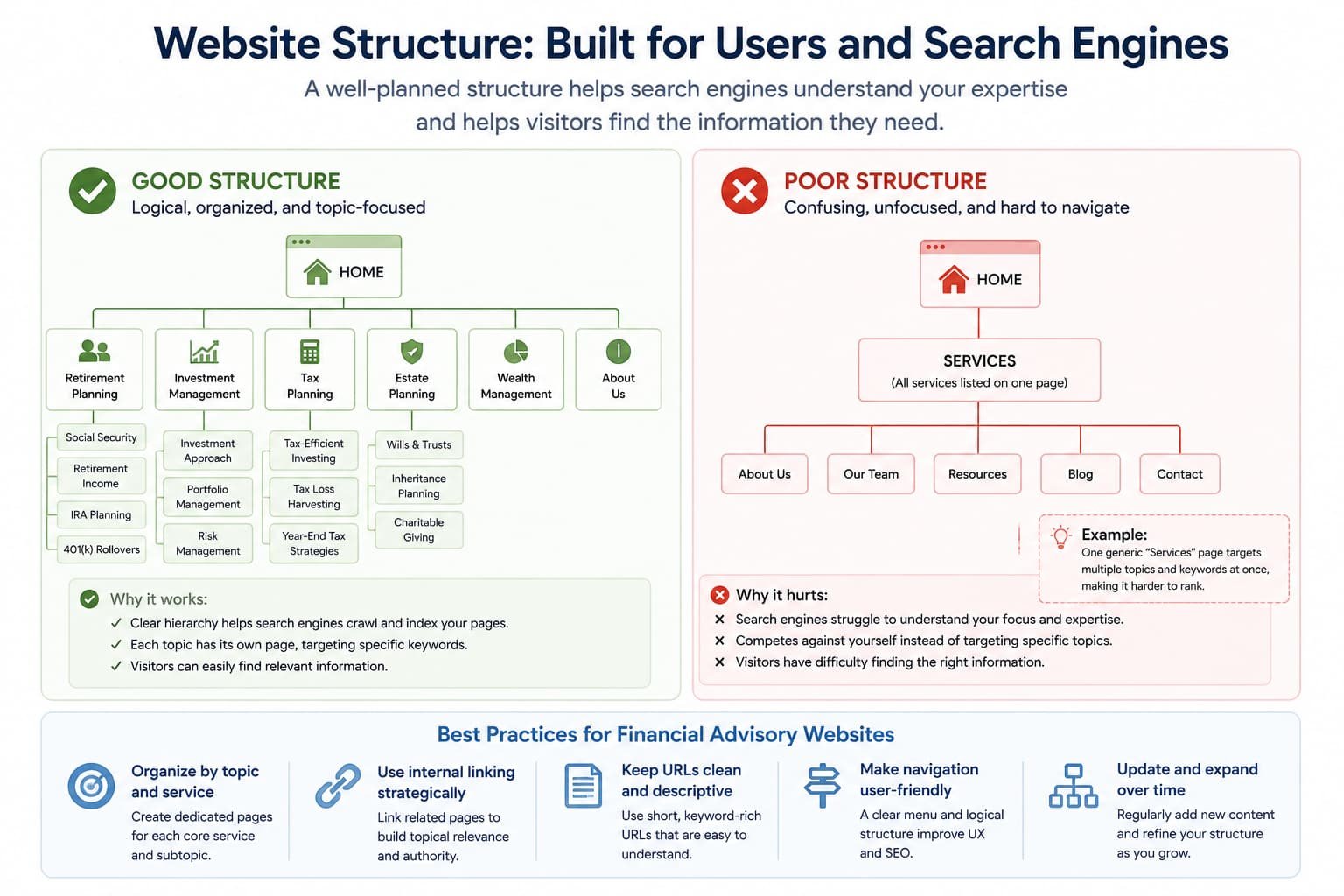
Even the most informative financial content may struggle to rank if search engines cannot efficiently crawl, index, and evaluate your website. Technical SEO ensures your site performs well for both users and search engines while supporting long-term organic growth.
Example: Imagine a financial advisory firm that offers retirement planning, estate planning, tax strategies, and investment management, but lists everything on a single “Our Services” page. A competing firm creates separate pages for each service, answers common client questions, and links related articles together through a logical content structure. The second website gives search engines much clearer signals about its areas of expertise while making it easier for prospective clients to find exactly the information they need.
Many financial advisory websites are built on modern content management systems such as WordPress, but they often accumulate technical issues over time. Broken links, duplicate pages, slow loading speeds, and indexing problems can all reduce search visibility.
A comprehensive technical SEO audit should evaluate:
- Core Web Vitals
- Mobile usability
- Page speed
- HTTPS implementation
- XML sitemaps
- Robots.txt configuration
- Indexation status
- Structured data
- Internal linking
- Broken pages and redirects
Google provides free tools such as Rich Results Test, PageSpeed Insights, and Google Search Console to help website owners identify technical issues and monitor search performance.
Financial advisory websites should also prioritize website security. Visitors are often submitting sensitive personal information through consultation forms, making HTTPS encryption and secure hosting essential for both user trust and compliance.
Strengthen Your Local SEO Presence
For many financial advisors, local visibility is one of the highest-value opportunities in organic search. Even firms that offer virtual consultations often work within specific states, cities, or regions where they have established expertise and licensing.
Local SEO helps search engines understand where your business operates and which geographic searches are most relevant to your services.
A strong local SEO strategy includes:
- Optimizing your Google Business Profile
- Maintaining consistent Name, Address, and Phone Number (NAP) information
- Building citations on reputable business directories
- Collecting authentic client reviews
- Creating location-specific landing pages
- Earning local backlinks from trusted organizations
Your Google Business Profile deserves particular attention. Complete business information, accurate service categories, updated office hours, professional photographs, and regular updates can all improve your visibility in Google’s Local Pack.
Reviews also play an important role in local trust. While financial advisors must always comply with applicable regulatory requirements regarding testimonials, positive client feedback can significantly influence prospective clients during their research process.
Building Trust Through SEO
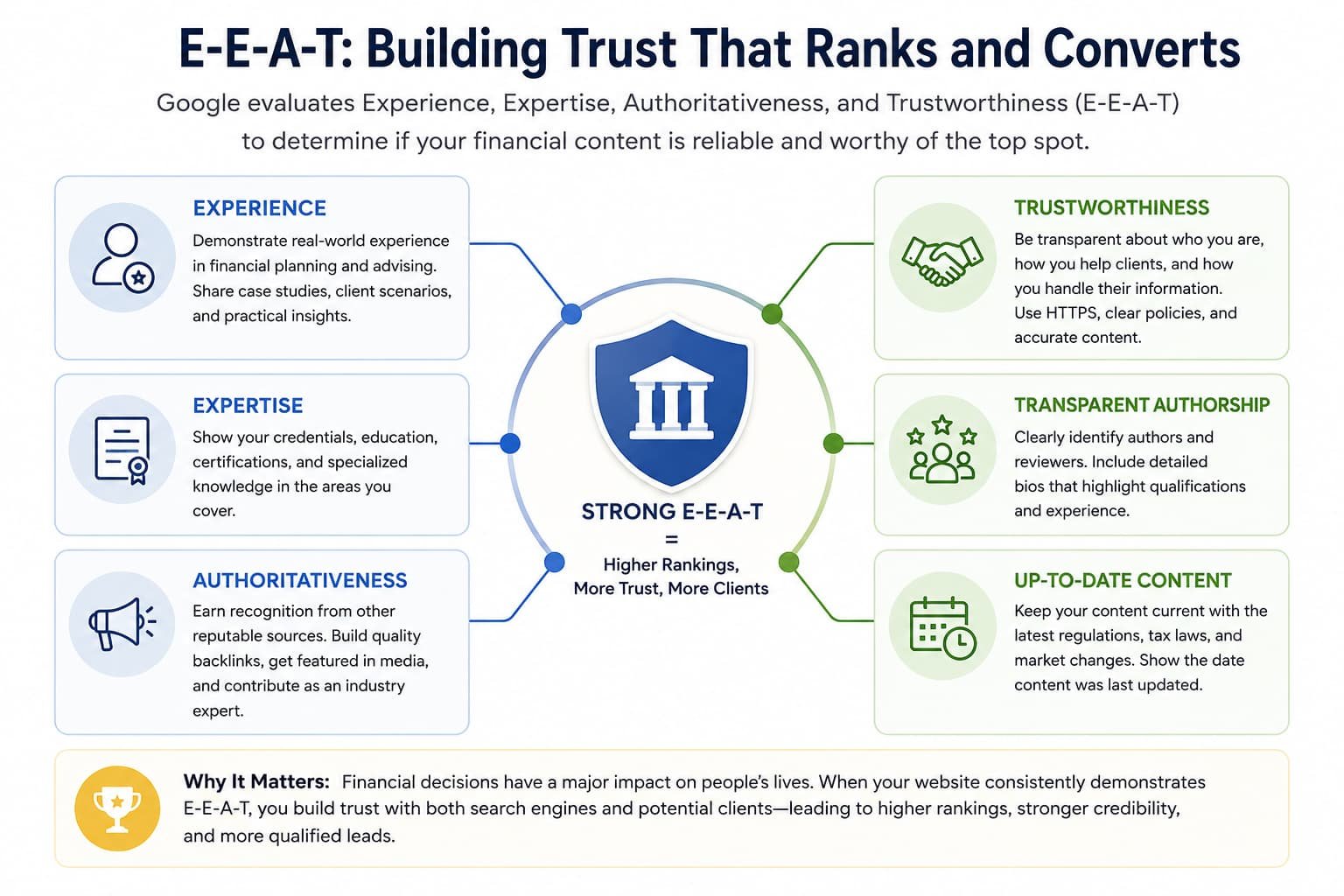
Trust is arguably the most important ranking and conversion factor for financial advisory websites. Visitors are not simply purchasing a product. They are evaluating whether your firm is qualified to guide decisions that may affect their retirement savings, investments, tax planning, or long-term financial security.
Effective SEO supports this process by making trust visible throughout the website rather than limiting it to an “About Us” page.
Show Who Is Behind the Advice
Financial content should clearly identify its authors and explain why they are qualified to discuss the subject.
Advisor biography pages should include:
- Professional experience
- Relevant certifications
- Education
- Areas of specialization
- Professional memberships
- Speaking engagements
- Published articles
- Media appearances
Where appropriate, include links to professional profiles or regulatory databases that help verify credentials. Transparency strengthens user confidence while supporting Google’s emphasis on trustworthy content. A well-written author bio should clearly explain who created the content, why they are qualified to discuss the topic, and when the information was last reviewed. A simple example might look like this:
Example Author Bio
Sarah Mitchell, CFP®
Senior Financial Advisor with over 15 years of experience helping individuals and business owners develop retirement, investment, and wealth management strategies. Sarah specializes in retirement income planning, tax-efficient investment strategies, and financial planning for high-net-worth families. She regularly contributes educational articles on personal finance and retirement planning and is committed to helping clients make informed financial decisions through clear, practical guidance.
Qualifications: Certified Financial Planner (CFP®), MBA in Finance, Member of the Financial Planning Association (FPA).
Reviewed: July 2026
Demonstrate Real Expertise
Many financial websites publish generic articles that could apply to almost any advisory firm. While these articles may answer basic questions, they often fail to demonstrate genuine expertise.
Instead, create content that reflects your firm’s real-world experience.
Examples include:
- Common retirement planning scenarios
- Financial planning considerations for physicians
- Business succession planning
- Tax-efficient withdrawal strategies
- Estate planning coordination
- Lessons learned from working with specific client segments
Whenever discussing financial strategies, explain that every client’s circumstances differ and encourage readers to seek personalized professional advice before making important financial decisions.
Maintain Transparency Across Your Website
Transparency reduces uncertainty and encourages prospective clients to move forward with confidence.
Important information should be easy to find, including:
- Services offered
- Client types served
- Fee structure
- Office locations
- Contact details
- Privacy policy
- Compliance disclosures
If your advisory firm is subject to regulatory oversight, provide the required disclosures. Clear communication not only improves user trust but also demonstrates professionalism.
Content Ideas That Attract Prospective Clients
Publishing content consistently is one of the most effective ways to expand your topical authority while attracting prospective clients at different stages of their financial journey.
Rather than focusing exclusively on industry news, develop evergreen resources that continue generating search traffic for years.
Examples include:
- Retirement planning guides
- 401(k) rollover checklists
- IRA contribution limit updates
- Social Security planning resources
- Tax planning calendars
- Investment risk guides
- Estate planning checklists
- College savings planning articles
- Business owner financial planning guides
- Frequently asked financial questions
Interactive resources can also improve engagement.
Consider adding:
- Retirement calculators
- Investment allocation tools
- Budget worksheets
- Downloadable planning checklists
- Financial planning timelines
These resources encourage longer engagement, generate backlinks naturally, and provide additional opportunities for visitors to subscribe to newsletters or request consultations.
Finally, organize your content into logical topic clusters. For example, a pillar page on retirement planning can link internally to supporting articles covering Social Security, Medicare, Required Minimum Distributions, retirement income strategies, tax planning, and healthcare costs. This structure helps search engines better understand your expertise while making navigation easier for users.
Common SEO Mistakes Financial Advisors Should Avoid
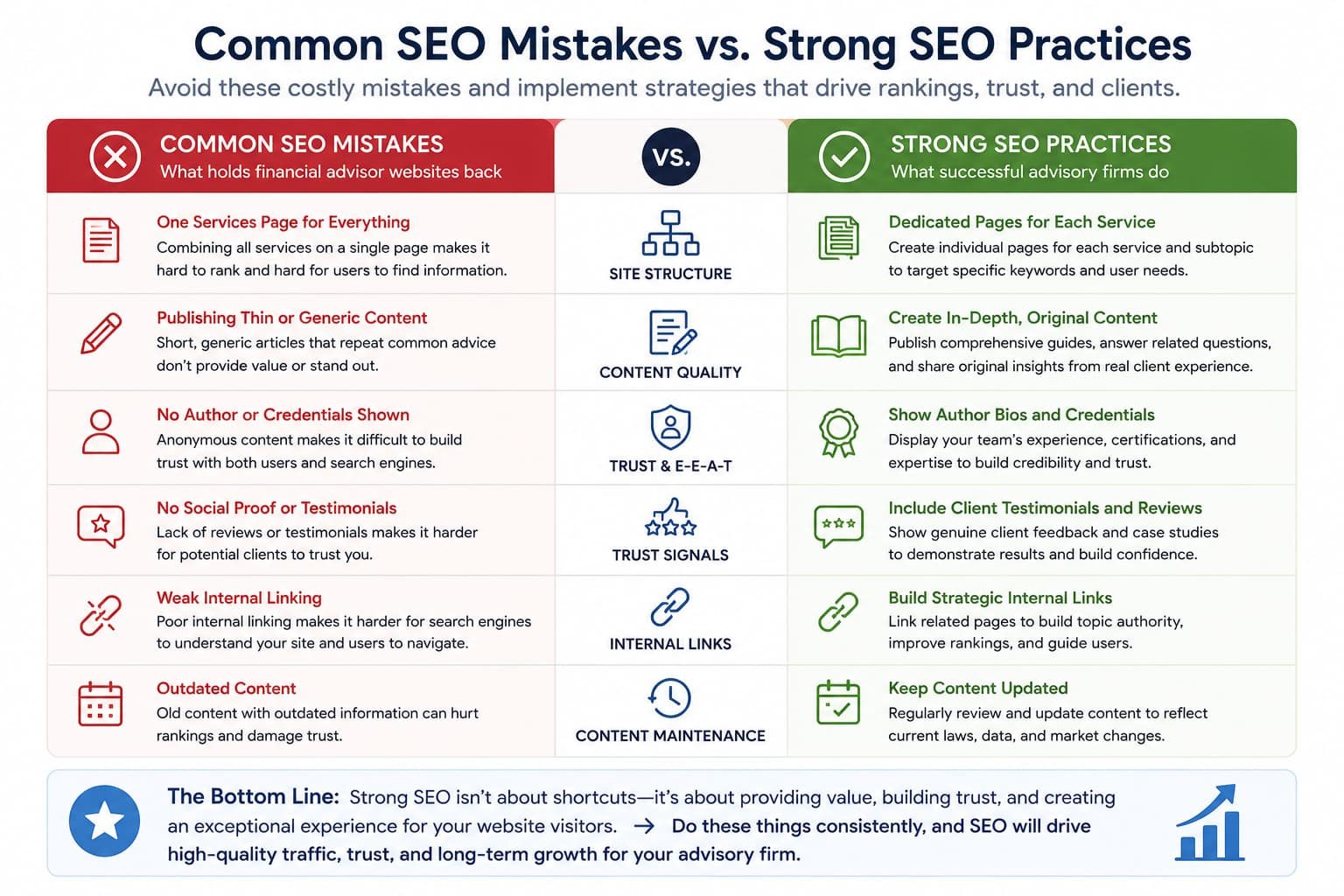
Even well-established advisory firms can struggle to generate organic traffic if their SEO strategy focuses on outdated tactics or overlooks the fundamentals. Fortunately, most SEO issues are entirely fixable once they are identified.
The following mistakes appear frequently across financial advisory websites and often prevent otherwise excellent firms from reaching prospective clients through search.
Targeting Only Highly Competitive Keywords
Many firms attempt to rank for broad keywords such as “financial advisor” or “wealth management” immediately after launching their SEO efforts. While these terms attract substantial search volume, they are also among the most competitive in the financial industry.
Instead of competing solely for broad phrases, focus on building topical authority around your areas of expertise.
For example, rather than targeting only financial advisor, consider developing content around:
- Retirement planning for physicians
- Financial planning for business owners
- Investment management for retirees
- Tax-efficient retirement income
- Estate planning strategies
- Financial planning for young professionals
This approach allows your website to rank for hundreds of relevant long-tail searches while gradually strengthening authority for broader commercial terms.
Publishing Thin or Generic Content
Financial topics are widely covered online, making generic articles unlikely to stand out. Publishing short posts that simply repeat common advice rarely provides enough value for users or search engines.
Instead, create comprehensive resources that answer related questions, explain complex concepts clearly, include practical examples where appropriate, and provide readers with actionable next steps.
Whenever possible, incorporate original insights from your firm’s experience working with clients. While maintaining confidentiality, practical examples and real-world scenarios often provide significantly more value than generic summaries available elsewhere.
Example: A generic article titled “Retirement Planning Tips” might briefly recommend saving early, diversifying investments, and reviewing your portfolio regularly. A more valuable resource could explain how retirement planning differs for business owners, compare Traditional and Roth IRAs, discuss Social Security claiming strategies, include a retirement planning checklist, and answer common questions clients ask during consultations. The second approach provides significantly more practical value while demonstrating deeper expertise.
Ignoring Local SEO
Some financial advisors assume that local SEO only matters for businesses such as restaurants or retail stores. In reality, many prospective clients actively search for advisors within their city or region.
Without optimized location pages, a complete Google Business Profile, consistent citations, and locally relevant content, your firm may struggle to appear for valuable geographic searches.
If you serve multiple locations, create dedicated landing pages for each office or service area. Avoid duplicating content across pages. Instead, include location-specific information that genuinely helps prospective clients.
Neglecting Internal Linking
Internal links help both users and search engines discover related content across your website.
For example, a retirement planning guide should naturally connect to articles discussing:
- Social Security
- Required Minimum Distributions
- IRA contribution limits
- Tax planning
- Investment diversification
- Estate planning
This creates topical clusters that strengthen your overall authority while helping visitors continue their research.
Failing to Update Older Content
Financial information changes regularly. Contribution limits, tax regulations, retirement rules, investment legislation, and compliance requirements evolve.
Older content should therefore be reviewed periodically to ensure it remains accurate and useful. Updating statistics, replacing outdated references, improving examples, and expanding content often provides a significant SEO benefit without creating entirely new pages.
Should Financial Advisors Hire an SEO Agency?
SEO can become a powerful long-term marketing channel, but achieving sustainable results requires expertise across content strategy, technical optimization, local search, analytics, and ongoing website improvements.
Some advisory firms manage SEO internally, particularly when they have dedicated marketing teams. Others choose to work with experienced SEO specialists who understand both search engine optimization and the unique challenges of financial services.
Benefits of Working With an SEO Agency
An experienced SEO partner can help financial advisors avoid costly mistakes while accelerating long-term growth.
Professional SEO services typically include:
- Comprehensive SEO audits
- Keyword research
- Content strategy
- Technical SEO improvements
- Local SEO optimization
- Schema markup implementation
- Internal linking strategy
- Performance reporting
- Competitor analysis
Because financial SEO is highly competitive, experienced specialists can also prioritize opportunities that offer the greatest long-term return rather than chasing vanity rankings.
Questions to Ask Before Hiring an SEO Agency
Not every agency has experience working with regulated industries or YMYL content. Before making a decision, consider asking questions such as:
- Have you worked with financial advisory firms before?
- How do you approach E-E-A-T?
- How do you measure SEO success?
- Can you provide case studies or references?
- How do you ensure content accuracy?
- How do you handle technical SEO?
- How frequently do you report results?
The best SEO agencies focus on sustainable growth rather than promising unrealistic ranking guarantees.
SEO Is a Long-Term Investment
Unlike paid advertising, SEO rarely produces dramatic results within a few weeks. Search visibility typically improves gradually as your website earns authority, publishes valuable content, strengthens technical performance, and gains recognition from both users and search engines.
For financial advisors, this long-term approach aligns naturally with how client relationships develop. Many prospects interact with multiple pieces of content before requesting a consultation, making SEO one of the few marketing channels that continuously builds trust throughout the decision-making process.
Conclusion
SEO for financial advisors is no longer simply about ranking higher for competitive keywords. It is about becoming the trusted resource prospective clients discover while researching important financial decisions.
A successful strategy combines technical excellence, helpful educational content, strong local visibility, and clear trust signals that demonstrate your firm’s experience and professionalism. Together, these elements help search engines understand your expertise while giving prospective clients the confidence to begin a conversation.
Although SEO requires patience and consistent effort, the long-term rewards can be substantial. A well-optimized website continues to attract qualified visitors, support client acquisition, and strengthen your firm’s reputation long after individual pages are published.
Rather than viewing SEO as a one-time project, treat it as an ongoing investment in your firm’s digital presence. By consistently publishing accurate, people-first content, improving user experience, and demonstrating genuine expertise, financial advisors can build lasting visibility in search results and create a sustainable source of high-quality leads.
References
- Google Search Central. Creating Helpful, Reliable, People-First Content.
- Google Search Central. SEO Starter Guide.
- Google Search Central. Google Search Console.
- Google. PageSpeed Insights.
- Google. Rich Results Test.
- U.S. Securities and Exchange Commission (SEC). Official Website.
- SEC. Investment Adviser Public Disclosure (IAPD).
- Financial Industry Regulatory Authority (FINRA). Official Website.
- FINRA. BrokerCheck.
- Internal Revenue Service (IRS). Official Website.