A dental practice can rank #1 on Google for “dentist near me” and still lose patients to a competitor it has never heard of. That competitor is not winning the blue links. It is winning the AI answer that now sits above them.
This is the shift that defines dental SEO in 2026. AI Overviews appear in roughly 75% of informational dental searches, and around 60% of U.S. adults now use AI tools in their provider-finding process. Traditional rankings still matter. They are no longer the whole game.
This guide covers the three layers of dental search visibility that actually drive new patients: traditional SEO (rankings and the local pack), GEO (getting cited and recommended by AI systems), and AEO (showing up in voice and conversational answers). It also maps the entities Google and AI systems use to understand a dental practice, because entity clarity is now the difference between being cited and being invisible.
Learn more about our white-label local SEO services.
Whether you run a single-location family practice or a specialist clinic, the framework is the same. The execution differs by specialty, and this guide covers that too.
Why Dental Is the Hardest Local SEO Niche
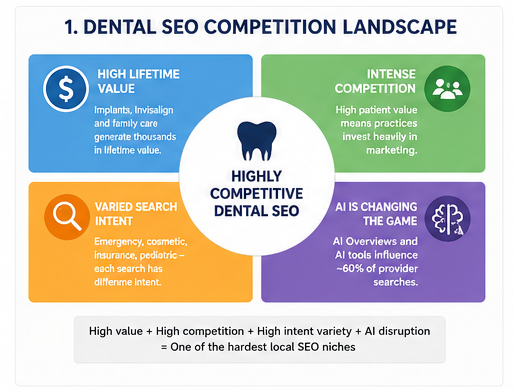
Three factors make dentistry one of the most competitive local search environments in healthcare.
- Patient lifetime value is high. A single implant case is worth $3,000 to $6,000. A full Invisalign case runs $3,000 to $8,000. A retained family of four generates recurring hygiene revenue for decades. High value means competitors spend aggressively, which raises the cost of every ranking position.
- Intent varies wildly by search. An emergency searcher wants help in the next hour. A cosmetic patient researches for weeks before booking. A parent looking for a pediatric dentist weighs comfort and trust above price. One keyword strategy cannot serve all of them, which is why generic dental SEO underperforms.
- The conversion gap between positions is steep. Practices in the top three local pack positions generate substantially more new patient inquiries than those pushed to the bottom of the pack or page two. The drop-off from position three to position four is not gradual. It is a cliff.
Add the AI layer and the competition intensifies further. A practice now competes not only for rank position but for inclusion in the synthesized answer that AI systems generate before a patient ever sees a list of links.
The Three Layers of Dental Search Visibility
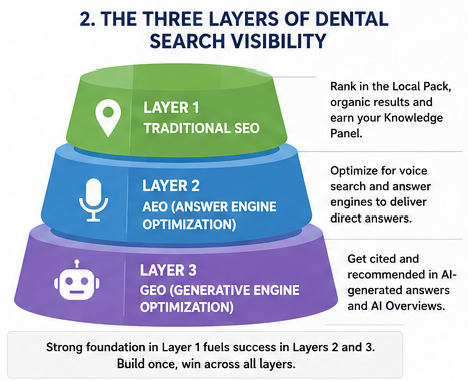
Understanding these three layers is the foundation for everything else in this guide. They overlap, they share signals, and a well-built piece of content can serve all three at once.
Layer 1: Traditional SEO
This is what most dentists already know: ranking in the Google local pack (the map with three practices), ranking in organic blue-link results, and earning a Knowledge Panel for the practice or individual dentist. The signals are proximity, relevance, and prominence.
Layer 2: GEO (Generative Engine Optimization)
GEO is the practice of getting your dental business cited and recommended inside AI-generated answers, rather than ranked on a results page. When a patient asks ChatGPT, Gemini, Perplexity, or Google’s AI Overview “who is a good cosmetic dentist in Denver,” the system returns a synthesized recommendation based on sources it deems credible. GEO is the work of becoming one of those sources.
GEO is not a replacement for SEO. It runs on the same foundation: indexed content, structured data, local authority, reviews, and technical health. The difference is the output. SEO targets ranked URLs. GEO targets citations.
Layer 3: AEO (Answer Engine Optimization)
AEO optimizes content so that answer engines and voice assistants can extract a direct response. “Hey Google, find an emergency dentist open now” or “How much does a root canal cost?” are answer-engine queries. They reward conversational content, FAQ structure, and clear direct answers over keyword-stuffed prose.
The practical takeaway: build once, optimize for all three. A service page on root canals that ranks organically (SEO), answers “is a root canal painful” in a structured FAQ (AEO), and carries clean Endodontist schema (GEO) does triple duty.
Dental Entities: How Google and AI Systems Understand Your Practice
Modern search does not rank pages by matching words. It ranks by understanding entities and their relationships. Google’s Knowledge Graph feeds directly into AI Overviews and Gemini answers, which means how your practice is represented as an entity determines whether AI cites you.
An entity is a distinct, identifiable thing: your practice, your dentist, a service, a condition, a location. The goal of entity optimization is to make these unambiguous to machines and to connect them correctly.
Your Core Entities
- The practice entity. Your business as a recognized, verified entity with a consistent name, address, phone, and category everywhere it appears.
- The dentist entity. The individual provider, with credentials, specialization, and professional affiliations. This is what earns a personal Knowledge Panel and supports E-E-A-T in a healthcare context.
- Service entities. Each treatment you offer, mapped to the correct specialty.
- Condition entities. The problems you treat (gum disease, tooth decay, malocclusion), which connect to your services.
- Location and demographic entities. Where you operate and who you serve.
The Specialty Entities That Matter
| Specialty | Entity | Conditions Treated | Core Services |
|---|---|---|---|
| Orthodontics | Orthodontist | Overbite, underbite, crowding | Braces, Invisalign |
| Endodontics | Endodontist | Abscess, pulp infection | Root canals, retreatment |
| Periodontics | Periodontist | Gingivitis, periodontitis | Gum therapy, implants |
| Pediatric Dentistry | Pediatric Dentist | Early dental issues | Preventive care, sedation |
| Oral Surgery | Oral Surgeon | Impacted teeth | Extractions, bone grafting |
Schema specificity is critical. A dental practice should use the Dentist schema type, not the generic LocalBusiness type. Specificity improves how AI classifies you and unlocks category features. Within dentistry, these are the entities to map against your services:
- General / Family Dentistry. Entity: General Dentist or Family Dentist. Services: preventive care, cleanings, fillings, exams. Demographics: families, all ages.
- Orthodontics. Entity: Orthodontist. Services: braces, clear aligners (Invisalign), retainers. Conditions: malocclusion, overbite, underbite, crowding. Demographics: teens, adults seeking alignment.
- Pediatric Dentistry. Entity: Pediatric Dentist. Services: children’s preventive care, behavior management, sedation, special needs care. Demographics segmented by age: infants (0-1), toddlers (1-3), preschool (3-5), school-age (5-12), teens (12-18).
- Periodontics. Entity: Periodontist. Services: gum disease treatment, scaling and root planing, gum grafting, LANAP, implant placement. Conditions: gingivitis, periodontitis, gum recession, bone loss.
- Endodontics. Entity: Endodontist. Services: root canal treatment, retreatment, emergency pulp therapy. Conditions: abscess, pulp infection, severe toothache.
- Prosthodontics. Entity: Prosthodontist. Services: dental implants, dentures, crowns, bridges, full-mouth rehabilitation. Conditions: missing or failing teeth.
- Oral and Maxillofacial Surgery. Entity: Oral Surgeon. Services: tooth extraction, wisdom tooth removal, implant placement, bone grafting, jaw surgery. Conditions: impacted teeth, surgical extractions.
- Dental Anesthesiology. Entity: Dental Anesthesiologist. Services: sedation dentistry, IV sedation, general anesthesia. Conditions: dental anxiety, dental phobia.
The remaining ADA-recognized specialties (oral pathology, oral and maxillofacial radiology, dental public health) follow the same pattern: a distinct entity, mapped to specific services and conditions.
Treatment, Demographic, and Access Entities
Beyond specialty, three other entity groups shape how patients search and how AI matches you:
- Treatment entities: dental implants, all-on-4, veneers, teeth whitening, Invisalign, wisdom tooth removal, same-day crowns, gum grafting.
- Demographic entities: by age (pediatric, adult, senior), by need (emergency, cosmetic, preventive), by situation (anxious patients, special needs patients, patients without insurance).
- Access entities: accepts Delta Dental, accepts Medicaid, dental payment plans, CareCredit, wheelchair accessible, emergency dentist open now, Saturday hours.
Each of these is something a patient searches for and something an AI system tries to match. The more clearly your content and schema connect your practice to the right entities, the more often you surface in both rankings and AI answers.
The knowsAbout Property
One underused schema property is knowsAbout. It lets you tell search engines and AI systems exactly what your practice is knowledgeable about, beyond your service names. An orthodontist can declare knowsAbout clear aligners, malocclusion, and bite correction. This signals expertise areas that AI systems use to judge whether to cite you for a specific query.
One caution: schema without substance is an empty declaration. A knowsAbout claim or a “30 years of experience” line in your structured data must be backed by matching on-page content. If the schema claims expertise the page never demonstrates, it does not build entity confidence.
Layer 1 in Practice: Traditional Dental SEO
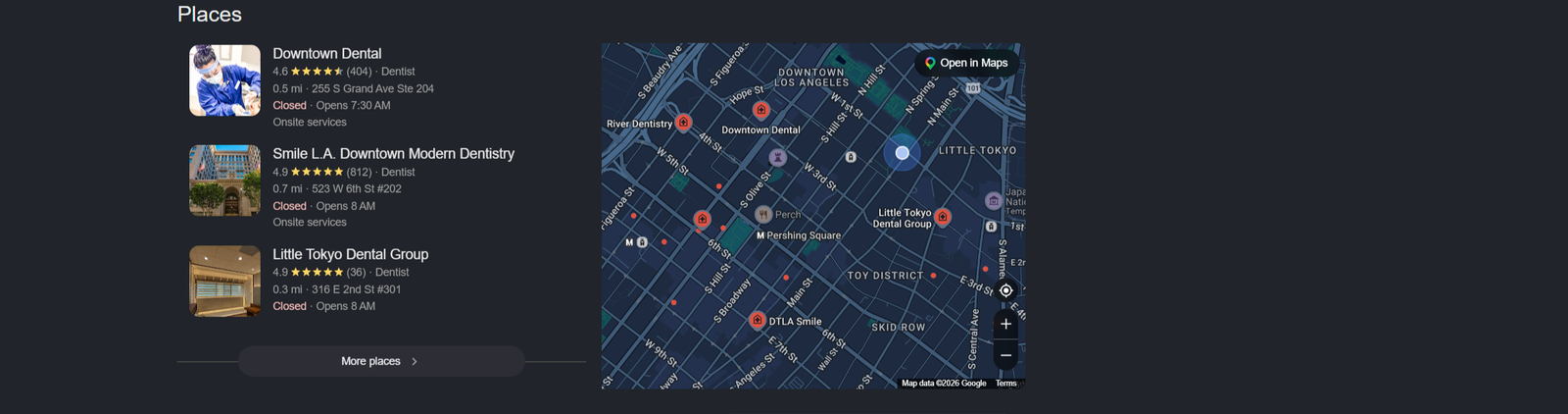
Google Business Profile: The Highest-Impact Single Asset
For local dental search, Google Business Profile (GBP) is the most important property you control. It drives the local pack, Google Maps rankings, and a growing share of the data that AI Overviews pull from.
Google’s local ranking weighs relevance, distance, and prominence. You cannot change distance. You can heavily influence relevance and prominence.
The optimizations that move rankings most:
- Choose the most specific primary category. “Dentist” is a signal; “Pediatric Dentist” or “Cosmetic Dentist” is a stronger one if it fits. Add secondary categories for additional services.
- Complete every section. Profile completeness correlates directly with both local pack visibility and AI mention frequency. Empty fields read as a low-quality signal.
- Build review velocity, not just review count. A practice with 40 reviews and 8 new ones this month outperforms one with 200 reviews and none in 90 days. Recency and steady arrival matter more than the raw total.
- Add a real services catalog. List each treatment with a description and, where you are comfortable, a price. This gives Google and AI systems structured content to match against specific queries.
- Upload genuine photos and video. Practices with photos receive significantly more requests for directions and website clicks. Include exterior, interior, team, and treatment images.
- Post consistently. Two to four GBP posts per week act as a freshness signal.
Targeting specific dental niches in the local pack:
Different searches require different optimization emphasis. “Emergency dentist open now” rewards accurate hours and emergency service attributes. “Cosmetic dentist [neighborhood]” rewards a strong photo gallery and cosmetic-specific reviews. “Pediatric dentist accepting Medicaid” rewards insurance attributes being filled in correctly. Map your highest-value searches and optimize the GBP fields each one depends on.
Organic Rankings: Service Pages That Convert
The local pack captures “near me” intent. Organic rankings capture the research and comparison phase, especially for high-value procedures.
Build a dedicated, deep page for each high-value service rather than a single thin “services” page:
- Dental implants
- Invisalign and clear aligners
- Cosmetic dentistry and teeth whitening
- Root canals
- Veneers
- Emergency dentistry
Emergency pages deserve priority. High-intent searches like “emergency dentist near me” convert at far higher rates than general dental terms because they represent a patient in active need making an immediate decision. Most practices either lack an emergency page or run a generic one that fails to rank locally. A dedicated, well-optimized emergency page is consistently one of the highest-ROI individual SEO investments a dental practice can make.
Structure each service page to serve searchers and AI systems:
State the problem the treatment solves. Explain the treatment clearly. Cover the process step by step. Address cost and financing honestly. Show before-and-after results where appropriate. Include patient testimonials specific to that treatment. Close with an FAQ section marked up with FAQPage schema.
This structure ranks (SEO), gets extracted (AEO), and gets cited (GEO).
Knowledge Panel: The Individual Dentist Brand
A Knowledge Panel for the practice or the individual dentist dominates branded search real estate and, more importantly, signals to Google’s AI systems that you are a verified, distinct entity. Google’s Gemini references Knowledge Graph data when answering questions about providers, so a panel is no longer a vanity feature. It is a prerequisite for some forms of AI citation.
Earning a panel requires consistent entity information across authoritative sources, professional association membership (ADA and specialty boards), media mentions, published content, and often a properly cited Wikidata entry. Wikidata is the structured backbone of the Knowledge Graph; a factual, well-sourced entry meaningfully increases the chance that a panel will appear. Entries without proper citations get flagged and removed, so accuracy matters.
Layer 2 in Practice: GEO for Dental Practices
What Determines Whether AI Cites You
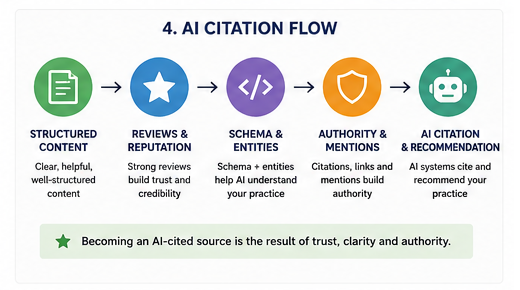
Google’s documentation makes it clear that pages need to be indexed and eligible for standard search to appear in AI Overviews. There is no secret technical gate. If your pages are indexed, well-structured, and authoritative, you are in the running.
That means GEO and traditional SEO share a foundation. The differentiated GEO signals, the things that specifically increase AI citation likelihood, are:
- Review content quality. Reviews that name a specific service, the dentist, and a concrete outcome are far more useful to AI than generic praise. “Dr. Smith’s implant work let me chew normally again after three years of missing teeth” is citable. “Great practice, friendly staff” is not.
- FAQ comprehensiveness and accuracy. AI systems extract directly from well-structured FAQ content that matches the questions patients actually ask.
- Service schema completeness. Detailed service entries with descriptions, and ideally duration and price, give AI the specifics it needs to recommend you for a specific query.
- Entity clarity. Machines must be able to tell what you do and where you do it without ambiguity. This is where specialty schema, consistent NAP, and knowsAbout pay off.
Content That Earns AI Citations
For local and transactional intent, AI Overviews synthesize reviews and nearby options, which makes your GBP and review content more important than ever, not less. For informational intent, AI pulls from structured, authoritative content. The content types most likely to be cited:
- Treatment guides. A complete guide to a procedure (process, timeline, cost, success rates, candidate criteria, aftercare) gives AI a structured source to draw from.
- Condition explainers. “What is periodontitis and how is it treated?” with symptoms, causes, treatment options, and when to see a specialist. These rank organically and feed AI answers.
- Service comparisons. “Invisalign vs. traditional braces” or “implants vs. bridges vs. dentures.” Comparison content has high AI citation potential because AI answers frequently take a comparison format.
- FAQ pages. Schema-marked Q&A addressing real patient concerns, organized by service and condition.
- Emergency guides. “What to do for a broken tooth” with immediate first aid, when to seek care, and treatment options. These capture urgent searches and feed AI answers for emergency queries.
Monitoring GEO Performance
Unlike rankings, AI citations are harder to track with standard tools. The practical approach:
Run your target searches in ChatGPT, Gemini, and Perplexity monthly and note whether you are mentioned. Check Google AI Overviews for your priority local and informational queries. Note when a competitor is cited and you are not, then examine what content or signals they have that you lack. This is manual work, but it is the only reliable read on GEO performance right now, and the measurement tools in this space are still maturing. Treat early GEO data as directional rather than precise.
Layer 3 in Practice: AEO and Voice Search
Voice and conversational queries are growing and overwhelmingly local. “Find an emergency dentist open now” or “Where’s the nearest pediatric dentist” are spoken in natural language, not keyword fragments.
To capture them:
- Write headers and content the way patients speak. “What should I do if my child is afraid of the dentist?” outperforms “Pediatric Anxiety Management” as a header for voice and AI extraction.
- Answer the question directly in the opening sentence, then expand. Answer engines extract the direct response.
- Keep paragraphs short and use lists for processes and comparisons. Scannable structure is extractable structure.
- Include specific, quantifiable information: cost ranges, treatment durations, candidate criteria. Vague content does not get extracted.
Earn Knowledge Panel eligibility and keep GBP accurate, since voice assistants lean heavily on Knowledge Panel and GBP data.
Local Citations and NAP Consistency for Dentists
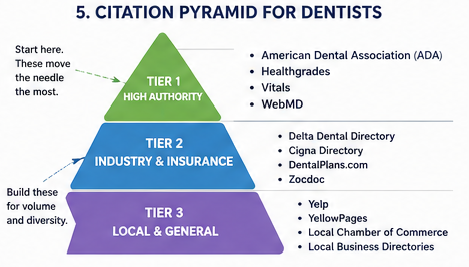
A citation is any online mention of your practice’s name, address, and phone. Citations build Google’s and AI systems’ confidence that you are a real, consistently located business. Inconsistency does the opposite. NAP data scattered inconsistently across 50 directories actively suppresses local pack visibility.
Dental Citation Tiers
- Tier 1, healthcare and data aggregators: Healthgrades, Zocdoc, WebMD, and the data brokers (Data Axle, Neustar Localeze) that feed downstream directories. Healthgrades and Zocdoc carry particular weight for medical and dental providers.
- Tier 2, professional and specialty directories: The ADA directory carries the highest authority. Add the relevant specialty board directory: the American Academy of Pediatric Dentistry for pediatric dentists, the American Association of Orthodontists for orthodontists, the American Academy of Periodontology for periodontists, the American Association of Endodontists for endodontists. Insurance provider directories (Delta Dental, Cigna, Aetna) also belong here.
- Tier 3, local and community: Chamber of commerce, local business directories, neighborhood guides, and any local healthcare network or hospital affiliation.
Audit before building. Use BrightLocal or Whitespark to find existing listings and identify inconsistencies, such as name variations, phone number formats, or missing suite numbers. Fix what exists before adding new citations, or you build on a faulty foundation.
Reviews: Conversion Tool and GEO Signal
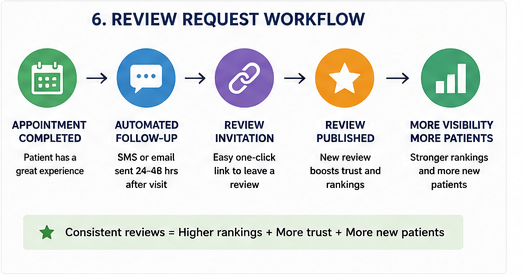
Reviews work on two levels for dentists. They drive conversions (patients trust practices with recent positive reviews) and feed AI citations.
Building a Review System
Ask every satisfied patient at the right moment, 48 to 72 hours after a positive appointment. SMS with a direct Google review link converts best. Email and QR codes on appointment cards supplement it.
Prioritize Google reviews (the largest share of impact), then Healthgrades, Yelp, and Facebook.
Never incentivize. Google prohibits offering discounts, gifts, or payment for reviews. The request must be unconditional.
Writing Review Requests for GEO
Standard review requests produce generic reviews. To produce reviews that AI can cite, guide patients toward specifics:
“Would you mind sharing which treatment you had and how it’s worked out?” produces a review mentioning the service and outcome. “Feel free to mention which of our team helped you” produces a review naming the dentist, which corroborates the dentist entity.
Target volume scales with practice size and market: a solo practice should aim for 4-6 new reviews monthly; a group practice, 10-15; more in competitive metros.
Responding to Reviews
Respond to every review. For positives, name the service or dentist mentioned, and keep it to 2 or 3 sentences. For negatives, acknowledge the issue without defensiveness, apologize for the experience, and move the resolution offline to a phone number or email address. The audience for a negative-review response is not the unhappy patient. It is every prospective patient reading the exchange, and a calm, professional reply builds more trust than an unbroken wall of five-star reviews.
Local Link Building for Dental Practices
Backlinks remain a ranking signal, and they increasingly function as citations that corroborate your entity across the web. For dentists, relevance and local authority matter more than raw volume.
- Authority links: ADA and specialty board directories, healthcare media (Healthline, Verywell), and university dental school directories if you are faculty or alumni.
- Local relevance links: chamber of commerce, city dental society, neighborhood business associations, hospital and medical referral networks, and community event sponsorships (youth sports, school health programs, charity drives).
- Content-driven links: genuinely useful resources such as a local guide to children’s dental milestones, a community oral-health resource page, or original data, which attract links from local bloggers, parenting sites, and news outlets.
- By specialty: orthodontists pursue Invisalign provider directories and teen-health sites; pediatric dentists pursue parenting publications and school-district provider lists; cosmetic dentists pursue beauty and wellness features; periodontists and implant specialists pursue patient-education and medical referral networks.
Content Strategy Across All Three Layers
Organize content as hubs and spokes built around four pillars.
- Service pages (conversion). One deep page per high-value treatment, structured as described earlier.
- Condition and education pages (informational, AEO and GEO). “Understanding Gum Disease,” “Dental Anxiety,” “Tooth Sensitivity,” “Pediatric Dental Development.” These rank organically and feed AI answers.
- Demographic pages (segment targeting). “Dental Care for Children,” “Cosmetic Dentistry for Older Adults,” “Dental Care for Anxious Patients,” “Pregnancy and Oral Health.”
- Comparison pages (commercial, high GEO value). “Invisalign vs. Braces,” “Implants vs. Bridges vs. Dentures,” “Root Canal vs. Extraction,” “In-Office vs. At-Home Whitening.”
Optimize each piece for all three layers at once: a target keyword and internal links for SEO, a schema-marked FAQ and direct answers for AEO, and clear entity markup plus authoritative structure for GEO.
Technical SEO and Schema Priority
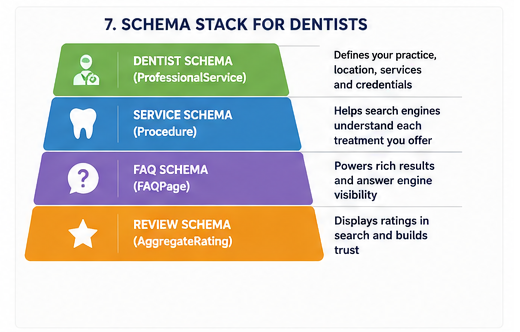
Schema Implementation Order
Build schema in this priority:
- Dentist schema (practice and individual provider, the specific type, not LocalBusiness)
- FAQPage schema (the highest-leverage GEO and AEO asset)
- Service schema (each major treatment)
- LocalBusiness or MedicalBusiness schema (local and healthcare attributes)
- Organization schema (practice structure and team)
- Review/AggregateRating schema
- BreadcrumbList schema (site structure clarity)
Validate every schema in Google’s Rich Results Test before deploying. Never mark up content that is not visible on the page; Google treats hidden-content markup as spam.
Core Web Vitals and Mobile
Over 60% of local dental searches happen on mobile, and Google indexes the mobile version of your site first. Target mobile load times under 2.5 seconds. Practices with mobile load times above 5 seconds fail the threshold Google uses as a ranking signal. Make click-to-call and appointment booking prominent on mobile, and keep emergency contact information one tap away.
On-Page Essentials
Title tags should pair specialty and city: “Pediatric Dentist in Denver, CO” or “Emergency Dentist Open Now in Portland, OR.” Meta descriptions include the primary keyword, the city, and a value proposition under 160 characters. Each page gets one unique H1. Internal links connect service pages to related conditions and education content using descriptive anchor text.
Tracking Performance Across SEO, GEO, and AEO
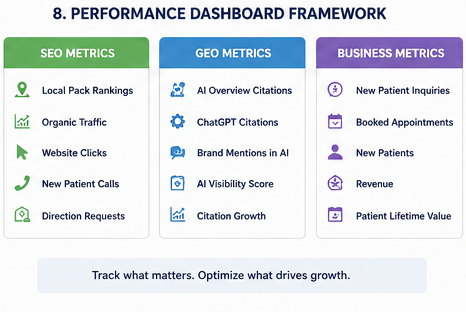
- SEO metrics: local pack rankings for target keywords, organic traffic by geographic segment, keyword rankings by category (service, emergency, specialty), and calls or bookings from organic traffic. Tools: Google Search Console, Google Analytics 4, BrightLocal, Semrush or Ahrefs.
- GEO metrics: frequency of mentions in AI Overviews for target searches, citations in ChatGPT and Gemini (checked manually), Knowledge Panel presence, and whether your GBP and review data surface in AI answers. Tracking is manual and directional for now.
- Business metrics that matter most: new patient inquiries by source, appointment bookings, cost per acquisition versus paid channels, average case value by source, and conversion rate from inquiry to booked appointment to accepted treatment. Set up call tracking and form-submission tracking so you can attribute revenue to search rather than guessing.
Track performance tied to services and revenue, not vanity metrics. A first-page ranking that produces no calls is not a win.
Specialty Playbooks
The framework is constant. The emphasis shifts by practice type.
Family and General Dentistry
Entity: Family Dentist. Lead with preventive-care education, treatment options for common issues, and a welcoming new-patient experience. Build links through the chamber of commerce, family community organizations, school health fairs, and pediatrician referral networks. Content should reassure and inform a broad household audience.
Pediatric Dentistry
Entity: Pediatric Dentist, with patient demographics segmented by age. Lead with a first-dental-visit guide for new parents, age-specific development content, behavior and anxiety management, and special-needs care. Encourage parent reviews that mention the child’s age and experience. Pursue the American Academy of Pediatric Dentistry directory, parenting publications, and school-district provider lists. Voice search matters here: parents often search hands-free.
Orthodontics
Entity: Orthodontist. The highest-value content is comparison-based: “Invisalign vs. braces,” “clear aligners for teens vs. adults.” Cover treatment timelines, costs and financing (this is a major, considered purchase), diet and care during treatment, and the importance of a retainer afterward. Pursue the American Association of Orthodontists directory and Invisalign provider listings. Comparison content has strong GEO citation potential.
Cosmetic Dentistry
Entity: Cosmetic Dentist. Lead with before-and-after galleries, the smile-design process, and procedure comparisons (whitening vs. veneers, bonding vs. veneers). Cover cost and longevity honestly; cosmetic patients research extensively before committing. Encourage reviews that describe the transformation and name the dentist. Pursue beauty and wellness feature placements.
Endodontics
Entity: Endodontist. The single highest-value content is “Is a root canal painful?” because it addresses the dominant patient fear and is heavily searched. Add emergency content (“what to do with an abscess”), the root canal process step by step, and signs a tooth needs treatment. Pursue the American Association of Endodontists directory and emergency referral networks.
Periodontics
Entity: Periodontist. Lead with gum-disease stage education (gingivitis through advanced periodontitis), treatment options by stage, and the connection between periodontal and systemic health. Add implant-therapy content and “when to see a periodontist” referral guidance. Consult the American Academy of Periodontology directory and implant patient education sites.
Implant and Oral Surgery
Entity: Oral Surgeon or Implant Specialist. Lead with the implant process and timeline, transparent cost breakdowns (implant, abutment, crown), success rates and longevity, and comparison content (implants vs. dentures vs. bridges). Financing content matters given the case value. Pursue prosthodontist and oral surgeon directories and dental-school implant programs.
Emergency Dentistry
Entity: Emergency Dentist, with a time-based service entity (“24/7 care,” “open evenings and weekends”). Lead with first-aid content for common emergencies, “is this a dental emergency?” symptom guidance, and clear hours and availability. These pages capture the highest-converting searches in dentistry and feed AI answers for urgent queries. Keep emergency contact information instantly accessible on mobile.
How the Three Layers Compound: A Worked Example
Consider a single piece of content: a root canal page for an endodontic practice.
- SEO: It targets “endodontist near me” and “root canal specialist in [city],” with internal links to related condition pages and a fast mobile load.
- AEO: Its FAQ section answers “Is a root canal painful?” and “How long does a root canal take?” in direct, conversational language that voice assistants and answer engines extract.
- GEO: It carries Endodontist schema with a knowsAbout declaration for root canal treatment and abscess care, backed by matching on-page content, making it a candidate for AI citation.
- Reviews: Patient reviews mentioning pain-free root canals with the endodontist named reinforce the entity and give AI specific, citable language.
- Links: A link from the American Association of Endodontists corroborates the specialist entity.
One page, well built, serves rankings, voice answers, and AI recommendations simultaneously. That is the integrated strategy in practice.
A 12-Month Roadmap
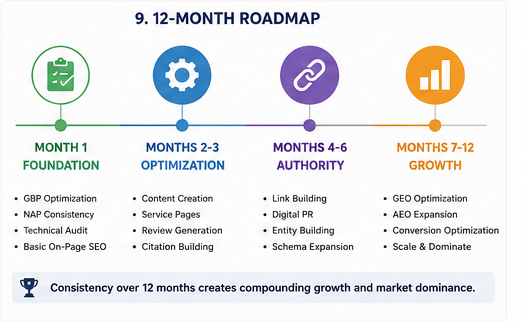
Month 1, foundation.
- Audit GBP completeness.
- Run a NAP audit across 30-plus directories and fix inconsistencies.
- Implement Dentist schema and a schema-marked FAQ page.
- Start a systematic review system.
Months 2-3, build.
- Complete Service schema for your five highest-value procedures.
- Build deep service pages with FAQ-structured content.
- Standardize your category across all citations.
- Reach 80%-plus GBP completeness.
Months 4-6, grow.
- Expand into condition and demographic content.
- Add specialty-specific pages.
- Secure professional directory placements (ADA and your specialty board).
- Begin monitoring GEO performance in AI tools.
- Build relevance-focused local links.
Months 7-12, authority.
- Pursue a Knowledge Panel if the practice is established.
- Build thought-leadership content.
- Maximize review velocity.
- Optimize specifically for AI citation.
- Add dedicated landing pages for your highest-value procedure keywords.
The work compounds. Each citation, review, and link strengthens the entity, and a stronger entity earns more rankings and more AI citations, which produce more patients, who leave more reviews. Consistency, not complexity, wins.
Frequently Asked Questions
How is SEO for dentists different from regular SEO?
Dental SEO adds healthcare-specific layers: stronger E-E-A-T requirements (Google holds medical content to a higher standard), specialty entity classification, professional directory citations (ADA and specialty boards), and patient-trust signals like reviews and credentials. It also splits sharply by intent, with emergency, cosmetic, and preventive searches requiring different content and targeting.
Does GEO replace traditional dental SEO?
No. GEO and SEO share the same foundation: indexed content, local authority, reviews, and technical accessibility. The difference is the output. SEO targets ranked links; GEO targets AI citations. Both still matter, and the same well-built content can serve both.
How long does dental SEO take to show results?
GBP optimizations often show movement within 30-90 days because Google re-evaluates profiles frequently. Competitive organic and local pack improvements generally take 3-6 months of consistent work. Entity authority and Knowledge Panel results compound over a year or more. The timeline depends heavily on your local competition.
Which dental SEO investment has the highest ROI?
For most practices, two things: full GBP optimization (free, fast, high-impact) and a dedicated emergency dental page (emergency searches convert far above general terms and most competitors neglect them). Both consistently outperform broad, generic optimization.
How do I get my dental practice cited in AI Overviews and ChatGPT?
Ensure your pages are indexed and well-structured, implement specific schema (Dentist, Service, FAQPage), keep your GBP complete and accurate, and build reviews that mention specific services and outcomes. AI systems pull local recommendations from GBP and review data and informational answers from authoritative, structured content. There is no special technical gate beyond standard search eligibility.
Can a small dental practice outrank larger competitors in AI search?
Yes. AI visibility rewards structural clarity and disciplined execution over budget. A smaller practice with clean schema, specific service pages, strong reviews, and consistent local signals can outperform a larger competitor that has neglected entity clarity. GEO is not about spending the most. It is about being the clearest, most credible source for a specific query.
Article references:
- SearchX – How Dentists Rank in Google Maps and AI Search Results in 2026
- Elevated DDS – AI SEO for Dentists: ChatGPT, Google AI and GEO in 2026
- Harris and Ward – AI Search for Dentists: 2026 GEO Strategy Guide
- Dental Design – Dental GEO: How AI Search Optimization Impacts Your Practice
- DentalScapes – Rankings to Recommendations: SEO, GEO, and the New Search Playbook for Dentists
- DentalBase – AI Search Optimization for Dentists: Complete Guide to 2026
- Backlinko – Schema Markup: What It Is and Why It Matters in 2026
- Digital Applied – Entity SEO and Knowledge Graph Optimization Guide 2026
- Digital Applied – Schema Markup Types 2026: Complete Reference Guide
- Dental Design – What Is knowsAbout Schema and How Can It Improve SEO
- Health Source Magazine – Google Knowledge Panel for Dental Practices
- Leland – The 12 ADA-Recognized Dental Specialties
- National Commission on Recognition of Dental Specialties (NCRDSCB) – Recognized Dental Specialties
- Firestarter SEO – Dental Practice SEO That Fills Schedules
- RankFast – Dental SEO Marketing Case Study
- Dominate Dental – SEO for Dentists: 7 Proven Strategies That Work in 2026
- Rosemont Media – Best SEO Strategies for Dental Practices in 2026