

Organic search plays a major role in how people find legal help. Many prospective clients begin their search on Google, compare several firms, and only then decide who to contact. For law firms, this means visibility in search results is directly connected to new consultations, qualified leads, and long-term case growth.
Backlinks are one of the signals that help search engines understand whether a law firm’s website is credible, authoritative, and worth ranking for competitive legal queries. A backlink is a link from another website to yours. When that link comes from a trusted and relevant source, it signals confidence in your content, expertise, and reputation.
In the legal industry, however, not all links carry the same value. A few strong links from credible legal, local, or editorial sources can do more for your rankings than dozens of weak links from unrelated websites. This matters even more as search evolves beyond traditional blue links and into AI Overviews and answer engines, where authority, reputation, and trusted external mentions can influence which sources are surfaced.
This guide explains what legal link building is, why it matters, what makes a backlink valuable, and how law firms can build links ethically. It also covers proven strategies, digital PR opportunities, link evaluation criteria, useful tools, common mistakes, and the metrics that show whether your efforts are generating real business value.
What Is Link Building for Lawyers?
Link building for lawyers is the process of earning links from trusted, relevant websites that point back to a law firm’s website. These links help search engines understand that your content is reliable, useful, and connected to real authority within the legal space.
In practice, legal link building can include directory listings, local media mentions, bar association profiles, guest contributions, expert quotes, scholarship pages, podcast appearances, digital PR campaigns, and links from professional partners. The goal is not simply to collect as many backlinks as possible. The goal is to build a backlink profile that supports trust, topical authority, and local relevance.
Link building in the legal industry differs from that in many other niches because legal content can directly affect a person’s finances, rights, safety, or future decisions. Google treats this kind of content as YMYL, which stands for “Your Money or Your Life.” As a result, law firm websites need stronger trust signals than ordinary informational websites.
Learn more about our white label local SEO services
Four factors make legal link building especially important:
- Quality over volume. A small number of links from credible sources such as universities, bar associations, legal publications, and established local media outlets can be more valuable than hundreds of low-quality links from generic blogs.
- Topical relevance. Links from legal, professional, or law-adjacent websites send stronger signals than links from unrelated websites. A family law firm, for example, benefits more from links connected to divorce, mediation, parenting, estate planning, or local legal resources than from random lifestyle websites.
- Local connection. Most legal searches have a local intent. Links from regional newspapers, chambers of commerce, local organizations, community events, and local directories help reinforce your firm’s geographic relevance.
- Reputation and trust. Law firms need to demonstrate experience, expertise, authoritativeness, and trustworthiness. Backlinks from respected sources support these E-E-A-T signals, and help show that the firm is known and referenced beyond its own website.
When done properly, link building supports both search performance and reputation building. It helps your firm become more visible, more credible, and easier for potential clients to find.
Why Link Building Matters for Law Firms
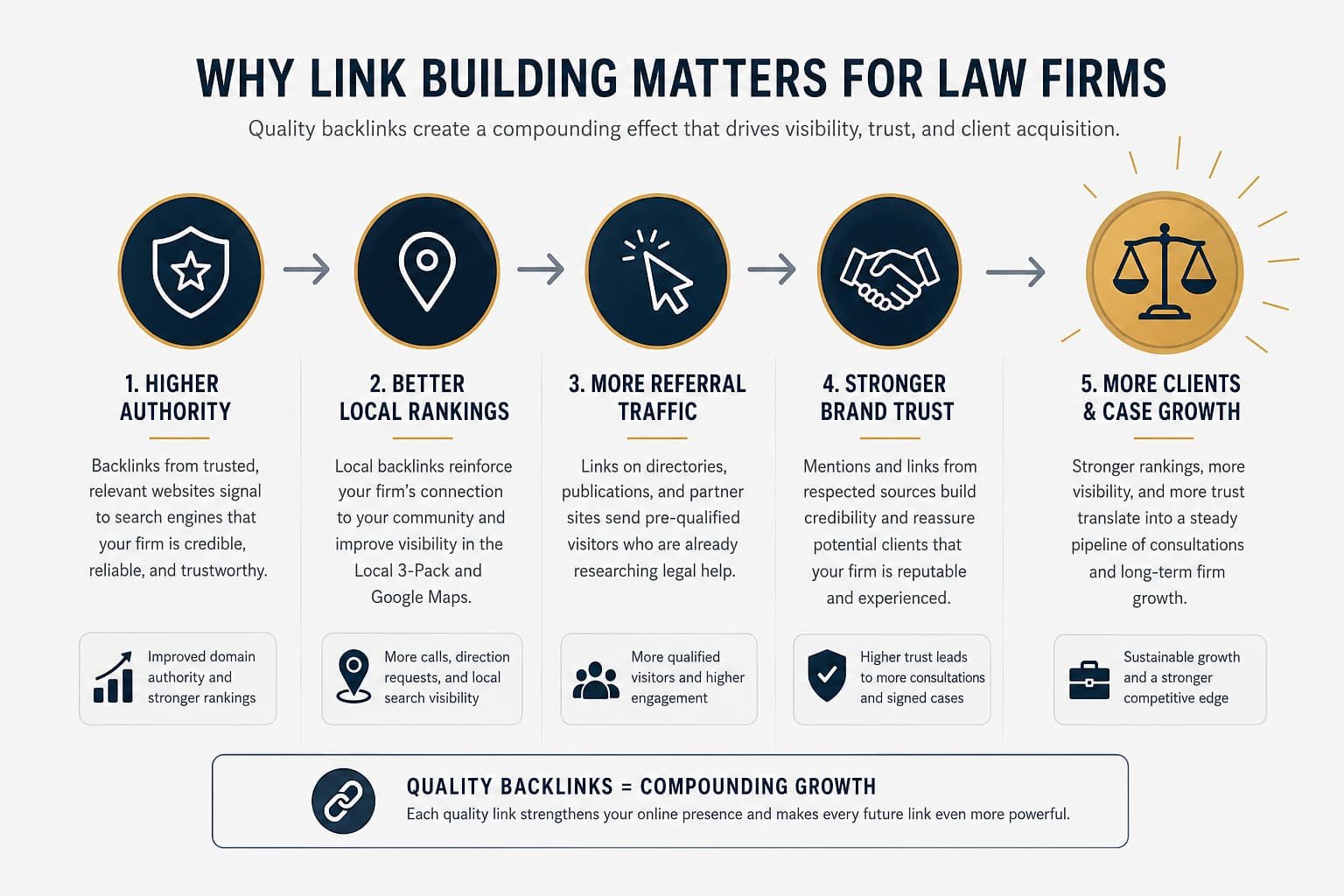
Law firm SEO is highly competitive. In major cities and profitable practice areas such as personal injury, criminal defense, family law, immigration, employment law, and medical malpractice, the websites ranking at the top usually have strong backlink profiles. They are not ranking only because their pages are well written. They are ranking because other websites consistently reference, cite, or link to them.
Backlinks matter because they influence authority, local visibility, referral traffic, and long-term search performance. For law firms, these benefits can translate directly into more calls, more consultation requests, and more signed cases.
Higher Authority With Search Engines
Search engines use backlinks to help evaluate the quality and trustworthiness of a website. When a law firm receives links from credible legal directories, respected publications, universities, professional associations, or local media outlets, those links support the site’s authority.
A Backlinko study found that the top-ranking result in Google has, on average, significantly more backlinks than lower-ranking pages. While backlinks are not the only ranking factor, they remain one of the clearest signals that a page or domain has earned recognition from other websites.
This becomes especially important in competitive legal searches. If several firms have strong service pages targeting the same keyword, the firm with the better backlink profile often has the advantage. For example, a firm trying to rank for a term like “car accident lawyer Chicago” will usually need more than optimized on-page content. It will need authority signals that show Google the firm is a trusted resource in that market.
Backlinks may also influence how legal content performs in AI-powered search experiences. AI Overviews and answer engines tend to rely on sources that appear trustworthy, well-cited, and broadly recognized. A strong backlink profile does not guarantee inclusion, but it can reinforce the authority signals that make a legal website more likely to be considered a reliable source.
Better Local Rankings
Most people searching for legal help want a lawyer in a specific location. That is why local SEO is so important for law firms. Backlinks from local websites help search engines connect your firm with a specific city, region, or community.
For example, a Denver law firm that is mentioned by a local newspaper, listed in a regional bar association directory, featured by a local business organization, or linked from a community event page sends clear geographic signals. These links help Google understand that the firm is active and relevant in that local market.
Local links can support visibility in organic search results, Google Maps, and the Local 3-Pack. This is the map-based section that appears for many local searches and highlights three nearby businesses. Strong local authority signals, combined with an optimized Google Business Profile, consistent citations, reviews, and strong website content, can improve the firm’s chances of appearing there.
More Referral Traffic
Backlinks are not only useful for SEO. They can also send direct referral traffic. Prospective clients often compare lawyers across legal directories, local publications, review platforms, professional association pages, and third-party guides before reaching out.
When your firm is cited or linked from a trusted source, users may click through to learn more. This traffic is often valuable because the person is already researching legal help. In many cases, the visitor is more qualified than someone arriving from a broad informational search.
Referral traffic also helps diversify your lead sources. Instead of relying solely on rankings, your firm can gain visibility through directories, media mentions, partner websites, interviews, podcasts, and legal resource pages.
Stronger Brand Trust
Legal decisions involve a high level of trust. People want to know that the lawyer they contact is credible, experienced, and recognized by others. Backlinks from respected websites can support that perception.
A potential client who sees your firm mentioned in a local newspaper, quoted in an article, listed on a respected legal directory, or featured by a professional organization may feel more confident contacting you. These trust signals work beyond SEO. They support the entire decision-making process.
What Makes a High-Quality Legal Backlink?
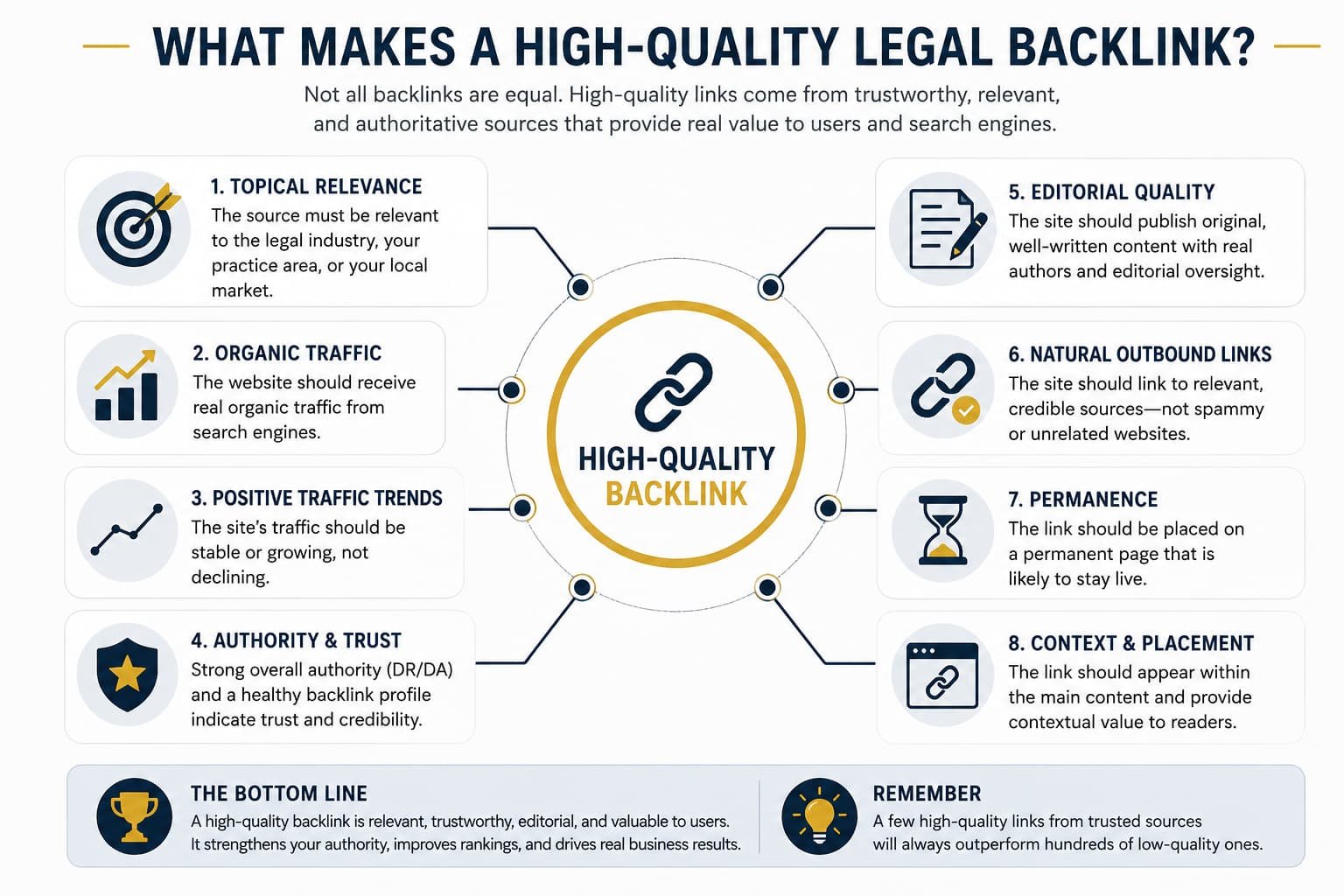
The phrase “high-quality backlink” is used often, but in legal SEO it needs a clear definition. A valuable legal backlink is not just a link from a website with a high metric in an SEO tool. It is a link from a source that is relevant, trusted, visible, editorially credible, and useful to real users.
Before pursuing a backlink, evaluate whether the source can support your firm’s authority, reputation, and visibility. The following factors matter most.
Topical Relevance
Topical relevance is one of the most important qualities of a legal backlink. A link from a website connected to law, business, finance, local services, education, media, or your specific practice area usually carries more value than a link from a random, unrelated blog.
For example, a personal injury firm may benefit from links from legal blogs, medical organizations, road safety resources, local news reports, accident statistics pages, or community organizations. An estate planning attorney may benefit from links from financial advisors, elder care resources, tax planning websites, and local professional associations.
Relevance helps search engines understand why the link exists. It also makes the link more useful to readers, increasing the likelihood of referral traffic and engagement.
Organic Traffic
A good link source should have real visibility. If a website receives steady organic traffic, ranks for relevant keywords, and appears to have genuine readership, it is more likely to be trusted by both users and search engines.
Tools such as Ahrefs, Semrush, and SE Ranking can help you estimate a domain’s organic traffic before pursuing a link. These estimates are not perfect, but they are useful for comparing opportunities.
A website with no traffic, no rankings, and no clear audience may not provide meaningful SEO or referral value, even if it has a high Domain Rating or Authority Score.
Positive Traffic and Keyword Trends
Current traffic is useful, but the trend matters too. A website with stable or growing organic visibility is usually a safer link source than one that has lost most of its rankings.
If a site’s traffic has dropped sharply, investigate why. It may have been affected by a Google update, thin content, spammy outbound links, poor editorial quality, or a manual action. A link from a declining or low-quality website may provide little value and could create risk if the site is part of a manipulative link network.
Domain Rating and Authority Metrics
Third-party authority metrics can help you evaluate link opportunities, but they should not be treated as the final decision. Ahrefs’ Domain Rating, Moz’s Domain Authority, and Semrush’s Authority Score all estimate the strength of a website’s backlink profile. They are useful directional signals, not Google ranking factors.
A high-DR website is not automatically a good link source. A lower-authority legal directory, local newspaper, bar association, or niche legal publication may be more valuable than a high-DR website that has no topical connection to your firm.
Use authority metrics as supporting data. Prioritize relevance, traffic, editorial quality, local connection, and trust first.
A Growing, Healthy Backlink Profile
A healthy link source should have its own natural backlink profile. If other credible websites continue to link to it, that is a sign the site is useful and active. If its backlink profile looks artificial, spam-heavy, or dominated by irrelevant links, be cautious.
The same principle applies to your law firm’s website. A backlink profile that grows steadily over time from diverse, reputable sources looks more natural than a profile that suddenly gains hundreds of similar links from weak websites.
Outbound Link Quality and Linking Patterns
Before pursuing a backlink, check how the website links to others. Trustworthy publishers usually link naturally to relevant, reputable websites. Low-quality link sellers often link out excessively to unrelated businesses, casino sites, CBD pages, adult content, finance spam, or thin affiliate pages.
If a website links to almost anyone willing to pay, the link is unlikely to be valuable. In some cases, it can be risky. Look for signs of editorial oversight, relevant outbound links, a normal publishing pattern, and a clear audience.
Permanent Links
Some links disappear after a few months. Others remain live for years. A link that is removed quickly has limited long-term SEO value.
Editorial links, legal directory listings, association profiles, guest contributions, interviews, research citations, and local media mentions tend to last longer than links placed on temporary pages or low-quality guest post networks. Before investing time or budget into a placement, check whether the site keeps older content live and whether links remain active.
Dofollow, Nofollow, and Relation Attributes
Dofollow links usually pass the most direct ranking value, but a natural backlink profile should include a mix of link types. Since 2019, Google has treated nofollow as a hint rather than a strict directive. This means nofollow links may still support discovery, referral traffic, and brand visibility.
Google also supports additional link attributes, including sponsored and UGC. The sponsored attribute should be used for paid or sponsored placements. The UGC attribute is used for user-generated content, such as forum posts or blog comments.
Using the correct link attribute is important for compliance with Google’s spam policies. Paid links intended to manipulate rankings can create serious risk. If a placement is paid, it should be clearly disclosed and marked appropriately.
How to Evaluate a Link Opportunity Before You Pursue It
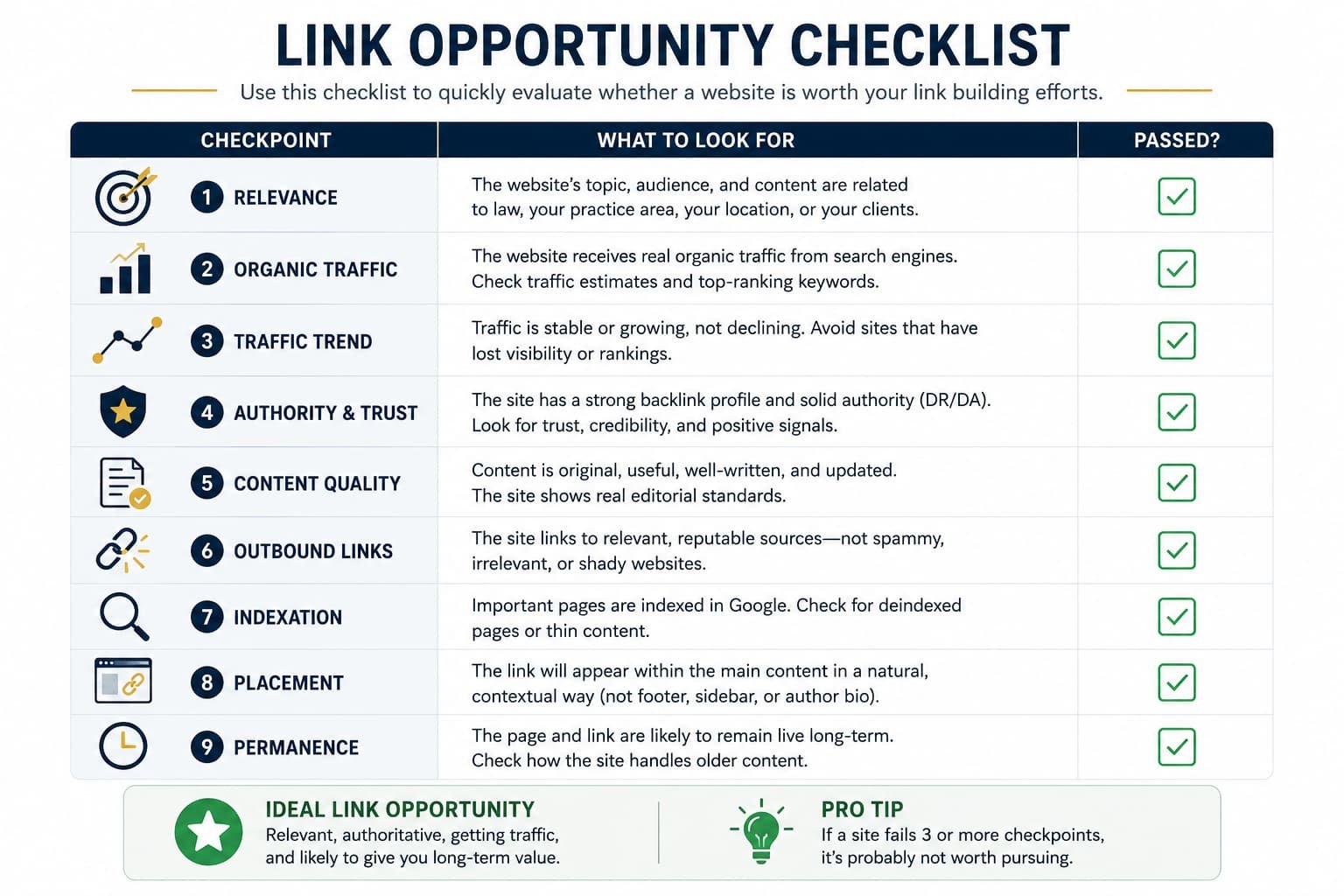
Before you spend time on outreach, guest posting, sponsorships, or partnerships, evaluate whether the website is actually worth pursuing. This step prevents wasted effort and helps your firm avoid weak or risky backlinks.
A simple evaluation process can reveal whether a link source has real value or only inflated SEO metrics.
- Check relevance. Does the website connect naturally to law, your practice area, your location, your audience, or a related professional field?
- Check organic traffic. Does the site receive search traffic, or does it have strong metrics with no real visibility?
- Review keyword rankings. Does the site rank for meaningful topics, or only for random, low-value keywords?
- Look at traffic trends. Is the site growing, stable, or declining sharply?
- Review outbound links. Does the site link to credible resources, or does it link to many unrelated commercial pages?
- Inspect content quality. Are the articles useful, edited, and written for real readers?
- Check indexation. Are important pages indexed in Google, or does the site appear partially deindexed?
- Assess link placement. Will the link appear naturally inside relevant content, or will it be hidden in a sidebar, footer, author bio, or unrelated paragraph?
- Review link permanence. Does the website keep older links live, or are placements removed after a short period?
This evaluation matters because legal websites need trust more than volume. A single relevant link from a trusted publication can outperform many links from sites that exist only to sell placements.
Anchor Text and Link Placement
Once you earn a backlink, two factors influence its usefulness: the anchor text and the link’s placement on the page.
What Anchor Text Is and Why It Matters
Anchor text is the clickable text used in a link. According to Google’s documentation, anchor text should be descriptive, concise, and relevant to the page it links to.
For users, anchor text sets expectations. If someone clicks a link labeled “personal injury attorney,” they expect to land on a page about personal injury legal services. For search engines, anchor text provides context about the linked page.
Good anchor text should feel natural in the sentence. It should describe the destination without sounding forced, repetitive, or over-optimized.
Anchor Text Types
A natural backlink profile usually includes a variety of anchor text types:
- Branded anchors: the law firm’s name, such as “Smith & Associates.”
- Descriptive anchors: phrases that describe the destination, such as “personal injury legal services.”
- Long-tail anchors: more specific phrases, such as “what to do after a car accident in Chicago.”
- Generic anchors: phrases such as “learn more,” “read the guide,” or “visit the website.”
- Naked URLs: the raw website address used as the link.
The most important rule is variety. If too many backlinks use the same keyword-rich anchor text, the pattern can look engineered. Search engines may discount those links or treat the pattern as manipulative.
Link Placement and Link Equity
Where a link appears on the page also matters. Links placed inside the main body content are usually more valuable than links hidden in footers, sidebars, author bios, or unrelated resource lists.
An in-content editorial link is more likely to be clicked and more likely to provide useful context. For example, a link to a law firm’s guide inside a relevant paragraph about accident claims is stronger than the same link placed at the bottom of a generic author bio.
When possible, aim for links that appear naturally in the first half of a relevant article. The link should support the reader’s understanding and point to a page that genuinely expands on the topic.
13 Strategies to Build High-Authority Legal Backlinks
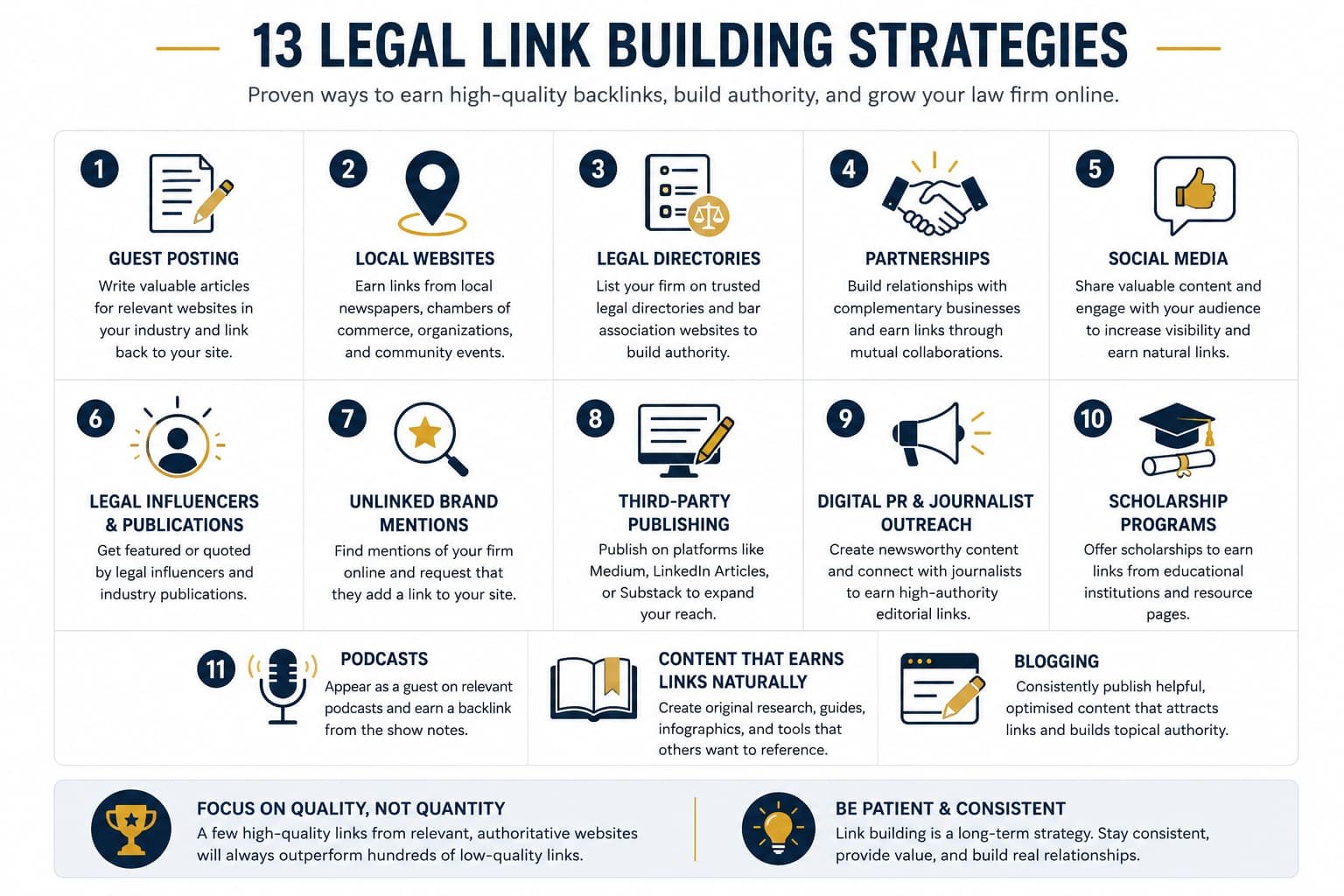
Effective legal link building usually combines several strategies. Some methods produce quick wins, such as directory listings and unlinked brand mentions. Others build authority over time, such as digital PR, original research, and relationship-based outreach.
The strongest law firm backlink profiles usually include a mix of legal directories, local links, editorial mentions, expert quotes, professional partnerships, guest contributions, and linkable content assets.
1. Guest Posting
Guest posting means writing an article for another website and earning a link back to your firm’s website. For law firms, it can be a strong strategy when the content is genuinely useful, and the publishing site is relevant.
Good guest post topics include legal tips, updates on new laws, practical guides, risk prevention advice, business compliance topics, or explanations of common legal processes. The goal is to provide value to the publication’s audience, not simply to place a link.
Target websites that already reach your audience. These may include legal blogs, local business publications, professional association websites, law school blogs, niche industry publications, and respected legal platforms such as Law Technology Today or Attorney at Work.
The best guest posts build credibility as well as links. If the article is useful, well written, and published on a site with real readership, it can generate referral traffic, brand recognition, and future relationship opportunities.
2. Local Websites
Local links are especially valuable for law firms because most legal searches are geographically focused. A person searching for a lawyer usually wants someone nearby, or at least someone licensed and active in their state or city.
Useful local link sources include local newspapers, chambers of commerce, business associations, nonprofit organizations, event pages, sponsorship pages, community groups, universities, local podcasts, and regional bar associations.
There are several ways to earn these links. A law firm can sponsor a community event, contribute expert commentary to a local article, host a free legal workshop, support a local nonprofit, speak at a business seminar, or create a useful resource for residents in its area.
These links support both SEO and reputation. They help Google associate the firm with a specific location, and they help local prospects recognize the firm as part of the community.
3. Legal Directories
Legal directories remain among the easiest and most relevant sources of links for lawyers. Many directories already rank well for attorney-related searches and are used by potential clients who are comparing their options.
Important legal directories include Justia, Avvo, FindLaw, Nolo, Martindale-Hubbell, Lawyers.com, and state or local bar association directories. Depending on your practice area, niche directories may also be useful.
Directory links are valuable because they support legitimacy, referral traffic, and local visibility. They also help reinforce consistency across the web when your firm’s name, address, phone number, website, and practice areas are listed accurately.
Do not treat all directories equally. Prioritize directories with strong search visibility, real user traffic, good editorial standards, and relevance to your jurisdiction or practice area. Avoid low-quality directories that exist only to sell listings and have little or no organic traffic.
4. Partnerships
Professional partnerships can create natural backlink opportunities because many businesses and organizations serve audiences that overlap with law firm clients.
A personal injury attorney might build relationships with chiropractors, physical therapists, auto repair businesses, safety organizations, or local medical providers. An estate planning lawyer might collaborate with financial advisors, accountants, elder care consultants, or real estate professionals. A business attorney might work with startup incubators, accountants, consultants, and local business groups.
These partnerships can lead to resource page links, co-authored guides, webinars, interviews, referral pages, event listings, or expert articles. The link should make sense for users and should be supported by a real professional relationship.
This strategy works best when the collaboration provides mutual value. Instead of asking only for a link, offer something useful: a guest resource, a legal checklist, a client education guide, a joint event, or expert input for their audience.
5. Social Media
Links from platforms such as LinkedIn, X, Facebook, and Instagram usually do not pass direct SEO value in the same way editorial backlinks do. However, social media can still indirectly support link building.
When you promote useful legal content on social platforms, it can reach journalists, business owners, bloggers, podcast hosts, community leaders, and other professionals who may later link to it from their own websites.
LinkedIn is especially useful for lawyers because it supports professional visibility. Sharing practical legal insights, commenting on relevant industry discussions, and publishing short expert posts can help build relationships that later turn into guest posts, interviews, quotes, and referral links.
Social media should not be treated as a replacement for link building, but it can amplify the content and relationships that make link building easier.
6. Legal Influencers and Publications
Legal influencers, industry publications, and professional commentators can be valuable sources of links because their audiences already care about legal topics. A mention from a respected legal voice can support both authority and referral traffic.
This strategy is different from guest posting. Instead of submitting your own article, you position yourself as a useful expert who can be quoted, referenced, or included in existing content.
To earn these opportunities, engage with legal writers, editors, journalists, podcast hosts, and LinkedIn creators who cover your practice area. Offer clear, practical commentary on legal developments, court decisions, regulatory updates, or common client questions.
Over time, consistent expert input can lead to citations, interviews, roundup features, podcast invitations, and editorial backlinks. These links are valuable because they are earned through expertise rather than manufactured through outreach alone.
7. Unlinked Brand Mentions
Many law firms are already mentioned online without receiving a backlink. These unlinked brand mentions are among the easiest link-building opportunities because the publisher has already decided your firm is worth referencing.
Mentions may appear in local news stories, event pages, conference websites, podcasts, interviews, legal roundups, community organizations, scholarship announcements, or blog posts. Instead of creating new content from scratch, you ask the publisher to turn the existing mention into a clickable link.
Tools such as Google Alerts, Brand24, Brandwatch, Ahrefs Alerts, and Semrush Brand Monitoring can help identify these opportunities. Regularly monitoring your firm’s name, attorneys’ names, and branded products or services makes it easier to recover valuable backlinks that already exist.
Keep your outreach brief and professional. Thank the publisher for mentioning your firm, explain that adding a link would help readers find additional information, and include the most relevant destination page. Since the relationship already exists, response rates are often much higher than with cold outreach.
8. Third-Party Publishing Platforms
Publishing on established content platforms helps expand your firm’s reach and increases the chances that other websites will discover and reference your expertise.
Platforms such as Medium, LinkedIn Articles, and Substack allow lawyers to publish educational content while linking back to relevant resources on their own websites. Although many of these links are nofollow, the content itself can attract journalists, bloggers, and industry professionals who later create editorial backlinks from their own websites.
Rather than copying articles word-for-word, adapt them for each platform. Summarize key legal concepts, discuss recent legal developments, or provide practical guidance that encourages readers to continue on your website for more comprehensive information.
Think of these platforms primarily as distribution channels rather than as direct link-building tools. Their greatest value comes from increasing visibility and exposing your content to people who may later cite it elsewhere.
9. Digital PR and Journalist Outreach
Digital PR has become one of the most effective ways for law firms to earn authoritative backlinks. Instead of requesting links directly, you create stories, research, or expert commentary that journalists naturally want to reference.
Law firms are uniquely positioned for digital PR because they work with legislation, public policy, court decisions, consumer rights, employment issues, data privacy, business regulation, and many other topics that regularly appear in the news.
Several approaches work particularly well:
- Original research. Analyze court records, legal trends, public datasets, or government statistics and publish unique findings.
- Expert commentary. Respond to breaking legal news with concise explanations that journalists can quote.
- Industry reports. Produce annual or quarterly reports covering legal trends within your practice area.
- Data visualizations. Create infographics or interactive resources that simplify complex legal topics.
Platforms such as HARO, Qwoted, and Featured connect journalists with expert sources. Responding quickly with clear, authoritative answers can earn backlinks from national publications, industry magazines, business websites, and local news organizations.
Unlike traditional outreach, digital PR scales exceptionally well. One successful story may generate dozens of editorial backlinks from reputable websites while simultaneously strengthening your firm’s public reputation.
10. Scholarship Programs
Scholarship campaigns can still generate valuable educational backlinks when they provide genuine value rather than existing solely for SEO purposes.
Many colleges and universities maintain scholarship resource pages that link to organizations offering financial support for students. A law firm that creates a legitimate scholarship for students pursuing legal studies, criminal justice, political science, or related disciplines may earn links from these educational resources.
The emphasis should always be on authenticity. Universities have become increasingly selective about the scholarships they promote, and thin campaigns created only to obtain backlinks are often ignored or removed.
If you pursue this strategy, build a real scholarship program with transparent eligibility requirements, a clear application process, publicly announced winners, and a long-term commitment. The educational value should always come before the SEO benefit.
11. Podcasts
Podcast appearances remain an underused opportunity for legal link building. Most podcast websites publish guest biographies that include backlinks to the guest’s website, while the interview itself helps build trust with prospective clients.
Focus on podcasts that serve your ideal audience, not just legal professionals. Business podcasts, entrepreneurship shows, local community podcasts, financial planning discussions, healthcare programs, and real estate channels may all be relevant depending on your practice area.
Before reaching out, prepare several topic ideas that solve real problems for listeners rather than directly promoting your firm. Practical conversations generate stronger engagement and make hosts more likely to recommend you again.
Beyond the backlink itself, podcast appearances often lead to additional invitations, media requests, referral partnerships, and speaking opportunities that continue generating links over time.
12. Content That Earns Links Naturally
The strongest backlinks are often earned rather than requested. When your website consistently publishes resources that people genuinely want to reference, link acquisition becomes much more sustainable.
The following content formats consistently perform well for law firms:
- Comprehensive legal guides. Step-by-step resources explaining legal procedures, rights, and common situations.
- Original research and statistics. Reports based on public legal data, court records, consumer research, or industry analysis.
- Interactive tools. Settlement calculators, legal checklists, eligibility assessments, or downloadable templates.
- Infographics. Visual explanations of legal processes that publishers can easily reference.
- Annual reports. Original studies that become citation resources for journalists and bloggers.
- Frequently updated resource hubs. Evergreen content covering laws, regulations, or legal procedures that evolve over time.
Content like this continues attracting backlinks long after publication because other writers naturally reference useful resources when explaining similar topics.
13. Blogging
A consistently updated blog provides ongoing opportunities to earn backlinks while expanding your firm’s topical authority.
Start by answering the questions clients ask most often. Build practical articles around common legal concerns, explain recent legislative changes, summarize important court decisions, and publish educational resources that simplify complex legal topics.
As your content library grows, journalists, bloggers, local organizations, and other legal professionals have more opportunities to reference your work. A single high-quality guide may attract backlinks for years, while regular publishing strengthens your website’s overall authority.
Successful legal blogs focus on solving problems rather than promoting services. The more useful your content becomes, the easier it is for other websites to justify linking to it.
Ethical and Compliant Link Building
Law firms operate in one of the most heavily regulated industries, making ethical link building especially important. Every backlink strategy should comply not only with Google’s guidelines but also with applicable legal advertising rules and professional conduct standards.
The good news is that the safest SEO practices are usually the most effective long-term strategies.
- Avoid manipulative link schemes. Buying backlinks, participating in private blog networks (PBNs), engaging in excessive reciprocal linking, using automated link building, or engaging in large-scale link exchanges violates Google’s spam policies and can lead to ranking losses or manual actions.
- Prioritize editorial links. Focus on backlinks earned because your content, research, or expertise deserves to be referenced. Editorial links remain the strongest and most sustainable type of backlink.
- Use proper disclosure. Sponsored collaborations should use the appropriate rel= “sponsored” attribute, while user-generated content should use rel= “ugc” where appropriate.
- Maintain a natural backlink profile. Build links gradually from different sources, including legal directories, local organizations, professional associations, news websites, guest articles, podcasts, partnerships, and digital PR campaigns. Diversity makes your backlink profile appear authentic and resilient.
- Protect your firm’s reputation. Every outreach campaign reflects your brand. Focus on building genuine professional relationships rather than chasing quick SEO wins.
Ethical link building is ultimately reputation building. When your firm consistently earns mentions for its expertise and contributions, both search engines and potential clients have stronger reasons to trust your business.
Tools and Resources for Link Building
Successful link building relies on good data. The right tools help you identify opportunities, evaluate websites, monitor backlink growth, and measure the impact of your campaigns.
- Backlink research. Ahrefs and Semrush remain the industry standards for competitor backlink analysis, referring domains, anchor text distribution, content research, and backlink gap analysis. Majestic is another useful option for evaluating trust and topical relevance.
- Competitor intelligence. Study where competing law firms earn links. Analyze their strongest referring domains, guest contributions, local citations, digital PR coverage, and resource pages to uncover opportunities for your own outreach.
- Brand monitoring. Google Alerts, Brand24, and Brandwatch help identify new mentions of your firm, making it easier to recover unlinked brand mentions before they are forgotten.
- Journalist outreach. HARO, Qwoted, and Featured connect subject matter experts with journalists seeking legal commentary and expert quotes.
- Audience discovery. SparkToro helps identify the publications, podcasts, influencers, and communities your target audience follows, making outreach significantly more focused.
- Performance monitoring. Google Search Console shows the backlinks Google associates with your website, while Google Analytics measures referral traffic, user engagement, and conversions generated by those links.
No single tool provides a complete picture. Combining backlink intelligence with performance data and manual evaluation usually leads to the best decisions.
Building a Sustainable Link Building Strategy
Successful link building is not about chasing individual backlinks whenever an opportunity appears. The firms that consistently outperform their competitors usually follow a repeatable process that combines research, content creation, outreach, relationship building, and ongoing measurement.
Rather than treating link building as a series of isolated campaigns, think of it as a long-term investment in your firm’s authority and online reputation. Every high-quality backlink strengthens the foundation supporting future rankings, referral traffic, and brand recognition.
The following framework can help law firms build a backlink profile that continues growing naturally over time.
Start With an SEO Audit
Before pursuing new backlinks, understand your current position. Review your existing backlink profile, identify your strongest pages, analyze lost links, and compare your authority with competing firms.
An SEO audit also helps determine which pages deserve backlinks first. In most cases, these include your homepage, primary practice area pages, location pages, and high-value educational resources that have the greatest potential to generate leads.
Create Linkable Assets
Outreach becomes much easier when you have something worth referencing. Instead of directing every backlink to commercial service pages, invest in resources that naturally attract citations.
Examples include comprehensive legal guides, original research, legal statistics, interactive tools, downloadable checklists, case studies, annual reports, and educational content that answers questions prospective clients regularly ask.
Strong informational content not only earns backlinks more easily but also supports internal linking to your commercial pages, strengthening the authority of your entire website.
Build a Qualified Prospect List
Not every website deserves your outreach efforts. Create a list of high-quality prospects based on topical relevance, editorial quality, local authority, and audience overlap.
Your prospect list may include:
- Legal publications
- State and local bar associations
- Regional newspapers
- Industry magazines
- Universities
- Professional organizations
- Business associations
- Relevant podcasts
- Community organizations
- Local resource websites
Prioritize quality over quantity. One trusted legal publication usually provides more long-term value than dozens of low-quality outreach targets.
Combine Multiple Link Building Methods
The strongest backlink profiles rarely rely on a single tactic. Instead, they grow through several complementary strategies working together.
For example, your firm may simultaneously:
- Publish original research.
- Respond to journalist requests.
- Write occasional guest articles.
- Appear on podcasts.
- Build local partnerships.
- Recover unlinked brand mentions.
- Earn links through digital PR.
- Maintain accurate legal directory listings.
This diversity creates a natural backlink profile while reducing dependence on any single acquisition channel.
Monitor Competitors
Your competitors continuously reveal new backlink opportunities. Regularly analyze where competing law firms earn links, which publications feature them, and what types of content receive the most attention.
Competitor research should inspire ideas rather than encourage copying. If multiple successful firms consistently earn links from certain legal publications or local organizations, those sources may also be valuable for your outreach.
Review and Maintain Your Backlink Profile
Link building does not end after a backlink goes live. Websites change ownership, pages disappear, links get removed, and new opportunities emerge continuously.
Review your backlink profile regularly to identify:
- Lost backlinks worth recovering.
- New referring domains.
- Potentially harmful links.
- Unlinked brand mentions.
- Competitor link growth.
Maintaining your backlink profile is often as valuable as building new links because preserving existing authority requires far less effort than replacing it.
Measuring the Success of Your Link Building
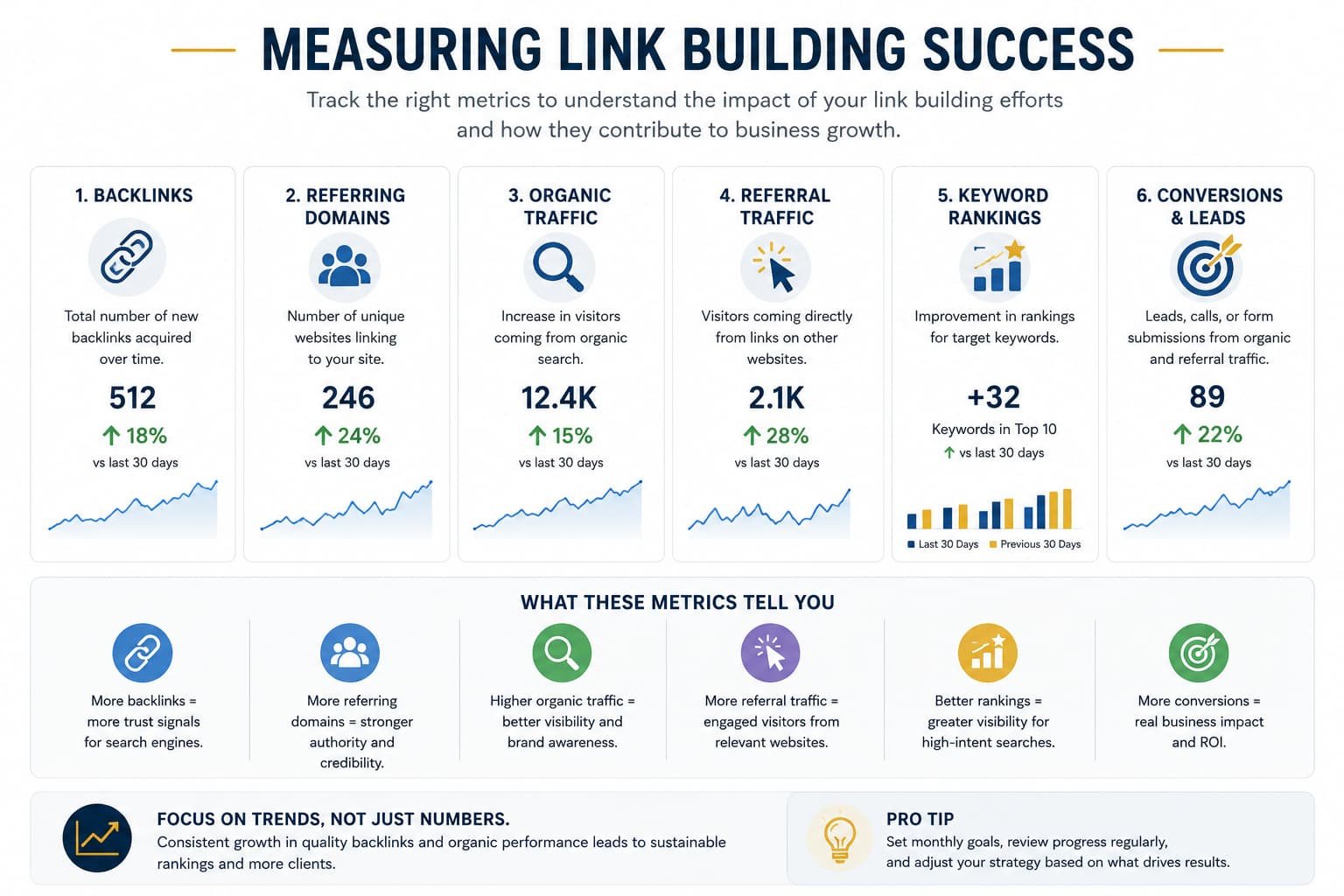
Backlinks should ultimately support business growth rather than increase SEO metrics. The success of a link building campaign should therefore be measured using both SEO performance indicators and real business outcomes.
Establish a baseline before beginning your campaign, then monitor progress consistently over time.
Backlink Growth
Track the number of new referring domains and backlinks your website earns each month. Consistent, gradual growth is generally healthier than sudden spikes that may appear unnatural.
Pay particular attention to new referring domains rather than total backlinks, as multiple links from the same website usually provide diminishing returns.
Backlink Quality
Evaluate each new backlink based on relevance, authority, editorial quality, referral potential, and long-term stability rather than simply counting links.
A handful of editorial backlinks from respected legal publications often produces greater SEO value than dozens of links from low-quality websites.
Referral Traffic
Monitor visitors arriving through your backlinks using Google Analytics. High-quality backlinks frequently generate qualified referral traffic in addition to their SEO value.
Review engagement metrics such as time on page, bounce rate, and conversions to understand which referring websites send the most valuable visitors.
Organic Visibility
Track changes in keyword rankings, impressions, clicks, and organic traffic using Google Search Console alongside your preferred SEO platform.
As your backlink profile strengthens, improvements should gradually become visible across multiple related keywords rather than only a handful of target phrases.
Lead Generation and Client Acquisition
The most important KPI is whether your backlink strategy contributes to new business.
Measure consultation requests, phone calls, contact form submissions, and signed clients originating from both referral traffic and improved organic visibility. Strong SEO ultimately exists to support business growth rather than vanity metrics.
Common Link Building Mistakes to Avoid
Many law firms invest time and money in link building but see disappointing results because they rely on shortcuts rather than sustainable practices. Avoiding the following mistakes can protect both your rankings and your reputation.
- Buying low-quality backlinks. Cheap backlink packages, link farms, and mass guest posting services often create more risk than value. Google’s systems continue to become better at identifying manipulative link patterns.
- Prioritizing Domain Rating over relevance. A highly relevant legal publication with moderate authority often provides greater value than a high-DR website unrelated to your practice area.
- Ignoring referral value. Some backlinks deliver excellent qualified traffic even if their SEO value is modest. Consider both ranking benefits and potential client acquisition.
- Over-optimizing anchor text. Repeating the same keyword-rich anchor text across numerous backlinks creates unnatural patterns. Maintain a balanced mix of branded, descriptive, generic, and long-tail anchors.
- Neglecting local opportunities. Many firms focus exclusively on national publications while overlooking local newspapers, business associations, charities, universities, and community organizations that can provide highly relevant local authority.
- Building links to every page equally. Concentrate your efforts on pages that support meaningful business objectives rather than distributing backlinks randomly across the website.
- Failing to monitor backlinks. Lost links, broken pages, and harmful backlinks should be identified regularly before they negatively affect performance.
- Treating link building as a one-time project. Authority compounds over time. Consistent monthly effort almost always outperforms occasional large campaigns.
Build Authority, Not Just Backlinks
Link building for lawyers has evolved far beyond simply acquiring backlinks. Modern legal SEO is built on authority, trust, expertise, and meaningful relationships that generate recognition across the web.
The firms that consistently earn the strongest backlinks rarely spend all of their time asking for links. Instead, they publish resources worth referencing, contribute valuable expertise to industry conversations, build relationships within their communities, and become trusted sources for journalists, organizations, and professional partners.
As search engines increasingly evaluate reputation through signals that extend beyond a firm’s own website, these activities become even more valuable. Strong editorial backlinks, local authority, digital PR, original research, and professional recognition all reinforce the trust that supports both traditional search rankings and emerging AI-powered search experiences.
Most importantly, remember that backlinks are only one part of the client acquisition process. Pair your link-building efforts with an excellent website, helpful content, strong local SEO, and an efficient intake process so that the authority you earn ultimately translates into more consultations, stronger client relationships, and sustainable business growth.
Frequently Asked Questions
What are the best link building strategies for lawyers?
The most effective strategies include earning links from trusted legal directories, publishing guest articles on relevant websites, creating original research and comprehensive legal guides, building local partnerships, responding to journalist requests through digital PR, recovering unlinked brand mentions, appearing on podcasts, and publishing educational resources that naturally attract editorial backlinks.
How long does law firm link building take to produce results?
Most firms begin seeing measurable improvements within three to six months of consistent effort, although highly competitive practice areas may require longer. Directory listings and unlinked brand mentions often generate quicker results, while editorial backlinks, digital PR, and content marketing usually deliver stronger long-term growth.
Are legal directories still valuable for SEO?
Yes. Established directories such as Justia, Avvo, FindLaw, Martindale-Hubbell, and reputable state or local bar associations continue providing authority, referral traffic, and legitimacy when your listings are complete, accurate, and regularly maintained.
How many backlinks does a law firm need to rank?
There is no universal number. Rankings depend on the quality, relevance, authority, and diversity of your backlink profile compared with competing firms targeting the same keywords. In competitive legal markets, earning stronger backlinks than your competitors is generally more important than simply earning more backlinks.
Should law firms outsource link building?
Many firms successfully outsource link building, but choosing the right provider is critical. Look for agencies or consultants that focus on editorial outreach, digital PR, legal-industry relevance, and ethical acquisition methods rather than on guaranteed backlink quantities or mass link packages. Sustainable authority is built through quality relationships, not shortcuts.
Is buying backlinks ever safe for a law firm?
No. Purchasing backlinks to manipulate search rankings violates Google’s spam policies and exposes your website to unnecessary risk. The safest long-term approach is earning backlinks naturally through valuable content, genuine expertise, digital PR, partnerships, and trusted professional relationships.